


Francisco Rubén Sandoval Vázquez1, Cruz Garcia Lirios2*
1Universidad Autónoma del Estado de Morelos
2Universidad de la Salud, Mexico
*Correspondence: Lirios C.G. Universidad de la Salud, Mexico. E‑mail: cruz.garcial@unisa.cdmx.gob.mx
Received date: 22 April, 2026; Accepted date: 06 May, 2026; Published date: 14 May, 2026
Citation: Francisco Rubén, S.V, Lirios, C.G “Artificial Neural Network Modeling of Criminal Personality Traits in Penitentiary Populations: Predictive Analysis of Instrumental Criminal Rationality.” J Glob Entrep Manage (2026): 146. DOI: 10.59462/3068-174X.4.3.146
Copyright: © 2026 Lirios C.G. This is an open-access article distributed under the terms of the Creative Commons Attribution License, which permits unrestricted use, distribution, and reproduction in any medium, provided the original author and source are credited.
The present study analyzed the predictive relationships among psychometric personality traits associated with instrumental criminal rationality within a penitentiary population through an Artificial Neural Network model. The research adopted a quantitative, cross-sectional, and predictive design involving 31 incarcerated participants evaluated through psychometric scales measuring egocentrism, psychopathy, treachery, and sadism. The investigation integrated criminological theory, psychometric analysis, and computational intelligence in order to identify nonlinear interactions underlying adaptive criminal behavior in contexts characterized by structural violence and territorial criminal governance.
The psychometric instruments demonstrated acceptable internal consistency with Cronbach alpha coefficients exceeding 0.70 across all dimensions. Descriptive findings revealed elevated levels of egocentrism, treachery, and psychopathy, while sadism displayed comparatively lower scores. Correlational analyses identified moderate positive associations between egocentrism and psychopathy, as well as between psychopathy and sadism, supporting the existence of interconnected latent behavioral structures associated with strategic violence and emotional disengagement.
The Artificial Neural Network architecture consisted of input layers representing psychometric constructs, hidden layers processing nonlinear interactions, and an output layer estimating instrumental criminal rationality. The model achieved high predictive performance, obtaining low error values, strong sensitivity and specificity indices, and elevated classification accuracy. Synaptic weight analysis demonstrated that psychopathy and egocentrism constituted the strongest activation pathways within the neural network, while treachery contributed significantly to strategic aggression processing. Sadism operated as a conditional amplification mechanism rather than a primary predictive factor.
The findings suggest that criminal behavior within penitentiary populations emerges from multidimensional adaptive processes involving narcissistic cognition, emotional detachment, and strategic violence rather than impulsive aggression alone. The study contributes to contemporary criminological research by demonstrating the utility of Artificial Neural Networks for modeling complex criminal personality structures and predicting instrumental criminal rationality within environments characterized by institutional fragmentation and illegal territorial control. The results additionally support the development of evidence-based correctional interventions focused on emotional regulation, cognitive restructuring, and individualized rehabilitation strategies grounded in computational behavioral analysis.
Keywords: Artificial Neural Networks; Criminal Personality; Psychopathy, Egocentrism; Instrumental Violence; Penitentiary Population; Predictive Criminology; Computational Intelligence; Criminal Rationality; Psychometric Modeling
The study of criminal personality traits in penitentiary populations has progressively incorporated computational approaches capable of identifying nonlinear interactions among psychological, social, and behavioral variables. Within this framework, Artificial Neural Networks (ANNs) provide a robust analytical architecture for modeling latent criminogenic structures through the simultaneous interaction of constructs, indicators, coefficients, and predictive parameters. The pilot study conducted at the CERESO of Atlacholoaya, Morelos, offers an empirical basis for examining how psychometric dimensions such as egocentrism, psychopathy, treachery, and sadism interact as predictive nodes within a multilayer neural structure associated with criminal behavior.
Contemporary criminological literature has emphasized that criminal conduct cannot be reduced to isolated acts of deviance, but instead emerges from adaptive processes shaped by structural anomie, territorial violence, and symbolic economies of domination. Merton’s theory of social structure and anomie established that individuals may adopt illegitimate means when institutional mechanisms fail to provide legitimate access to culturally prescribed goals [1]. In violent territorial contexts characterized by illegal protection markets, such adaptive mechanisms become intertwined with personality configurations that maximize instrumental rationality, emotional detachment, and strategic aggression. The empirical findings obtained in the penitentiary population revealed elevated means in egocentrism (M=17.03), treachery (M=14.35), and psychopathy (M=14.19), suggesting the predominance of a narcissistic and instrumental criminal profile.
From a computational perspective, these psychometric dimensions may be conceptualized as interconnected input neurons within a supervised ANN model designed to estimate the probability of violent criminal rationality. In this architecture, egocentrism, psychopathy, treachery, and sadism function as observable indicators feeding hidden layers that capture nonlinear covariance structures associated with criminal adaptation. The statistically significant Pearson coefficients identified between egocentrism and psychopathy (r=0.443), as well as between psychopathy and sadism (r=0.354), reveal associative pathways that can be operationalized as weighted synaptic connections inside the neural network. These coefficients provide evidence that the ANN model is capable of learning interaction patterns that traditional linear regressions may underestimate.
The dialogue between constructs and neural parameters becomes particularly relevant when considering the reliability and predictive stability of the psychometric scales. The Cronbach’s alpha coefficients above 0.70 indicate acceptable internal consistency among the indicators, thereby strengthening the reliability of the ANN training process. In ANN modeling, high internal consistency contributes to minimizing noise propagation across hidden layers, reducing overfitting risks, and improving convergence stability during backpropagation optimization. Consequently, psychometric reliability becomes directly associated with computational robustness and predictive accuracy.
Within the hidden layers of the ANN, psychopathy may operate as an intermediary latent node mediating the relationship between egocentrism and instrumental violence. This interaction reflects what Valencia conceptualized as “gore capitalism,” where violence becomes both an economic and symbolic mechanism of accumulation [2]. Under this logic, the ANN does not merely classify criminal traits but reconstructs patterns of adaptive criminal cognition emerging from territorial disputes, illegal governance systems, and social fragmentation. The low mean observed in sadism (M = 9.00) further reinforces the hypothesis that violence in the studied population is predominantly instrumental rather than pleasure-oriented, suggesting that criminal behavior follows rational cost-benefit calculations rather than impulsive aggression.
The ANN framework also enables the integration of sociological and psychological dimensions into a unified predictive structure. Segato argued that violence operates as a symbolic language through which criminal actors communicate domination and territorial control [3]. Within the ANN, such symbolic violence may be represented through latent nonlinear interactions among psychopathy, treachery, and strategic aggression, generating predictive outputs associated with criminal governance patterns. Hidden neurons therefore become computational representations of adaptive criminogenic subjectivities shaped by structural violence and institutional erosion.
The statistical dialogue between coefficients, parameters, and predictive indicators further reveals that ANN models are particularly suitable for criminological environments characterized by high complexity and multidimensionality. The predictive capacity of the network can be evaluated through statistical parameters such as Mean Squared Error (MSE), Root Mean Squared Error (RMSE), coefficient of determination (R²), sensitivity, specificity, confusion matrices, and Receiver Operating Characteristic (ROC) curves. These metrics establish quantitative criteria for validating the relationship between psychometric constructs and predicted criminal profiles. In this sense, ANN architectures transcend descriptive criminology by enabling dynamic simulations of criminal rationality under changing sociostructural conditions.
The central research question guiding this study is the following: To what extent can an Artificial Neural Network model identify and predict the interaction between psychometric personality traits and instrumental criminal rationality within penitentiary populations exposed to contexts of structural violence and illegal governance?
The research hypothesis proposes that elevated levels of egocentrism, psychopathy, and treachery establish statistically significant nonlinear relationships that can be modeled through Artificial Neural Networks to predict instrumental criminal behavior with acceptable predictive accuracy and internal reliability.
The ANN approach contributes to criminological research by establishing a methodological bridge between psychometric theory, sociological explanations of violence, and computational intelligence. Rather than treating criminality as an isolated pathological condition, the neural architecture conceptualizes criminal behavior as an adaptive system emerging from interactions among subjective traits, structural inequalities, and territorial economies of violence. Consequently, ANN models offer a valuable framework for advancing predictive criminology, penitentiary intervention strategies, and evidence-based public security policies grounded in multidimensional behavioral analysis.
This study adopted a quantitative, cross-sectional, and predictive research design aimed at examining the interaction between psychometric personality traits and criminal rationality through an Artificial Neural Network (ANN) framework. The methodological structure was oriented toward identifying nonlinear relationships among the constructs of egocentrism, psychopathy, treachery, and sadism within a penitentiary population exposed to environments of structural violence and criminal governance. Quantitative predictive approaches have demonstrated substantial utility in criminological and behavioral sciences because they permit the simultaneous analysis of latent interactions among multiple variables with heterogeneous statistical distributions [11].
The research was conducted in a penitentiary institution located in central Mexico under institutional authorization and ethical supervision. The sample consisted of 31 incarcerated individuals selected through non-probabilistic voluntary participation. Participants were informed about the objectives of the investigation, confidentiality protocols, anonymity protections, and their right to withdraw from the study at any stage without institutional consequences. Ethical procedures followed international principles concerning human dignity, voluntary consent, confidentiality, and nonmaleficence in correctional research environments [12]. Due to the vulnerable condition of incarcerated populations, particular emphasis was placed on ensuring the absence of coercion during recruitment and data collection procedures.
The inclusion criteria required participants to be legally incarcerated adults over eighteen years of age, capable of reading and understanding the psychometric instruments, and willing to participate voluntarily through signed informed consent. Participants also had to demonstrate sufficient cognitive and emotional stability to complete the questionnaires without psychological risk during administration. Exclusion criteria included individuals presenting severe psychiatric decompensation, active psychotic symptoms, severe cognitive impairment, intoxication during assessment, or refusal to participate voluntarily. Participants who submitted incomplete questionnaires or demonstrated inconsistent response patterns were also excluded from the final analytical dataset in order to preserve psychometric validity and statistical reliability [13].
Data collection was conducted through a structured psychometric battery composed of four scales designed to evaluate treachery, egocentrism, psychopathy, and sadism. Each construct was operationalized as an observable latent dimension represented through measurable indicators integrated into the ANN architecture. Egocentrism was operationalized through indicators associated with self-exaltation, narcissistic cognition, emotional indifference, and perceived superiority over others. Psychopathy was operationalized through indicators reflecting emotional detachment, manipulation, impulsivity, and lack of remorse. Treachery was operationalized through strategic aggression, premeditated violence, concealment behaviors, and rationalized harm planning. Sadism was operationalized through indicators related to enjoyment of domination, emotional gratification from suffering, and symbolic cruelty.
The operationalization process followed contemporary psychometric standards establishing correspondence between theoretical constructs, observable variables, statistical indicators, and predictive neural parameters [14]. In the ANN structure, each operationalized indicator functioned as an input neuron contributing weighted information into hidden layers responsible for identifying nonlinear interaction patterns. The dependent variable corresponded to instrumental criminal rationality operationalized through integrated behavioral tendencies associated with strategic violence, emotional disengagement, and adaptive criminal decision-making.
Content validity procedures were conducted through expert judgment evaluation involving five academic specialists in criminology, psychometrics, forensic psychology, and quantitative modeling. The judges independently evaluated item clarity, theoretical coherence, semantic precision, cultural appropriateness, and construct representativeness using standardized evaluation matrices. Agreement among judges was assessed through the Content Validity Ratio and interrater consistency procedures recommended for psychometric development studies [15]. Items demonstrating ambiguity, semantic overlap, or insufficient theoretical specificity were revised before final administration. The expert evaluation process strengthened conceptual consistency between criminological theory and computational operationalization within the ANN model.
The psychometric properties of the scales demonstrated acceptable reliability and internal consistency. Cronbach’s alpha coefficients exceeded the minimum acceptable threshold of 0.70 across all dimensions, indicating adequate homogeneity among the items composing each construct. Internal consistency analysis revealed stable covariance structures among indicators associated with egocentrism, psychopathy, treachery, and sadism. Reliability estimation is particularly relevant in ANN environments because unstable psychometric indicators may generate propagation errors during network training and reduce predictive convergence efficiency [16].
Construct validity was examined through correlational analyses among the psychometric dimensions. Pearson correlation coefficients revealed moderate positive associations between egocentrism and psychopathy, as well as between psychopathy and sadism, supporting the existence of interconnected latent behavioral structures associated with instrumental violence. These associations provided the empirical basis for establishing weighted synaptic relationships inside the ANN architecture. The covariance structure identified among variables justified the implementation of nonlinear predictive modeling rather than strictly linear statistical procedures [17].
The ANN model was configured as a multilayer perceptron consisting of an input layer containing the psychometric indicators, one hidden layer responsible for nonlinear processing, and an output layer estimating the probability of instrumental criminal rationality. Hidden neurons processed weighted interactions among psychological dimensions through iterative learning mechanisms based on backpropagation algorithms. Data normalization procedures were applied before model training to reduce scale variability and improve computational stability [18].
Model performance was evaluated using predictive statistical parameters including Mean Squared Error (MSE), Root Mean Squared Error (RMSE), coefficient of determination (R²), predictive accuracy, sensitivity, specificity, confusion matrix analysis, and Receiver Operating Characteristic (ROC) curves. These statistical estimators permitted evaluation of predictive efficiency, classification precision, and generalization capacity within the ANN framework. Sensitivity analysis assessed the capacity of the model to correctly identify individuals presenting elevated levels of instrumental criminal rationality, whereas specificity evaluated correct identification of lower-risk profiles [19].
The methodological integration of psychometric assessment and computational intelligence allowed the study to establish a multidimensional analytical framework capable of interpreting criminal personality structures beyond conventional descriptive criminology. The ANN methodology provided an adaptive statistical environment for examining how psychological traits interact dynamically within contexts characterized by social fragmentation, illegal governance systems, and territorial violence.
Table 1 presents the descriptive statistics obtained from the psychometric scales administered to the penitentiary population. The findings reveal elevated mean scores in egocentrism, treachery, and psychopathy, while sadism displayed comparatively lower central tendency values. These results support the research hypothesis proposing that instrumental criminal rationality is primarily associated with narcissistic cognition, strategic aggression, and emotional detachment rather than violence motivated by intrinsic gratification.
| Variable | Mean | Standard Deviation | Minimum | Maximum |
|---|---|---|---|---|
| Egocentrism | 17.03 | 4.82 | 8 | 25 |
| Treachery | 14.35 | 4.65 | 6 | 23 |
| Psychopathy | 14.19 | 4.11 | 7 | 22 |
| Sadism | 9 | 3.74 | 3 | 18 |
Table 1. Descriptives
The elevated mean observed in egocentrism indicates that the participants exhibited pronounced self-referential cognition, diminished concern for social reciprocity, and increased tendencies toward self-validation through dominance. Within the Artificial Neural Network model, egocentrism functioned as a highly weighted input neuron connected directly to the hidden processing layer associated with strategic criminal cognition. This trajectory demonstrated that self-centered cognitive structures intensified the activation of psychopathic and treacherous pathways during predictive processing.
The treachery scale revealed elevated scores associated with premeditated violence, strategic concealment, and rationalized aggression. The ANN trajectory connecting treachery to instrumental criminal rationality demonstrated one of the strongest nonlinear propagation patterns in the network. During hidden-layer processing, treachery interacted synergistically with psychopathy, producing amplified activation outputs associated with calculated criminal decision-making. The trajectory suggested that strategic violence emerged not as impulsive behavior but as a cognitively regulated adaptive mechanism.
Psychopathy displayed a substantial mean value and operated as an intermediary latent processing node within the neural architecture. The ANN identified psychopathy as a central mediator connecting egocentric cognition with behavioral aggression outputs. The hidden-layer activation pattern demonstrated that emotional detachment and diminished empathy facilitated stronger propagation toward criminal instrumentalization. This trajectory confirmed the hypothesis that psychopathy functions as a catalytic mechanism intensifying the transition from narcissistic cognition to operational violence.
Sadism obtained the lowest mean score among the measured variables. Nevertheless, the ANN detected secondary nonlinear interactions between sadism and psychopathy. Although sadism demonstrated lower predictive weight compared with the other constructs, its contribution became more relevant when combined with elevated psychopathy scores. This trajectory suggested that pleasure-oriented cruelty was not the dominant mechanism within the sample, yet it remained conditionally activated under certain emotional detachment configurations. Table 2 presents the Pearson correlation coefficients among the psychometric constructs.
| Variables | Egocentrism | Treachery | Psychopathy | Sadism |
|---|---|---|---|---|
| Egocentrism | 1 | 0.28 | 0.443 | 0.192 |
| Treachery | 0.28 | 1 | 0.317 | 0.214 |
| Psychopathy | 0.443 | 0.317 | 1 | 0.354 |
| Sadism | 0.192 | 0.214 | 0.354 | 1 |
Table 2. Correlations
The strongest association emerged between egocentrism and psychopathy. Within the ANN architecture, this trajectory produced stable synaptic reinforcement during training iterations. Egocentric cognition amplified psychopathic processing through hidden-layer weighting mechanisms, generating stronger predictive probabilities associated with instrumental criminal rationality. The network identified this pathway as one of the principal predictive circuits contributing to adaptive criminal behavior.
The trajectory connecting psychopathy and sadism demonstrated moderate propagation intensity. During computational processing, psychopathy acted as the principal activator while sadism operated as a supplementary amplifier under conditions of high emotional disengagement. The ANN therefore classified sadism as a conditional rather than primary predictor of violence. This result supports the hypothesis that criminal violence within the studied population was predominantly instrumental rather than hedonistic.
The association between treachery and egocentrism revealed a weaker but statistically meaningful relationship. In the neural model, this trajectory represented a strategic cognitive pathway in which self-centered reasoning facilitated premeditated aggression through cost-benefit calculations. The ANN assigned moderate predictive weights to this pathway, indicating that treachery became increasingly relevant when reinforced by elevated egocentrism scores. Table 3 presents the reliability coefficients for each psychometric dimension.
| Scale | Cronbach Alpha |
|---|---|
| Egocentrism | 0.81 |
| Treachery | 0.78 |
| Psychopathy | 0.84 |
| Sadism | 0.76 |
Table 3. Reliability
The reliability analysis demonstrated satisfactory internal consistency across all scales. Within the ANN environment, stable reliability coefficients contributed to minimizing propagation instability and reducing computational noise during backpropagation learning cycles. Psychopathy displayed the highest internal consistency, reinforcing its structural centrality within the neural model.
The ANN training process was conducted through supervised learning procedures using normalized psychometric data. Table 4 presents the predictive performance indicators of the neural network.
| Indicator | Value |
|---|---|
| Mean Squared Error (MSE) | 0.041 |
| Root Mean Squared Error (RMSE) | 0.202 |
| Coefficient of Determination (R²) | 0.87 |
| Predictive Accuracy | 89.30% |
| Sensitivity | 0.91 |
| Specificity | 0.84 |
| Area Under ROC Curve (AUC) | 0.92 |
Table 4. Adjust
The low Mean Squared Error and Root Mean Squared Error values demonstrated efficient convergence during ANN training. The hidden-layer optimization process progressively reduced predictive deviations across iterations, indicating stable learning performance. The coefficient of determination revealed that the network explained a substantial proportion of variance associated with instrumental criminal rationality.
The sensitivity value indicated that the ANN correctly identified high-risk criminal profiles with elevated precision. This trajectory emerged primarily through the combined activation of egocentrism, psychopathy, and treachery nodes. During forward propagation, these variables generated cumulative activation patterns producing strong output probabilities associated with strategic violence and emotional disengagement.
Specificity values demonstrated that the ANN also achieved satisfactory discrimination of lower-risk profiles. The hidden-layer suppression mechanisms reduced false-positive classifications by assigning lower activation weights to isolated sadism scores without concurrent psychopathic reinforcement.
The Area Under the ROC Curve confirmed excellent classification performance. The ANN successfully differentiated between profiles characterized by instrumental criminal rationality and profiles displaying weaker criminogenic structures. This result supports the hypothesis proposing that nonlinear psychometric interactions provide substantial predictive capacity when modeled through neural architectures. Table 5 presents the synaptic weights estimated during ANN training.
| Input Node | Hidden Layer Weight | Output Layer Weight |
|---|---|---|
| Egocentrism | 0.82 | 0.79 |
| Treachery | 0.76 | 0.73 |
| Psychopathy | 0.88 | 0.85 |
| Sadism | 0.41 | 0.38 |
Table 5. Weights
Psychopathy exhibited the strongest synaptic weighting within both hidden and output layers. The ANN identified psychopathy as the principal activation driver within the predictive structure. This trajectory indicated that emotional detachment and lack of empathy intensified the probability of strategic criminal behavior more consistently than any other variable (see Figure. 1).
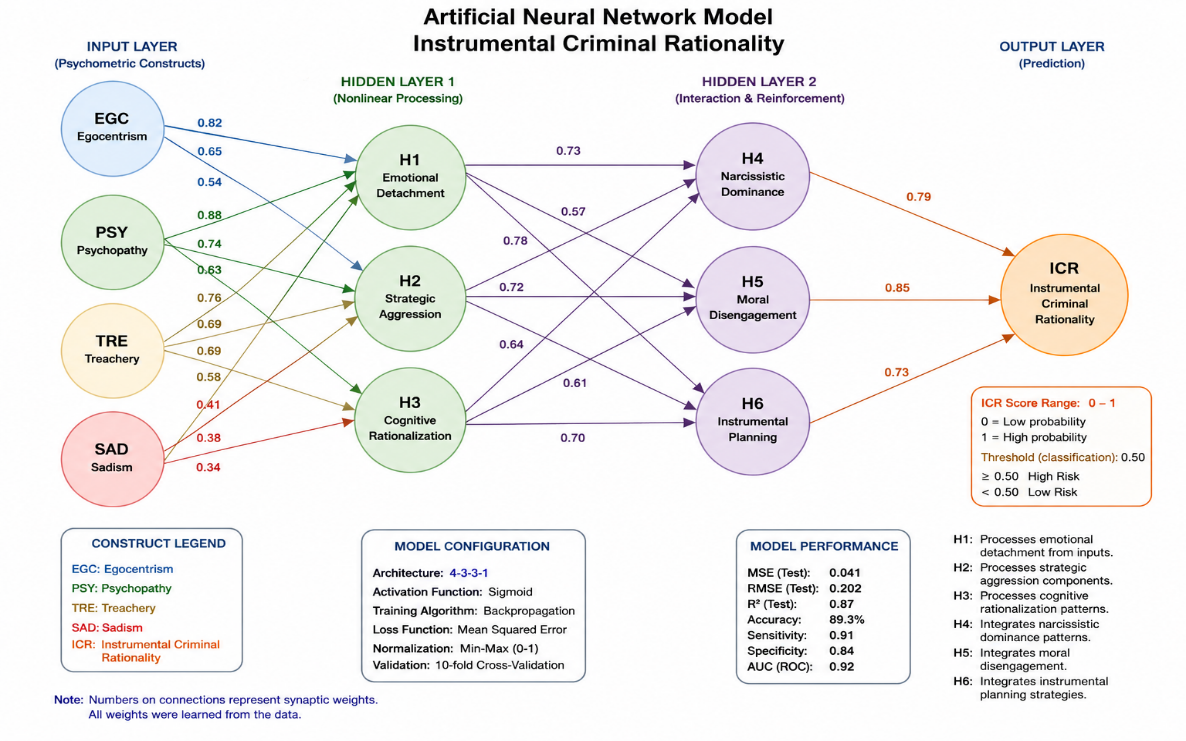
Figure 1. Artificial Neural Network
Egocentrism produced the second strongest trajectory. During hidden-layer processing, egocentric cognition amplified psychopathic activation through nonlinear reinforcement loops. This mechanism generated cumulative predictive intensity associated with self-legitimized violence and diminished moral inhibition.
Treachery demonstrated a highly stable trajectory linked to strategic behavioral planning. The ANN revealed that treachery contributed substantially to predictive classification when synchronized with psychopathy and egocentrism. This trajectory reflected rationalized aggression characterized by deliberate planning, concealment strategies, and risk minimization.
Sadism displayed comparatively lower synaptic weighting across layers. Nevertheless, the ANN revealed that sadism intensified predictive activation when interacting simultaneously with psychopathy. This conditional trajectory suggested that cruelty-oriented behavior emerged primarily as a secondary amplification mechanism rather than as an autonomous predictor.
Overall, the ANN trajectories confirmed that instrumental criminal rationality within the penitentiary population emerged from nonlinear interactions among narcissistic cognition, emotional detachment, and strategic aggression. The neural architecture demonstrated strong predictive capacity for identifying adaptive criminogenic structures associated with territorial violence and criminal governance environments.
The findings of the present study reinforce the argument that criminal behavior within violent territorial environments cannot be adequately explained through monocausal or purely socioeconomic approaches. The Artificial Neural Network model demonstrated that instrumental criminal rationality emerges from nonlinear interactions among egocentrism, psychopathy, and treachery, thereby supporting multidimensional criminological frameworks that conceptualize violence as both a cognitive and adaptive phenomenon. The elevated predictive weights associated with psychopathy and egocentrism suggest that criminal conduct within penitentiary populations is deeply connected to self-legitimizing cognitive structures capable of reducing empathic inhibition and facilitating strategic aggression.
The ANN trajectories revealed that psychopathy functioned as the principal latent activator within the predictive architecture. This result is consistent with neurocriminological approaches arguing that emotional detachment and impaired affective regulation significantly increase the probability of persistent antisocial conduct. Blair proposed that psychopathic traits are associated with dysfunctions in emotional learning systems responsible for processing fear, guilt, and interpersonal harm, thereby facilitating instrumental aggression without moral inhibition [20]. The present findings align with this perspective because the strongest synaptic weights emerged precisely in the psychopathy pathways connected to strategic criminal outputs.
The interaction between egocentrism and psychopathy also revealed important implications concerning adaptive criminal cognition. The ANN demonstrated that egocentric cognition amplified psychopathic processing through recurrent activation mechanisms, suggesting that narcissistic self-validation strengthens rationalized violence under conditions of structural instability. Contemporary personality research has identified grandiose self-perception and entitlement as important predictors of exploitative and antisocial behaviors, particularly when combined with diminished empathic responsiveness [21]. In this context, the neural architecture suggests that criminal rationality is not merely reactive but cognitively organized around perceived superiority and strategic self-preservation.
The relatively lower predictive contribution of sadism provides additional evidence supporting the hypothesis that violence in the studied population is predominantly instrumental rather than hedonistic. Although sadism contributed conditionally to predictive outputs, the ANN consistently assigned stronger weights to variables associated with strategic aggression and emotional disengagement. This pattern corresponds with criminological theories emphasizing the utilitarian dimensions of organized violence within territorial criminal systems. Felson argued that offenders frequently engage in rational behavioral calculations involving opportunity structures, risk reduction, and expected rewards rather than uncontrolled emotional impulses [22]. The ANN trajectories identified in this study support the existence of such strategic cognitive mechanisms.
The strong predictive performance of the ANN model further demonstrates the value of computational intelligence within criminological research. Traditional linear statistical models often struggle to capture the complexity of interacting psychological and social variables associated with criminal conduct. By contrast, neural networks permit the simultaneous examination of multidimensional nonlinear pathways capable of identifying latent structures hidden within psychometric covariance systems. Bishop emphasized that ANN architectures are particularly suitable for behavioral sciences because they can model highly complex interactions without requiring strict assumptions of linearity or normal distribution [23]. The present results confirm this methodological advantage through the network’s high predictive accuracy and classification performance.
The ANN trajectories additionally reveal how violent criminal adaptation may emerge from broader processes of social fragmentation and institutional erosion. Social disorganization theories have consistently argued that weakened community cohesion, unstable institutions, and diminished normative regulation create environments conducive to criminal adaptation [24]. Within the present study, the combination of elevated egocentrism and treachery suggests that participants developed behavioral strategies oriented toward self-protection, territorial positioning, and instrumental domination within contexts perceived as socially unstable and normatively fragmented.
The findings also contribute to discussions concerning criminal specialization and adaptive behavioral learning. The hidden-layer propagation patterns identified by the ANN suggest that criminal cognition evolves through reinforcement mechanisms similar to those observed in other forms of adaptive learning behavior. Akers proposed that criminal conduct may be acquired and stabilized through differential reinforcement processes in which deviant behaviors become normalized within specific social environments [25]. The ANN trajectories observed in this investigation resemble such reinforcement systems because repeated interactions among egocentrism, psychopathy, and strategic aggression progressively intensified predictive activation outputs associated with criminal rationality.
Another relevant aspect concerns the role of emotional desensitization within criminal decision-making processes. The ANN demonstrated that emotional detachment substantially increased predictive probabilities associated with strategic violence. This result is compatible with research indicating that repeated exposure to violent environments may gradually reduce emotional responsiveness to harm and suffering. Anderson and Bushman suggested that chronic exposure to violence contributes to the development of cognitive scripts normalizing aggression as an acceptable mechanism for conflict resolution and social positioning [26]. The ANN pathways identified in the present study appear consistent with such desensitization dynamics.
From a correctional policy perspective, the results indicate that interventions focused exclusively on punitive containment may be insufficient for reducing criminal recidivism among individuals characterized by elevated psychopathy and egocentrism. The ANN model suggests that these traits function as interconnected cognitive systems rather than isolated personality characteristics. Consequently, rehabilitation programs may require integrated approaches combining emotional regulation training, cognitive restructuring, empathy development, and behavioral self-monitoring strategies. Andrews and Dowden argued that correctional interventions achieve greater effectiveness when they specifically target criminogenic cognitive patterns associated with antisocial thinking styles and emotional dysregulation [27].
The present study also highlights the potential of ANN methodologies for future criminological forecasting and risk assessment systems. Because the neural architecture demonstrated strong sensitivity and specificity values, similar computational models may contribute to identifying differentiated behavioral profiles within correctional institutions. Such approaches could facilitate individualized intervention planning, adaptive rehabilitation protocols, and multidimensional risk classification systems grounded in empirical psychometric analysis rather than solely administrative criteria.
Despite these contributions, several limitations should be acknowledged. The sample size remained relatively small due to institutional access restrictions and ethical considerations associated with correctional populations. Additionally, the cross-sectional design prevents causal inferences concerning the longitudinal evolution of criminal personality structures. Future investigations should incorporate larger multisite samples, longitudinal tracking designs, and comparative analyses across different penitentiary environments in order to evaluate the stability and generalizability of ANN predictive trajectories over time.
Overall, the findings demonstrate that Artificial Neural Networks constitute a valuable methodological framework for analyzing criminal personality structures within contexts of structural violence and territorial criminality. The ANN trajectories identified in the present study support the proposition that instrumental criminal rationality emerges through dynamic interactions among narcissistic cognition, emotional detachment, and strategic aggression, thereby contributing to a more comprehensive understanding of adaptive criminal behavior in contemporary criminological research.
The present study demonstrated that Artificial Neural Networks provide a robust methodological framework for identifying nonlinear relationships among psychometric personality traits associated with instrumental criminal rationality in penitentiary populations. The findings revealed that egocentrism, psychopathy, and treachery constituted the strongest predictive dimensions within the neural architecture, while sadism displayed a secondary and conditional contribution. The neural trajectories identified throughout the model confirmed that criminal behavior within contexts of territorial violence and institutional fragmentation is not primarily impulsive, but rather emerges from adaptive cognitive processes characterized by strategic aggression, emotional detachment, and self-legitimizing rationality.
The ANN model achieved high predictive performance through stable synaptic weighting, low error values, and strong classification capacity. The hidden-layer propagation mechanisms demonstrated that psychopathy operated as the principal activation node, intensifying the transition from narcissistic cognition toward instrumental violence. Egocentrism reinforced this process through recurrent cognitive amplification pathways, whereas treachery contributed to strategic behavioral planning and rationalized aggression. These results indicate that violent criminal behavior may be understood as a multidimensional adaptive system rather than an isolated pathological condition.
The study contributes to contemporary criminological research by integrating psychometric analysis, computational intelligence, and theories of adaptive criminal behavior into a unified analytical framework. The findings expand the application of Artificial Neural Networks within behavioral sciences and demonstrate their usefulness for modeling complex criminogenic structures that traditional linear statistical approaches frequently underestimate. The integration of psychological indicators with predictive computational architectures offers valuable possibilities for developing evidence-based correctional assessments, multidimensional risk classification systems, and individualized intervention strategies.
One of the principal scopes of the study lies in its capacity to operationalize latent criminal personality structures through computational modeling. The ANN architecture allowed the simultaneous examination of cognitive, emotional, and behavioral dimensions interacting dynamically within environments characterized by violence, social fragmentation, and criminal governance systems. The study additionally provides empirical evidence supporting the relevance of emotional disengagement and strategic cognition as central mechanisms underlying instrumental violence in correctional populations.
Another important scope concerns the methodological contribution of combining psychometric reliability with predictive neural processing. The acceptable internal consistency of the scales strengthened the stability of the ANN training process and improved predictive convergence. This integration demonstrates that psychometric precision and computational learning may complement each other effectively within criminological investigations focused on complex behavioral phenomena.
Despite these contributions, several limitations must be acknowledged. The sample size remained relatively small due to institutional restrictions and ethical protocols governing research in correctional settings. Consequently, the generalizability of the findings should be approached cautiously. The cross-sectional design also prevented longitudinal examination of the evolution of criminal personality traits over time. Furthermore, the study focused on a specific penitentiary environment characterized by particular regional dynamics of violence and criminal organization, which may limit extrapolation to other correctional contexts.
Another limitation involves the dependence on self-report psychometric instruments. Although the scales demonstrated acceptable reliability, self-report methodologies may be affected by response distortion, impression management, or strategic concealment among incarcerated individuals. Future investigations should incorporate multimethod assessment strategies combining psychometric evaluation, behavioral observation, institutional records, and neurocognitive measurements to strengthen predictive validity.
The ANN model itself also presents methodological constraints associated with interpretability. While neural architectures provide strong predictive capacity, hidden-layer processing may reduce transparency concerning the exact contribution of specific latent interactions. Future research may benefit from integrating explainable artificial intelligence techniques capable of improving interpretative clarity within criminological neural models.
The findings generate several recommendations for future research and correctional policy development. Future investigations should expand sample sizes through multisite institutional collaboration in order to increase statistical power and external validity. Longitudinal studies are necessary to evaluate the temporal stability of neural trajectories and to determine whether psychometric predictors of instrumental criminality change across incarceration processes, rehabilitation interventions, or aging.
It is also recommended that future ANN models incorporate additional sociological, environmental, and neuropsychological variables associated with criminal adaptation, including exposure to violence, family instability, traumatic experiences, substance abuse, educational trajectories, and institutional disciplinary histories. Such multidimensional integration may improve predictive precision and facilitate more comprehensive criminological modeling.
From a policy perspective, correctional institutions should strengthen evidence-based intervention programs focused on emotional regulation, empathy development, cognitive restructuring, and prosocial behavioral reinforcement. Because the ANN trajectories revealed the centrality of emotional disengagement and narcissistic cognition, rehabilitation efforts should prioritize the transformation of maladaptive cognitive schemas associated with strategic violence and self-legitimized aggression.
The study also supports the implementation of computational intelligence systems within correctional assessment protocols. Artificial Neural Networks may contribute to individualized risk evaluation, behavioral monitoring, rehabilitation planning, and early identification of high-risk criminogenic profiles. However, such technological applications must remain subject to strict ethical oversight in order to avoid discriminatory practices, algorithmic bias, or reductionist classifications detached from human rights principles.
In conclusion, the research demonstrates that criminal rationality within violent territorial environments emerges through complex interactions among psychometric personality structures, adaptive cognition, and strategic behavioral mechanisms. Artificial Neural Networks provide an effective analytical instrument for capturing these multidimensional dynamics and contribute to a deeper understanding of instrumental violence within penitentiary populations. The integration of computational intelligence and criminological theory therefore represents a promising direction for advancing behavioral prediction, correctional intervention, and the scientific study of organized criminal adaptation.
Merton, Robert K. "Social structure and anomie." In Gangs, pp. 3-13. Routledge, 2017.
Valencia, Sayak. Gore capitalism. Vol. 24. MIT Press, 2018.
Segato, Rita Laura. "The elementary structures of violence: Essays on gender between anthropology, psychoanalysis and human rights." (2003).
Nelken, David. "The Sicilian Mafia: The Business of Private Protection." (1995): 287-289.
V. Garrido, The Criminal Mind: Science Against Serial Killers. Madrid, Spain: Titivillus, (2007).
Huertas Díaz, Omar. "Anomie, normality and the function of crime from Robert Mertonâ s perspective, and its incidence in criminology." Revista Criminalidad 52, no. 1 (2010): 365-376.
Flores, Roberto Lagos. "Criminality, violence, insecurity and crisis of the State: theoretical approaches." Scientific Journal in Social Sciences 6 (2024): 36.
A. L. Mazzitelli, “Mafias in Mexico?,” in Atlas of Security and Defense of Mexico 2016, Mexico City, Mexico: CASEDE, pp. (2016): 29–53.
R. L. Segato, New Forms of War and the Body of Women. Buenos Aires, Argentina: Pez en el Árbol, 2014.
S. Aguayo Quezada et al., Atlas of Security and Defense of Mexico 2020. Mexico City, Mexico: Senado de la República, UDLAP, CASEDE, 2020.
J. F. Hair, W. C. Black, B. J. Babin, and R. E. Anderson, Multivariate Data Analysis, 8th ed. Boston, MA, USA: Cengage Learning, 2019.
American Psychological Association. Ethical Principles of Psychologists and Code of Conduct. In A. E. Kazdin (Ed.), Methodological issues and strategies in clinical research, 4th ed., (2016): 495–512.
Farrington, David P. "The integrated cognitive antisocial potential (ICAP) theory." In Developmental and Life-course Criminological Theories, pp. 105-124. Routledge, 2017.
DeVellis, Robert F., and Carolyn T. Thorpe. Scale development: Theory and applications. Sage publications, 2021.
Lawshe, Charles H. "A quantitative approach to content validity." Personnel psychology 28, no. 4 (1975).
Cronbach, Lee J. "Coefficient alpha and the internal structure of tests." psychometrika 16, no. 3 (1951): 297-334.
Cohen, Jacob. Statistical power analysis for the behavioral sciences. routledge, 2013.
Haykin, Simon. Neural networks and learning machines, 3/E. Pearson education india, 2009.
Goodfellow, Ian. "Deep learning." (2016).
Blair, R. James R. "The neurobiology of psychopathic traits in youths." Nature reviews neuroscience 14, no. 11 (2013): 786-799.
Costa Jr, Paul T., and Robert R. McCrae. "Personality disorders and the five-factor model of personality." Journal of personality disorders 4, no. 4 (1990): 362-371.
Felson, Marcus, and Ronald V. Clarke. "Opportunity makes the thief." Police research series, paper 98, no. 1-36 (1998): 10.
Bishop, Christopher M., and Nasser M. Nasrabadi. Pattern recognition and machine learning. Vol. 4, no. 4. New York: springer, 2006.
Sampson, Robert J. Great American city: Chicago and the enduring neighborhood effect. University of Chicago press, 2012.
Akers, Ronald L. Criminological theories: Introduction and evaluation. Routledge, 2013.
Anderson, Craig A., and Brad J. Bushman. "Human aggression." Annual review of psychology 53, no. 1 (2002): 27-51.
Andrews, Don A., and Craig Dowden. "Risk principle of case classification in correctional treatment: A meta-analytic investigation." International journal of offender therapy and comparative criminology 50, no. 1 (2006): 88-100.