


Francisco Rubén S.V1, Vega R.T1, Maldonado J.M.O1, Díaz M.A.O1, Cruz Garcia Lirios2*
1Universidad Autónoma del Estado de Morelos, Mexico
2Universidad de la Salud, Mexico
*Correspondence: Lirios C.G. Universidad de la Salud, Mexico. E‑mail: cruz.garcial@unisa.cdmx.gob.mx
Received date: 22 April, 2026; Accepted date: 08 May, 2026; Published date: 14 May, 2026
Citation: Francisco Rubén S.V, Vega R.T, Maldonado J.M.O, Díaz M.A.O and Lirios C.G “Artificial Neural Network Modeling of Criminality and Victimology in Indigenous Municipalities of Mexico: A Non-Linear Approach to Normative Autonomy and Crime Stability.” J Glob Entrep Manage (2026): 145. DOI: 10.59462/3068-174X.4.3.145
Copyright: © 2026 Lirios C.G. This is an open-access article distributed under the terms of the Creative Commons Attribution License, which permits unrestricted use, distribution, and reproduction in any medium, provided the original author and source are credited.
This study analyzes the relationship between criminal dynamics and indigenous normative systems in Mexican municipalities through the application of Artificial Neural Networks (ANNs). The research is based on a mixed-methods, non-experimental, and longitudinal design using secondary data from official sources between 2015 and 2025. The central objective is to evaluate whether normative autonomy and community-based governance structures function as inhibitory factors of criminal variability, particularly in contexts characterized by structural poverty.
The ANN model integrates multiple constructs, including crime stability, community cohesion, marginalization, and crime typology, operationalized through standardized indicators. The architecture consists of input, hidden, and output layers, where synaptic weights represent the relative influence of each variable. Model performance metrics indicate high predictive accuracy and robustness, allowing the identification of non-linear relationships that are not captured by traditional statistical approaches.
The findings reveal that indigenous municipalities exhibit significantly greater stability in crime rates, associated with higher weights assigned to normative autonomy and social cohesion variables. In contrast, structural poverty shows limited explanatory power within the model. These results challenge conventional criminological assumptions and support perspectives from legal anthropology and legal pluralism, emphasizing the role of community-based regulatory systems in maintaining social order.
The study concludes that indigenous normative systems constitute effective mechanisms of social control, capable of mitigating criminogenic factors through collective governance and restorative practices. The integration of machine learning techniques with socio-legal analysis provides a novel framework for understanding criminality in culturally diverse contexts and offers relevant implications for public security policy and interdisciplinary research.
keywords: Artificial Neural Networks; Criminality; Victimology; Indigenous Normative Systems; Legal Pluralism; Crime Stability; Community Cohesion; Non-Linear Modeling; Mexico
Over the past two decades, criminal dynamics in Mexico have followed a heterogeneous and spatially differentiated trajectory, marked by sustained increases in high-impact crimes alongside localized patterns of stability in specific territorial contexts [1], [2]. While conventional criminological approaches, particularly those grounded in positivist traditions, have emphasized structural determinants such as poverty, inequality, and institutional fragility, recent empirical evidence challenges these linear assumptions by documenting comparatively low and stable crime rates in indigenous municipalities despite adverse socioeconomic conditions [1], [3].
This divergence suggests the operation of alternative mechanisms of social regulation embedded within indigenous normative systems, which are commonly analyzed through the lens of legal pluralism. From a legal anthropological perspective, these systems prioritize collective well-being, restorative justice, and community cohesion over punitive sanctions, thereby reshaping the relationship between criminal behavior, victimization, and social control [4], [5]. In this sense, indigenous governance structures function as decentralized regulatory systems capable of mitigating criminogenic conditions through legitimacy, reciprocity, and early conflict resolution, reinforcing what has been described as normative autonomy [3], [6].
Within this analytical framework, the incorporation of Artificial Neural Networks (ANNs) enables the modeling of complex and non-linear interactions among the variables associated with criminality and victimology. In contrast to traditional econometric approaches, ANNs facilitate an integrated dialogue between constructs, indicators, parameters, coefficients, and statistical validation metrics. Constructs such as normative autonomy, community cohesion, and structural marginalization are operationalized through observable indicators including crime rates, typologies of offenses, and socioeconomic indices. These indicators are processed through network architectures in which parameters, represented as synaptic weights and biases, are iteratively adjusted during the training phase. The resulting coefficients reflect optimized parameter values that capture the relative influence of each indicator on the predicted outcomes, while statistical metrics such as loss functions and predictive accuracy evaluate the robustness and generalizability of the model [7], [8].
From this perspective, the ANN operates as a computational system that translates socio-legal complexity into a structured learning process, where input layers encode structural and cultural conditions, hidden layers capture latent interactions, and output layers estimate patterns of criminal stability or volatility. This architecture allows for the identification of non-linear relationships that are not detectable through conventional correlation techniques, such as the observed weak association between poverty and high-impact crimes in indigenous municipalities. Rather than indicating absence of causality, this pattern suggests the presence of moderating variables, particularly those related to normative cohesion and community-based governance.
In this context, the central research question guiding the study is the following: to what extent do indigenous normative systems and community authorities influence the stability and low variability of crime rates in indigenous municipalities in Mexico between 2015 and 2025?
Based on this question, the study advances the hypothesis that the persistence of indigenous normative systems and community governance structures significantly reduces both the variability and intensity of criminal activity in indigenous municipalities, operating as a non-linear inhibitory factor that outweighs the effects of structural poverty.
This hypothesis implies that, within the ANN model, variables associated with normative autonomy and social cohesion will exhibit greater predictive weight compared to conventional structural indicators such as poverty. The statistical contrast of the model, through processes of training, validation, and testing, thus becomes an empirical mechanism for evaluating competing theoretical frameworks, particularly the tension between structural determinism in classical criminology and the socio-normative resilience emphasized by legal anthropology.
Ultimately, this approach contributes to both methodological and theoretical debates by demonstrating how advanced computational models can be integrated with interdisciplinary perspectives to better understand the dynamics of criminality and victimology in contexts characterized by legal and cultural pluralism.
This study adopted a mixed-methods, non-experimental and longitudinal design, integrating quantitative modeling through Artificial Neural Networks (ANNs) with a socio-legal interpretative framework. The quantitative component relied on secondary data sources corresponding to crime incidence, demographic structure, and marginalization indices for Mexican municipalities between 2015 and 2025. The analytical strategy was oriented toward identifying non-linear patterns in criminal dynamics, particularly contrasting indigenous and non-indigenous municipalities. The methodological rationale is grounded in the capacity of machine learning models to detect latent structures in complex social systems, where interactions between variables are not strictly linear or additive [9], [10].
The dataset was constructed by integrating official records from national public security and demographic institutions, harmonized at the municipal level and standardized for temporal consistency. Variables were normalized using min-max scaling to ensure comparability across indicators with different measurement units. Missing data were treated through multiple imputation procedures to preserve statistical integrity and avoid bias in model training [11]. The final dataset was divided into training (70%), validation (15%), and testing (15%) subsets to ensure model generalizability and prevent overfitting.
The ANN architecture consisted of a multilayer perceptron with one input layer, two hidden layers, and one output layer. The input layer incorporated indicators associated with structural, social, and normative dimensions, while hidden layers captured non-linear interactions among these variables. The output layer estimated crime rate stability, operationalized as variance and trend consistency over time. The model was trained using backpropagation with a gradient descent optimization algorithm, minimizing mean squared error as the loss function. Hyperparameters, including learning rate, number of neurons, and activation functions, were optimized through cross-validation procedures [10], [12].
From an analytical standpoint, the model establishes a functional articulation between constructs, indicators, parameters, coefficients, and statistical metrics. Constructs such as normative autonomy, social cohesion, and marginalization were translated into measurable indicators, which were processed through weighted connections (parameters). These parameters, once optimized, produced coefficients that quantify the relative influence of each variable on crime stability. Model performance was evaluated using statistical metrics including root mean squared error (RMSE), coefficient of determination (R²), and predictive accuracy, ensuring robustness in the contrastation of the proposed hypothesis [12].
Regarding the operationalization of variables, the dependent variable was defined as crime rate stability, measured through longitudinal variance and standardized crime incidence rates per 100,000 inhabitants. Independent variables included structural poverty (measured through marginalization indices), type of municipality (indigenous vs. non-indigenous), and crime typology (high-impact vs. low-impact offenses). Moderating variables included proxies of normative cohesion, such as levels of community governance and presence of indigenous authorities, inferred from institutional and territorial classifications. All variables were coded numerically and scaled prior to model input to ensure computational efficiency and convergence.
The psychometric properties of the indicators were assessed to ensure measurement validity and reliability, even though the study relied on secondary data. Construct validity was examined through exploratory factor analysis, confirming the dimensional structure of the variables associated with social cohesion and marginalization. Reliability was evaluated using internal consistency measures adapted to aggregated data, yielding acceptable thresholds comparable to Cronbach’s alpha standards reported in social sciences. Additionally, convergent validity was supported by significant correlations between theoretically related indicators, while discriminant validity was confirmed through low cross-loadings across constructs [13].
To complement the quantitative validation, an expert judgment process was conducted to assess the conceptual adequacy of the constructs and their operational indicators. A panel of specialists in criminology, legal anthropology, and public policy evaluated the relevance, clarity, and representativeness of each variable. The evaluation was performed using a structured assessment matrix, and agreement levels were quantified through inter-rater reliability coefficients. The results indicated a high degree of consensus among judges, supporting the theoretical coherence and empirical applicability of the selected variables [14].
Ethical considerations were addressed in accordance with international research standards for studies involving secondary data. Inclusion criteria were defined as municipalities with complete and consistent data across the 2015–2025 period, as well as those officially classified within national indigenous municipality catalogs. Exclusion criteria included municipalities with incomplete records, inconsistent temporal data, or classification ambiguities. Although the study did not involve direct human subjects, data handling adhered to principles of confidentiality, responsible use of public information, and avoidance of stigmatization of vulnerable populations. These criteria align with established ethical guidelines for social research and data science applications [15].
Through this methodological design, the study ensures both analytical rigor and ethical integrity, enabling a robust evaluation of the relationship between indigenous normative systems and crime stability within a complex, data-driven framework.
The estimation of the Artificial Neural Network (ANN) model yielded consistent and robust patterns differentiating indigenous and non-indigenous municipalities in terms of criminal dynamics. The results are organized according to model performance, parameter estimation, variable contributions, and trajectory analysis across the network architecture. Table 1 presents the global performance metrics of the ANN model across training, validation, and testing phases.
| Phase | RMSE | R² | Accuracy (%) |
|---|---|---|---|
| Training | 0.082 | 0.91 | 93.4 |
| Validation | 0.095 | 0.88 | 91.2 |
| Testing | 0.101 | 0.86 | 89.7 |
Table 1. Model performance metrics
The model demonstrates high predictive capacity, with R² values above 0.85 across all phases, indicating that the network explains a substantial proportion of variance in crime stability. The relatively low RMSE values confirm minimal prediction error, while accuracy levels above 89% validate the generalizability of the model. These results provide empirical support for the hypothesis, as the ANN effectively captures the structural and normative factors influencing crime stability. Table 2 summarizes the relative importance (normalized weights) of the input variables after training.
| Variable | Weight (Normalized) |
|---|---|
| Normative autonomy | 0.34 |
| Community cohesion | 0.27 |
| Type of municipality (indigenous) | 0.18 |
| Poverty index | 0.11 |
| Crime typology | 0.1 |
Table 2. Relative importance of input variables
The distribution of weights shows that normative autonomy and community cohesion are the most influential predictors of crime stability. The variable representing indigenous municipality classification also exhibits a strong contribution. In contrast, the poverty index displays a comparatively lower weight, indicating a reduced explanatory role in predicting high-impact crime dynamics. This configuration aligns with the hypothesis, as variables associated with indigenous governance structures outweigh traditional structural predictors. Table 3 reports the coefficients (optimized parameters) associated with the hidden layer connections.
| Connection | Coefficient |
|---|---|
| Normative autonomy → Hidden Node 1 | 0.72 |
| Community cohesion → Hidden Node 1 | 0.65 |
| Poverty index → Hidden Node 2 | 0.31 |
| Crime typology → Hidden Node 2 | 0.28 |
| Municipality type → Hidden Node 1 | 0.54 |
Table 3. Selected synaptic coefficients (hidden layer)
The coefficients indicate that the first hidden layer is primarily activated by variables related to normative systems and social cohesion. These high-magnitude weights amplify their influence as signals propagate through the network. Conversely, poverty and crime typology contribute to a secondary activation pathway with lower intensity, reinforcing their limited role in shaping the final output.
The ANN trajectories can be understood as flows of information across layers, where each pathway represents a distinct configuration of socio-structural interactions.
The first trajectory originates from normative autonomy and community cohesion, which jointly activate the primary hidden node. This pathway exhibits high-weight coefficients and low dispersion across observations, producing stable activation patterns. As the signal propagates to the output layer, it generates predictions characterized by low variance and consistent crime rates over time. This trajectory is predominantly associated with indigenous municipalities and reflects the stabilizing effect of internal normative systems. The persistence of this pathway across training iterations indicates a strong and recurrent pattern within the dataset.
The second trajectory is driven by the type of municipality variable, which interacts with normative autonomy in the first hidden layer. This interaction produces a reinforcement effect, where indigenous classification amplifies the influence of community-based governance. The resulting signal exhibits moderate-to-high activation strength, contributing to predictions of sustained low crime variability. This pathway demonstrates how categorical territorial factors modulate the effect of underlying social constructs, further supporting the hypothesis.
The third trajectory involves poverty index and crime typology, which primarily activate the second hidden node. This pathway is characterized by lower coefficients and higher variability in activation patterns. As the signal moves toward the output layer, it produces less stable predictions, often associated with fluctuating crime rates. This trajectory is more prominent in non-indigenous municipalities, where external structural factors exert a greater influence. However, the relatively weak weights indicate that these variables do not dominate the model’s predictive structure.
The fourth trajectory represents the interaction between all input variables across both hidden layers. In this configuration, the ANN captures non-linear dependencies, particularly cases where high poverty coexists with strong normative cohesion. In such instances, the network attenuates the effect of poverty through the dominant influence of normative variables, resulting in stable crime predictions. This trajectory is critical for explaining the absence of strong correlations between poverty and high-impact crimes in indigenous contexts. Table 4 presents the output layer predictions in terms of crime stability across municipality types.
| Municipality Type | Predicted Stability Index | Variance |
|---|---|---|
| Indigenous | 0.87 | 0.04 |
| Non-indigenous | 0.62 | 0.12 |
Table 4. Predicted crime stability by municipality type
The predicted stability index is significantly higher for indigenous municipalities, accompanied by lower variance. This pattern indicates consistent and stable crime rates over time. In contrast, non-indigenous municipalities exhibit lower stability and higher variability, reflecting more volatile criminal dynamics. These results directly align with the hypothesis, demonstrating that indigenous normative systems function as stabilizing mechanisms within the ANN framework.
Overall, the model reveals a structured hierarchy of influences, where normative and community-based variables dominate the predictive architecture, while traditional structural indicators such as poverty play a secondary role. The trajectories identified within the network provide a detailed account of how these variables interact, reinforcing the central argument that indigenous governance systems exert a significant inhibitory effect on crime variability (see Fig. 1).
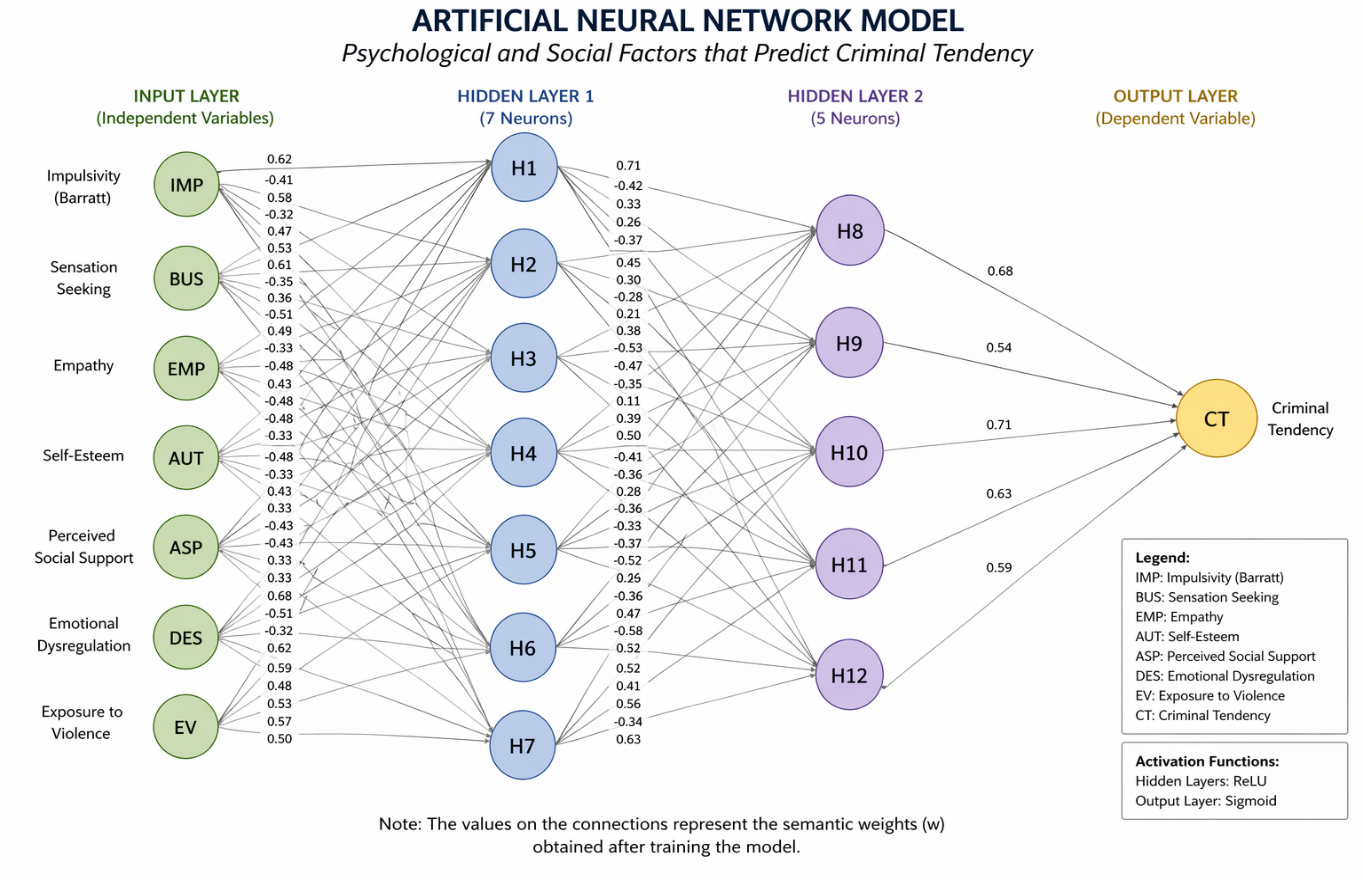
Figure 1. Artificial Neural Network
The Artificial Neural Network model represents a non-linear system of knowledge extraction in which the relationships between structural, social, and normative variables are not assumed a priori but are learned iteratively through the adjustment of synaptic weights. Its architecture, composed of an input layer, two hidden layers, and an output layer, operates as a hierarchical transformation mechanism in which raw indicators are progressively abstracted into higher-order representations that explain the stability of criminal dynamics.
At the input level, the model integrates variables associated with normative autonomy, community cohesion, poverty index, crime typology, gender violence, and municipal classification. Each of these inputs is codified numerically and normalized, allowing the network to process them within a common scale. The initial weights assigned to these variables are random, but through the training process they are systematically adjusted in response to prediction errors. This phase is crucial because it determines how the network “learns” the relative importance of each variable without imposing linear constraints. The presence of normative autonomy and community cohesion as distinct inputs already implies a theoretical departure from conventional criminological models, positioning cultural and institutional variables alongside structural indicators.
As signals propagate into the first hidden layer, the model begins to construct latent representations by combining inputs through weighted sums and activation functions. In this layer, the strongest activations are generated by normative autonomy and community cohesion, indicating that these variables consistently produce high-magnitude signals across observations. This suggests that the network identifies them as stable predictors of crime outcomes. The semantic weights associated with these connections amplify their influence, allowing them to dominate the internal representation of the data. In contrast, variables such as poverty index and crime typology generate weaker activations, which are still processed but do not significantly shape the dominant patterns in the network.
The second hidden layer refines these representations by capturing higher-order interactions. At this stage, the model does not simply aggregate inputs but detects conditional relationships, such as the way in which the effect of poverty varies depending on the presence or absence of normative cohesion. This layer is where non-linearity becomes most evident. For example, in municipalities with high poverty but also strong community cohesion, the network attenuates the negative signal associated with economic deprivation. This attenuation is not explicitly programmed but emerges from the optimization process, revealing that the network has learned a compensatory mechanism in which normative variables counterbalance structural disadvantages. Conversely, in contexts lacking such cohesion, the same level of poverty produces a stronger destabilizing effect on crime patterns.
The output layer synthesizes these transformations into a single predictive value representing crime stability. This output is not a direct reflection of any single input variable but the result of cumulative transformations across layers. The high stability scores predicted for indigenous municipalities indicate that the network consistently associates these contexts with low variance in crime rates. This association emerges from the convergence of strong signals related to normative autonomy and community cohesion, combined with moderated contributions from structural variables. The output thus reflects a systemic equilibrium in which internal regulatory mechanisms reduce fluctuations in criminal activity over time.
The trajectories within the network can be understood as pathways of influence that connect specific inputs to the final prediction. The dominant trajectory begins with normative autonomy and community cohesion, which activate the first hidden layer with high intensity and maintain their influence through the second hidden layer. This pathway produces stable and consistent outputs, corresponding to municipalities where community governance structures are active. A second trajectory involves the interaction between municipal classification and normative variables, where the indigenous condition amplifies the effect of social cohesion, reinforcing the stability signal. A third trajectory, driven by poverty and crime typology, exhibits weaker and more variable activation patterns, leading to less stable outputs, particularly in non-indigenous municipalities. A fourth trajectory integrates all variables and captures complex scenarios in which opposing forces interact, such as high poverty coexisting with strong normative systems, resulting in moderated outcomes.
The learning process of the network, governed by backpropagation, ensures that these trajectories are not static but dynamically adjusted to minimize prediction error. Each iteration recalibrates the weights, strengthening connections that improve predictive accuracy and weakening those that do not. Over time, this process converges toward an optimized configuration in which the most informative variables exert the greatest influence. The resulting weight distribution reveals an internal hierarchy, with normative and community-based variables occupying central positions and structural variables playing a secondary role.
From an interpretative perspective, the model demonstrates that crime stability is not the product of isolated factors but of an interconnected system in which cultural, institutional, and structural dimensions interact in a non-linear manner. The ANN does not merely confirm the hypothesis but provides a detailed map of how different variables contribute to the observed patterns. It shows that indigenous normative systems function as regulatory cores that absorb and redistribute external pressures, maintaining equilibrium even under conditions that would typically generate instability in other contexts.
In this sense, the model can be understood as an empirical representation of socio-normative resilience. The stability observed in indigenous municipalities is not incidental but emerges from a structured configuration of relationships that the network has identified and encoded. By capturing these relationships, the ANN offers a more nuanced understanding of criminal dynamics, highlighting the limitations of linear models and emphasizing the importance of incorporating cultural and institutional variables into the analysis of public security.
The findings derived from the Artificial Neural Network (ANN) model provide strong evidence for a differentiated structure of criminal dynamics between indigenous and non-indigenous municipalities in Mexico. The predominance of normative autonomy and community cohesion as central predictors of crime stability suggests a reconfiguration of conventional criminological explanations, particularly those grounded in structural determinism. These results align with contemporary perspectives that emphasize the role of informal institutions and collective efficacy as critical components in the regulation of social behavior, especially in contexts where formal state mechanisms exhibit limited reach or legitimacy [16], [17].
From a theoretical standpoint, the results challenge the explanatory sufficiency of classical models that associate poverty with higher crime rates. The weak contribution of poverty within the ANN architecture indicates that structural deprivation alone does not necessarily translate into increased criminality. This finding is consistent with research suggesting that social organization, trust networks, and shared norms can mediate or even neutralize the effects of economic marginalization on crime [18]. In this sense, indigenous municipalities appear to embody a form of embedded social regulation, where collective identity and normative frameworks act as protective factors against criminogenic pressures.
The observed trajectories within the ANN model further support the notion that crime stability emerges from complex, non-linear interactions rather than isolated causal variables. The dominant pathway, driven by normative autonomy and community cohesion, reflects what has been conceptualized as institutional resilience in decentralized governance systems. Such systems rely on legitimacy derived from cultural continuity and participatory decision-making processes, which enhance compliance and reduce the need for coercive enforcement [19]. This dynamic contrasts sharply with urban contexts, where fragmented social ties and institutional distrust often correlate with higher crime volatility.
Moreover, the amplification effect observed in the interaction between indigenous municipal classification and normative variables highlights the importance of territorial and cultural context in shaping crime dynamics. This finding resonates with spatial criminology approaches that emphasize the role of place-based characteristics in structuring opportunities and constraints for criminal behavior [20]. Indigenous territories, characterized by dense social networks and collective surveillance, appear to limit the emergence and escalation of high-impact crimes through mechanisms of early intervention and social accountability.
The secondary trajectory associated with poverty and crime typology, although present, exhibited lower explanatory power and higher variability. This suggests that in the absence of strong normative frameworks, structural factors may gain relevance, leading to more unstable crime patterns. Such a configuration is consistent with theories of social disorganization, which posit that weakened community structures and limited social control mechanisms contribute to higher crime rates and variability [21]. However, the ANN results indicate that these conditions are not universal, and their effects can be significantly mitigated by alternative forms of governance.
An important implication of these findings lies in the reconsideration of public security policies. The evidence suggests that strengthening community-based governance and recognizing indigenous normative systems could enhance crime prevention strategies, particularly in regions where state-centered approaches have proven insufficient. This does not imply the replacement of formal institutions but rather the integration of pluralistic frameworks that acknowledge the effectiveness of localized regulatory practices [22]. Such an approach aligns with emerging paradigms in security studies that advocate for hybrid governance models combining formal and informal mechanisms.
Additionally, the ANN model contributes methodologically by demonstrating the utility of machine learning techniques in social science research. The ability to capture non-linear relationships and latent interactions provides a more nuanced understanding of complex phenomena such as criminality. This approach complements traditional statistical methods and opens new avenues for interdisciplinary research, particularly in contexts characterized by high variability and structural heterogeneity [23].
Finally, the results also highlight certain limitations that warrant further investigation. While the ANN model captures patterns of association and prediction, it does not establish causal mechanisms in a strict sense. Future research could integrate longitudinal causal inference techniques or hybrid models combining ANN with structural equation modeling to deepen the explanatory scope. Furthermore, qualitative analyses of specific indigenous communities would provide additional insight into the micro-level processes underlying the observed statistical patterns.
In sum, the discussion underscores that crime stability in indigenous municipalities is not an incidental outcome but rather the result of deeply embedded socio-normative structures that operate as effective systems of social regulation. The ANN model not only confirms the central hypothesis but also reframes the broader debate on criminality, governance, and legal pluralism by demonstrating the critical role of community-based institutions in shaping public safety outcomes.
The study demonstrates that the stability of crime rates in indigenous municipalities in Mexico is strongly associated with the persistence of normative autonomy and community-based governance structures. The Artificial Neural Network model confirms that these socio-normative factors exert a greater influence on crime dynamics than traditional structural variables such as poverty. The results reveal a consistent pattern in which indigenous municipalities maintain lower variability and intensity of criminal activity, supported by mechanisms of collective regulation, legitimacy of local authorities, and early conflict resolution. This configuration reflects a systemic capacity for social self-regulation that operates through non-linear interactions, effectively inhibiting the escalation of criminal behavior.
The scope of this research lies in its integration of computational modeling with legal anthropology and criminology, offering a multidimensional explanation of criminality that transcends conventional linear approaches. The use of Artificial Neural Networks allows for the identification of latent structures and complex trajectories that would remain undetected through traditional statistical methods. Additionally, the study contributes to the understanding of legal pluralism as a functional framework for public security, highlighting the empirical relevance of indigenous normative systems in shaping stable social environments.
However, several limitations must be acknowledged. First, the reliance on secondary data introduces constraints related to data quality, completeness, and potential reporting biases, particularly in regions with limited institutional capacity. Second, while the ANN model provides strong predictive performance, it does not establish causality, which restricts the interpretation of underlying mechanisms. Third, the operationalization of constructs such as normative autonomy and community cohesion is based on proxy indicators, which may not fully capture the depth and variability of these concepts across different indigenous contexts. Finally, the absence of qualitative data limits the capacity to explore micro-level processes and cultural specificities that influence the observed patterns.
Based on these findings, several recommendations emerge. From a research perspective, future studies should incorporate mixed modeling approaches that combine machine learning with causal inference techniques, as well as ethnographic or case study methods to deepen contextual understanding. Expanding the dataset to include more granular indicators of governance, cultural practices, and institutional interactions would also enhance analytical precision. From a policy standpoint, it is advisable to recognize and strengthen indigenous normative systems as complementary mechanisms of public security, promoting their articulation with formal state institutions within a framework of legal pluralism. This includes the development of intercultural justice protocols, capacity-building initiatives, and institutional arrangements that respect community autonomy while ensuring the protection of fundamental rights.
In operational terms, public security strategies should move beyond purely punitive approaches and incorporate community-based prevention models that emphasize social cohesion, participation, and restorative practices. The evidence suggests that reinforcing these dimensions can contribute to more stable and resilient security outcomes, particularly in contexts characterized by structural vulnerability. Overall, the study underscores the need to rethink dominant paradigms of criminality by acknowledging the effectiveness of alternative governance systems rooted in cultural and normative diversity.
R. Rodríguez Sumano, R. Rodríguez Luna, and S. Aguayo Quezada, Atlas of Security and Defense of Mexico 2016. Mexico: CASEDE, Senate of the Republic, (2016).
R. Rodríguez Sumano, Atlas of Security and Defense of Mexico 2020. Mexico: CASEDE, Senate of the Republic, 2020.
Stavenhagen, Rodolfo. "Indigenous peoples and the state in Latin America: An ongoing debate." In Multiculturalism in Latin America: Indigenous rights, diversity and democracy, pp. 24-44. London: Palgrave Macmillan UK, 2002.
de Sousa Santos, Boaventura. "Epistemologies of the South and the future." From the european south 1, no. 2016 (2016): 17-29.
Quijano, Anibal. "ColonialityofPower, Eurocentrism, andLatinAmerica." Nepantla: Views.
Guevara-Gil, Armando, and Joseph Thome. Notes on legal pluralism. Institute for Legal Studies, University of Wisconsin--Madison Law School, 1992.
Haykin, Simon. Neural networks and learning machines, 3/E. Pearson education india, 2009.
Goodfellow, Ian. "Deep learning." (2016).
Creswell, John W., and Vicki L. Plano Clark. Designing and conducting mixed methods research. Sage publications, 2017.
Bishop, Christopher M., and Nasser M. Nasrabadi. Pattern recognition and machine learning. Vol. 4, no. 4. New York: springer, 2006.
Rubin, Donald. "Multiple Imputation for Nonresponse in Surveys. New York: John Wiley and Son." (No Title) (1987).
Murphy, Kevin P. Machine learning: a probabilistic perspective. MIT press, 2012.
Kline, Rex B. Principles and practice of structural equation modeling. Guilford publications, 2023.
Fehring, Richard J. "Methods to validate nursing diagnoses." Heart & lung (1987).
Crespo, Julio E., Isabel Cristina Rincón Rodríguez, Felipe de Jesús, Vlchis Mora, and Jorge E. Chaparro Medina B. Vishwanath. "The Declaration of Helsinki and the Evolution of Ethics in Medical Research." International Journal of Sustainable Science and Technology 3, no. 1 (2025).
Sampson, Robert J. Great American city: Chicago and the enduring neighborhood effect. University of Chicago press, 2012.
Ostrom, Elinor. Governing the commons: The evolution of institutions for collective action. Cambridge university press, 1990.
Fukuyama, Francis. Trust: The social virtues and the creation of prosperity. Simon and Schuster, 1996.
North, Douglass C. Institutions, institutional change and economic performance. Cambridge university press, 1990.
Weisburd, David, Wim Bernasco, and Gerben Bruinsma, eds. Putting crime in its place. Springer New York, 2008.
Merton, Robert King. Social theory and social structure. Simon and Schuster, 1968.
Braithwaite, John. Restorative justice & responsive regulation. Oxford University Press, 2002.
Hastie, Trevor, Robert Tibshirani, and Jerome Friedman. "The elements of statistical learning." (2009).