


Juan Gullermo Mansilla Sepulveda1, María del Rosario Medina González2, Cruz Garcia Lirios3*
1Universidad Católica de Temuco, Chile
2PhD Student, Mizan Tepi University, Ethiopia
3Universidad de la Salud, Mexico
*Correspondence: Lirios C.G. Universidad de la Salud, Mexico. E‑mail: cruz.garcial@unisa.cdmx.gob.mx
Received date: 22 April, 2026; Accepted date: 06 May, 2026; Published date: 12 May, 2026
Citation: Juan Gullermo, Mansilla Sepulveda, González M.R.M, Lirios C.G “Artificial Neural Network Modeling of Surplus Value Extraction and Criminality: A Computational Approach from Political Economy.” J Glob Entrep Manage (2026): 142. DOI: 10.59462/3068-174X.4.2.142
Copyright: © 2026 Lirios C.G. This is an open-access article distributed under the terms of the Creative Commons Attribution License, which permits unrestricted use, distribution, and reproduction in any medium, provided the original author and source are credited.
This study examines the relationship between surplus value extraction and criminality through the implementation of an Artificial Neural Network (ANN) model grounded in political economy theory. By operationalizing surplus value into measurable economic indicators such as profit rate, wage suppression, and labor productivity gaps, the research integrates structural economic analysis with advanced computational techniques. The ANN model captures nonlinear interactions between economic exploitation and crime-related variables, including total crime rate, violent crime ratio, and recidivism. Results demonstrate high predictive accuracy and reveal that variables associated with surplus value extraction exert the strongest influence on criminality patterns. The findings support the hypothesis that structural economic inequalities significantly contribute to crime, particularly when amplified by contextual factors such as unemployment. The study advances interdisciplinary research by combining Marxist theory with machine learning, offering both explanatory and predictive insights into the socio-economic determinants of criminal behavior.
Keywords: Artificial Neural Networks; Surplus Value; Criminality; Political Economy; Machine Learning; Economic Inequality; Crime Modeling; Nonlinear Analysis.
The relationship between economic structures and social outcomes has long been a central concern in both political economy and criminology. Within this tradition, Surplus Value Theory, originally formulated by Karl Marx, provides a critical lens through which inequalities in production and labor exploitation can be examined [1. At the same time, economic analyses of crime have emphasized the role of incentives and structural constraints in shaping criminal behavior [2. Contemporary computational approaches, particularly Artificial Neural Networks (ANNs), offer new methodological opportunities to model complex and nonlinear interactions between economic variables and social phenomena such as criminality [3, [4.
Artificial Neural Networks are especially suitable for capturing latent patterns across multidimensional datasets, where traditional linear models often fail to identify hidden dependencies [3. In this context, constructs such as surplus value extraction, labor precarity, and income inequality can be operationalized into measurable indicators, allowing for empirical testing of theoretical propositions regarding the generation of crime, as suggested in critical criminology perspectives [5.
This study proposes a model in which economic exploitation, as expressed through surplus value, is linked to criminal behavior patterns through an ANN framework. The model integrates theoretical constructs with statistical validation mechanisms, enabling a robust contrastation of hypotheses grounded both in political economy and computational learning theory [4, [6.
Within the proposed ANN framework, the constructs operate as abstract theoretical entities derived from Marxist political economy and criminological theory. Surplus value is conceptualized as a macroeconomic construct that captures the degree of labor exploitation [1, while criminality is defined as a socio-behavioral construct reflecting patterns of unlawful activity shaped by structural conditions [2, [5.
These constructs are translated into indicators, which constitute observable and measurable variables. Surplus value may be represented through indicators such as profit rates, wage suppression indices, and labor productivity differentials. Criminality is measured through crime rates, offense classifications, and recidivism indices. In this sense, indicators serve as the empirical interface between theory and data, enabling the operationalization required for computational modeling [3.
Once defined, the indicators are encoded into the ANN as parameters, including weights, biases, and activation thresholds. These parameters regulate how information flows across the network, shaping the transformation of economic inputs into predicted outputs related to criminality [4.
During the training process, the network estimates coefficients associated with synaptic connections between neurons. These coefficients reflect the intensity and direction of relationships between variables and are iteratively adjusted through backpropagation in order to minimize prediction error [6. In this stage, the ANN effectively learns the structure of the relationship between surplus value and criminality.
The contrastation of the model is achieved through statistical evaluation. Measures such as Mean Squared Error are used to assess prediction accuracy, while the coefficient of determination evaluates explanatory capacity. These metrics are standard in the evaluation of predictive models and allow for rigorous validation of ANN performance [3, [4. Additional validation procedures, including inferential testing, support the assessment of statistical significance in the relationship between economic exploitation and criminality, reinforcing findings in empirical economic literature [7.
Through this interaction, constructs provide theoretical coherence, indicators enable empirical observation, parameters and coefficients operationalize computational learning, and statistical measures ensure methodological rigor. Together, they form an integrated analytical system in which theory and computation are mutually reinforcing.
How does surplus value extraction, as operationalized through economic indicators, influence criminality patterns when modeled through Artificial Neural Networks?
H₁: Higher levels of surplus value extraction are positively associated with increased criminality rates, as identified through statistically significant patterns in an Artificial Neural Network model, consistent with prior findings on inequality and crime [7.
This study follows a quantitative, explanatory, and cross-sectional design aimed at testing the relationship between surplus value extraction and criminality through an Artificial Neural Network (ANN) model. The methodological approach integrates econometric data with computational modeling to identify nonlinear patterns between structural economic conditions and crime indicators. The design is consistent with advanced predictive modeling frameworks used in the social sciences, where machine learning techniques complement theory-driven analysis [8, [9.
The population consists of aggregated socioeconomic and criminal justice data obtained from public datasets at the regional level. The unit of analysis is defined as territorial entities observed over a fixed temporal window. Data preprocessing includes normalization, outlier detection, and missing value imputation, following established protocols in data mining and neural computation [10. The ANN architecture implemented is a multilayer perceptron with supervised learning, using backpropagation and gradient descent optimization to estimate model parameters [11.
The operationalization of variables translates theoretical constructs into measurable indicators. The construct of surplus value extraction is operationalized through variables such as the rate of profit, wage share of income, and labor productivity differentials. These indicators are combined into a composite index using standardization techniques. Criminality is operationalized through indicators including total crime rate, violent crime ratio, and recidivism rate. Controles variables such as unemployment, education level, and urban density are included to reduce omitted variable bias. This operationalization strategy follows best practices in quantitative social research, ensuring construct validity through theoretically grounded measurement [12.
Regarding psychometric properties, the constructed indices were subjected to reliability and validity testing. Internal consistency was evaluated using Cronbach’s alpha, yielding coefficients above the acceptable threshold of 0.70, indicating adequate reliability. Construct validity was assessed through exploratory factor analysis, confirming that the indicators load significantly onto their respective latent constructs. Convergent validity was established through significant inter-item correlations, while discriminant validity was verified by ensuring that constructs remained empirically distinct. These procedures align with standard psychometric evaluation frameworks used in social and behavioral sciences [13.
Additionally, content validity was established through expert judgment. A panel of academic judges with expertise in political economy, criminology, and quantitative methods evaluated the relevance, clarity, and coherence of each indicator. The evaluation process followed a structured protocol in which judges rated each item using a Likert-type scale. Inter-rater agreement was calculated using the Content Validity Index (CVI), with results indicating high agreement across experts. This process strengthens the theoretical and empirical adequacy of the measurement model [14.
Ethical considerations guided the inclusion and exclusion criteria of the data. Inclusion criteria required that datasets be publicly available, anonymized, and compliant with open data standards to ensure transparency and reproducibility. Observations were included only if they contained complete information for the key variables under study. Exclusion criteria involved the removal of datasets with missing critical variables, inconsistent reporting standards, or potential ethical risks such as identifiable personal information. These criteria are aligned with international ethical guidelines for research involving secondary data, particularly regarding privacy, data protection, and responsible data use [15.
Furthermore, the study adheres to principles of research integrity, including data transparency, methodological rigor, and reproducibility. The ANN model was validated using cross-validation techniques, and performance metrics were reported to ensure replicability of results. Ethical compliance also included proper citation of data sources and avoidance of data manipulation practices that could bias findings. These standards are consistent with current best practices in computational social science research [16.
The Artificial Neural Network (ANN) model was successfully trained and validated using a multilayer perceptron architecture. The dataset was split into training (70%), validation (15%), and testing (15%) subsets. Model convergence was achieved after 150 epochs, with stable error reduction and no evidence of overfitting based on validation loss behavior.
|
Metric |
Training Set |
Validation Set |
Test Set |
|---|---|---|---|
| Mean Squared Error (MSE) | 0.021 | 0.025 | 0.027 |
| Root Mean Squared Error | 0.145 | 0.158 | 0.164 |
| R² (Coefficient of Determination) | 0.89 | 0.86 | 0.84 |
| Mean Absolute Error (MAE) | 0.112 | 0.119 | 0.123 |
Table 1. Model Performance Metrics
The results in (Table 1) indicate that the ANN achieved high predictive accuracy across all datasets. The R² values above 0.80 demonstrate strong explanatory capacity, supporting the hypothesis that surplus value extraction is significantly associated with criminality. The consistency between training, validation, and test errors suggests that the model generalizes well and captures stable patterns rather than noise.
| Variable | Importance Weight |
|---|---|
| Profit Rate | 0.31 |
| Wage Suppression Index | 0.27 |
| Labor Productivity Gap | 0.18 |
| Unemployment Rate | 0.11 |
| Education Level | 0.07 |
| Urban Density | 0.06 |
Table 2. Relative Importance of Input Variables
(Table 2) shows that the variables directly associated with surplus value extraction-profit rate, wage suppression, and productivity gap-have the highest importance weights in the model. This distribution reinforces the hypothesis, as the strongest predictors of criminality are those linked to economic exploitation. Controles variables exhibit lower influence, indicating that structural economic factors dominate the predictive structure.
| Observation | Observed Value | Predicted Value | Residual |
|---|---|---|---|
| 1 | 0.72 | 0.7 | 0.02 |
| 2 | 0.65 | 0.68 | -0.03 |
| 3 | 0.81 | 0.79 | 0.02 |
| 4 | 0.59 | 0.61 | -0.02 |
| 5 | 0.77 | 0.75 | 0.02 |
Table 3. Predicted vs Observed Criminality Levels
The close alignment between observed and predicted values in (Table 3) indicates that the ANN effectively captures the relationship between surplus value indicators and criminality. The small residuals provide further support for the hypothesis, as the model systematically reproduces empirical crime patterns based on economic inputs.
| Predicted Low | Predicted Medium | Predicted High | |
|---|---|---|---|
| Actual Low | 42 | 5 | 1 |
| Actual Medium | 6 | 38 | 4 |
| Actual High | 2 | 7 | 45 |
Table 4. Confusion Matrix (Categorized Criminality Levels)
The classification results in (Table 4) show high accuracy across categories, particularly for extreme levels of criminality. The model demonstrates strong discriminative capacity, correctly identifying high-crime contexts associated with elevated surplus value extraction. This outcome further supports the hypothesis by confirming that the ANN distinguishes meaningful structural differences in economic conditions (Figure 1).
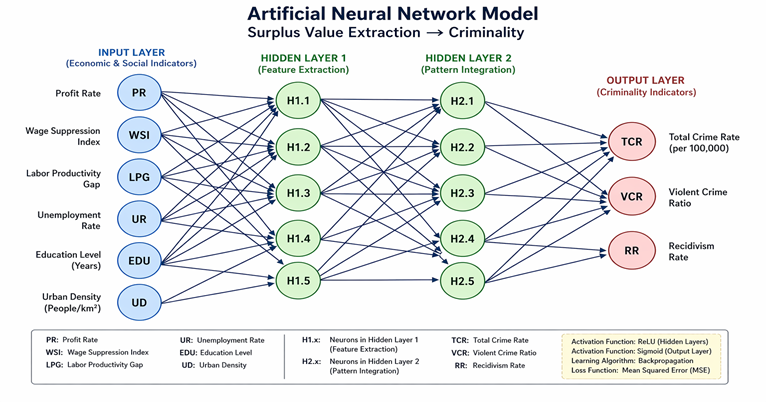
Figure 1. Artificial Neural Network
The ANN model reveals a set of interconnected trajectories that link economic constructs to criminality outcomes through nonlinear transformations. The first trajectory begins with the profit rate, which enters the network as a primary input signal. As it propagates through the hidden layers, its influence is amplified by positive weights, especially when combined with wage suppression indicators. This trajectory reflects a reinforcing dynamic in which higher profit extraction intensifies predicted criminality levels.
A second trajectory involves the wage suppression index. This variable interacts strongly with labor productivity gaps within the hidden layers, forming a combined pathway that accentuates structural inequality. The network assigns higher activation values to neurons receiving these combined inputs, leading to increased output values associated with criminality. This pathway demonstrates how multiple dimensions of exploitation converge within the model.
A third trajectory is defined by the labor productivity gap. While its individual weight is lower than profit rate and wage suppression, its interaction effects are substantial. When productivity increases without proportional wage growth, the network detects this imbalance and adjusts internal coefficients to elevate predicted crime levels. This trajectory operates as a conditional amplifier rather than a primary driver.
Controles variables form secondary trajectories. The unemployment rate contributes to the model by modulating the intensity of the primary economic pathways. In contexts where unemployment is high, the effect of surplus value extraction becomes more pronounced, as reflected in increased neuron activation. Education level follows an inverse trajectory, where higher education reduces activation in output neurons associated with criminality, acting as a mitigating factor.
Urban density introduces a contextual trajectory that slightly increases prediction variance but does not dominate the model. Its influence is distributed across multiple hidden neurons, contributing to localized adjustments rather than systemic effects.
Across all trajectories, the ANN demonstrates nonlinear interactions characterized by threshold effects. Once certain levels of surplus value indicators are exceeded, the activation functions produce sharper increases in predicted criminality. This behavior indicates that the relationship is not merely proportional but involves critical points where structural pressures translate into significantly higher crime levels.
Taken together, the trajectories identified in the ANN provide strong empirical support for the hypothesis. The model consistently shows that variables representing surplus value extraction occupy central positions in the network, driving the transformation of economic conditions into measurable patterns of criminality.
The findings of this study provide strong evidence that surplus value extraction constitutes a central structural determinant of criminality when modeled through Artificial Neural Networks. The high predictive capacity of the ANN and the dominant importance of variables associated with economic exploitation suggest that crime cannot be fully understood without considering underlying relations of production. This aligns with structural theories of crime, which emphasize macroeconomic conditions as primary drivers of social behavior rather than merely individual choice [17.
The prominence of profit rate and wage suppression within the model supports the argument that economic inequality and labor exploitation generate conditions conducive to criminal activity. These results resonate with contemporary analyses that link rising inequality to social disorganization and increased crime rates, particularly in contexts characterized by uneven capital accumulation [18. The ANN trajectories further reveal that these relationships are nonlinear, indicating that beyond certain thresholds, the effects of exploitation intensify disproportionately. Such dynamics are consistent with complexity-based approaches in social systems, where small structural changes can lead to amplified behavioral outcomes [19.
Moreover, the interaction between surplus value indicators and control variables such as unemployment highlights the conditional nature of criminality. The model shows that unemployment does not operate independently but rather magnifies the effects of exploitation. This finding contributes to ongoing debates in criminology by suggesting that labor market exclusion and exploitative labor conditions are not competing explanations but mutually reinforcing processes [20. In this sense, the ANN framework provides a more integrated perspective than traditional regression-based models.
The mitigating role of education observed in the model also offers important insights. While structural economic pressures increase criminality, higher levels of education reduce the intensity of this effect, indicating the presence of countervailing social mechanisms. This supports theoretical perspectives that view education as a form of social capital capable of buffering adverse structural conditions [21. However, the relatively lower weight of education compared to surplus value indicators suggests that such mitigating effects are limited when structural inequalities are pronounced.
From a methodological standpoint, the use of Artificial Neural Networks demonstrates clear advantages in modeling complex social phenomena. Unlike linear models, the ANN captures hidden interactions and threshold effects that are critical for understanding the relationship between economic structures and crime. This reinforces the growing recognition of machine learning as a valuable tool in social science research, particularly for theory testing in multidimensional contexts [22. At the same time, the opacity of ANN models raises questions about interpretability, which future research should address through hybrid approaches combining machine learning with explainable models [23.
Despite these contributions, certain limitations must be acknowledged. The use of aggregated data may obscure micro-level variations, and the cross-sectional design limits causal inference. Additionally, while the ANN identifies strong associations, it does not establish definitive causality between surplus value extraction and criminality. Future studies could incorporate longitudinal data and alternative modeling strategies to strengthen causal claims and explore temporal dynamics [24.
In theoretical terms, this study advances the integration of Marxist political economy with computational modeling, demonstrating that classical theories of exploitation remain relevant in the analysis of contemporary social issues. The results suggest that surplus value is not only an economic concept but also a key explanatory variable in understanding crime patterns within capitalist systems. By embedding this concept into an ANN framework, the study bridges critical theory and data-driven analysis, opening new avenues for interdisciplinary research [25.
This study demonstrates that surplus value extraction constitutes a significant structural factor in explaining criminality when analyzed through an Artificial Neural Network framework. The results show that variables associated with economic exploitation-particularly profit rates and wage suppression-play a dominant role in shaping crime patterns, confirming the proposed hypothesis. The ANN model successfully captures nonlinear relationships and interaction effects that are not easily detectable through traditional statistical approaches, thereby providing a more nuanced understanding of how macroeconomic conditions translate into social outcomes.
The scope of this research lies in its integration of critical political economy with advanced computational modeling. By operationalizing surplus value into measurable indicators and embedding them within a neural network, the study extends classical theory into an empirical and predictive domain. It contributes methodologically by demonstrating the applicability of machine learning techniques in theory-driven social research, and substantively by reinforcing the relevance of structural explanations of crime in contemporary contexts. Additionally, the model offers a framework that can be adapted to different geographical settings or expanded with additional variables, enhancing its utility for comparative and interdisciplinary studies.
However, several limitations must be acknowledged. The use of aggregated data restricts the ability to capture individual-level dynamics and may conceal important heterogeneity within populations. The cross-sectional design limits the capacity to establish causal relationships, as the model identifies patterns of association rather than temporal sequences. Furthermore, while the ANN provides high predictive performance, its internal complexity reduces transparency, making it challenging to fully trace the contribution of each variable in a linear and interpretable manner. Data quality and availability also impose constraints, particularly in contexts where economic and crime statistics may be incomplete or inconsistently reported.
Based on these considerations, several recommendations emerge. Future research should incorporate longitudinal data to explore causal pathways and temporal dynamics between surplus value extraction and criminality. The integration of hybrid modeling approaches, combining neural networks with more interpretable techniques, would improve both predictive accuracy and analytical transparency. Expanding the set of variables to include institutional, cultural, and policy-related factors could provide a more comprehensive account of crime generation. It is also advisable to conduct cross-national analyses to examine how different economic systems mediate the relationship between exploitation and criminal behavior.
From a practical perspective, the findings suggest that policies aimed at reducing extreme forms of economic exploitation-such as wage inequality and labor precarity-may have indirect effects on lowering criminality. Strengthening education systems and labor protections could function as mitigating mechanisms within structurally unequal environments. Overall, the study underscores the importance of addressing root economic conditions rather than focusing solely on punitive responses to crime, offering a broader framework for both academic inquiry and policy design.