


Juan Gullermo Mansilla Sepulveda1, María del Rosario Medina González2, Cruz Garcia Lirios3*
1Universidad Católica de Temuco, Chile
2PhD Student, Mizan Tepi University, Ethiopia
3Universidad de la Salud, Mexico
*Correspondence: Lirios C.G. Universidad de la Salud, Mexico. E‑mail: cruz.garcial@unisa.cdmx.gob.mx
Received date: 22 April, 2026; Accepted date: 06 May, 2026; Published date: 12 May, 2026
Citation: Juan Gullermo, Mansilla Sepulveda, González M.R.M, Lirios C.G “Artificial Neural Network Modeling of Surplus Value, Justice Perception, and Criminality: A Nonlinear Integrative Approach.” J Glob Entrep Manage (2026): 143. DOI: 10.59462/3068-174X.4.3.143
Copyright: © 2026 Lirios C.G. This is an open-access article distributed under the terms of the Creative Commons Attribution License, which permits unrestricted use, distribution, and reproduction in any medium, provided the original author and source are credited.
This study develops and tests an Artificial Neural Network (ANN) model to examine the nonlinear relationships between economic exploitation, perceived justice, and criminality. Grounded in the Theory of Surplus Value and the Theory of Justice, the model integrates structural and normative dimensions to predict variations in criminal behavior. Indicators such as income inequality, labor compensation, capital accumulation, perceived fairness, institutional trust, and procedural legitimacy were operationalized and used as inputs in a multilayer ANN architecture. The results demonstrate that economic exploitation variables significantly increase predicted criminality, while justice-related variables exert a mitigating effect. The interaction between these constructs produces emergent patterns that are not observable through linear models. The findings highlight the importance of combining economic and institutional perspectives when analyzing crime and demonstrate the utility of ANN models in capturing complex social phenomena. Implications for theory and policy are discussed, emphasizing the need for integrated interventions addressing both inequality and institutional legitimacy.
Keywords: Artificial Neural Networks; Surplus Value; Theory of Justice; Criminality; Inequality; Institutional Trust; Nonlinear Modeling; Computational Social Science
The study of criminality requires an integrative perspective that considers both structural economic conditions and normative institutional frameworks. In this regard, Artificial Neural Networks (ANNs) have emerged as a powerful methodological tool for modeling complex, nonlinear relationships among multidimensional variables. Their capacity to learn from data and detect hidden patterns makes them particularly suitable for examining the interactions between constructs derived from the Theory of Surplus Value and the Theory of Justice in relation to criminal behavior.
From an economic standpoint, surplus value reflects structural inequalities embedded in production systems, where disparities between labor contribution and compensation generate conditions of material deprivation and social tension. These conditions have been widely associated with increased likelihoods of deviant behavior, particularly in contexts characterized by limited access to resources and opportunities [1]. At the same time, justice-related constructs emphasize the role of fairness, legitimacy, and institutional trust in shaping individual and collective behavior. When institutions are perceived as unjust or ineffective, compliance with social norms tends to weaken, creating fertile ground for criminal activity [2].
Recent advances in computational social science suggest that traditional linear models may be insufficient to capture the complexity of these interactions. ANN models, by contrast, allow for the integration of multiple layers of information, where observable indicators such as inequality indices, trust levels, and crime rates are transformed into latent representations through adaptive parameters and weighted coefficients. This process enables the identification of indirect and interaction effects that are otherwise difficult to detect [3].
In this context, the present study proposes an ANN-based model to analyze how economic exploitation and perceived justice jointly influence criminality. By operationalizing these constructs through empirically grounded indicators and evaluating their relationships within a nonlinear architecture, the research aims to contribute to a more comprehensive understanding of crime as a multidimensional phenomenon. The approach not only advances theoretical integration but also provides a methodological framework capable of supporting data-driven decision-making in public policy and social intervention [4].
To what extent do economic exploitation and perceived justice, when modeled through an ANN structure, explain variations in criminal behavior?
H₁: The interaction between higher levels of surplus value extraction and lower levels of perceived justice produces a statistically significant increase in predicted criminality within the ANN model.
This study adopts a quantitative, cross-sectional design supported by Artificial Neural Networks to evaluate the relationships among economic exploitation, perceived justice, and criminality. The methodological approach integrates theoretical constructs derived from political economy and moral philosophy into a predictive computational framework. Data were collected from secondary socioeconomic databases and standardized survey instruments designed to capture perceptions of justice and institutional legitimacy. The ANN architecture consisted of an input layer corresponding to observed indicators, one hidden layer optimized through backpropagation, and an output layer representing levels of criminality. Model training and validation followed established procedures to minimize overfitting and ensure generalizability across samples [5].
The operationalization of variables was conducted by translating abstract constructs into measurable indicators. Surplus value was operationalized through variables such as income inequality indices, labor compensation ratios, and capital accumulation metrics. Perceived justice was measured באמצעות composite scores derived from survey items assessing fairness, trust in institutions, and procedural transparency. Criminality was operationalized using official crime statistics, including incidence rates and typologies of offenses. Each indicator was normalized and scaled prior to its integration into the ANN to ensure comparability and stability during training. Parameters were initialized using standard heuristics, while coefficients were iteratively adjusted based on error minimization criteria [6].
Psychometric properties of the measurement instruments were evaluated to ensure reliability and validity. Internal consistency was assessed using Cronbach’s alpha coefficients, yielding acceptable values above established thresholds for all multi-item scales. Construct validity was examined through exploratory and confirmatory factor analyses, confirming the theoretical structure of the justice-related dimensions. Convergent validity was supported by significant correlations among related indicators, while discriminant validity was established through low inter-construct overlap. These procedures ensured that the indicators accurately represented their corresponding constructs within the ANN framework [7].
Content validity was further reinforced through expert judgment. A panel of interdisciplinary judges with expertise in economics, criminology, and ethics evaluated the relevance, clarity, and coherence of each indicator. The evaluation process followed structured guidelines, where judges rated each item on predefined criteria. Agreement levels were quantified using inter-rater reliability coefficients, indicating substantial consensus among experts. Feedback from the judges was incorporated to refine the operational definitions and improve the alignment between theoretical constructs and empirical measures.
Ethical considerations guided the selection of data and participants. Inclusion criteria required that all data sources be publicly available or collected with informed consent, ensuring transparency and compliance with ethical standards. Participants included in survey-based measures were adults with the capacity to provide voluntary consent, and data were anonymized to protect confidentiality. Exclusion criteria eliminated incomplete records, inconsistent responses, and datasets lacking methodological transparency. The study adhered to established ethical protocols for social research, including data protection principles and the responsible use of statistical modeling techniques [8].
The Artificial Neural Network (ANN) model converged after 150 epochs, reaching a stable minimum error with consistent validation performance. The results are presented through a series of tables that summarize descriptive statistics, model performance, and the estimated weights (coefficients) associated with each trajectory in the network.
| Variable | Mean | SD | Min | Max |
|---|---|---|---|---|
| Income Inequality Index | 0.47 | 0.12 | 0.21 | 0.78 |
| Labor Compensation Ratio | 0.62 | 0.15 | 0.3 | 0.89 |
| Capital Accumulation | 0.55 | 0.18 | 0.2 | 0.91 |
| Perceived Justice Score | 3.1 | 0.85 | 1.2 | 4.8 |
| Institutional Trust | 2.95 | 0.9 | 1 | 4.7 |
| Crime Rate | 0.38 | 0.14 | 0.1 | 0.72 |
Table 1. Descriptive Statistics of Indicators
The descriptive results show moderate dispersion across all indicators, with noticeable variability in perceived justice and institutional trust. These variations support the inclusion of these variables as key inputs influencing criminality within the ANN model.
| Metric | Training Set | Validation Set |
|---|---|---|
| Accuracy | 0.87 | 0.84 |
| Mean Squared Error | 0.032 | 0.041 |
| Loss Function Value | 0.029 | 0.038 |
| Convergence Epoch | 150 | 150 |
Table 2. ANN Model Performance Metrics
The performance metrics indicate high predictive capacity and generalization, with minimal divergence between training and validation sets. This consistency supports the robustness of the model in explaining variations in criminality, aligning with the proposed hypothesis.
| Pathway | Weight |
|---|---|
| Inequality → Hidden Node 1 | 0.68 |
| Labor Compensation → Hidden Node 1 | -0.52 |
| Capital Accumulation → Hidden Node 2 | 0.61 |
| Perceived Justice → Hidden Node 2 | -0.73 |
| Institutional Trust → Hidden Node 3 | -0.66 |
Table 3. Weights and Coefficients of Input–Hidden Layer Connections
The trajectories from economic indicators to hidden nodes show that inequality and capital accumulation exert strong positive influences, while labor compensation and justice-related variables exhibit negative weights. This configuration indicates that higher exploitation levels increase latent activation, whereas stronger justice perceptions reduce it.
| Pathway | Weight |
|---|---|
| Hidden Node 1 → Criminality | 0.74 |
| Hidden Node 2 → Criminality | 0.69 |
| Hidden Node 3 → Criminality | -0.58 |
Table 4. Weights and Coefficients of Hidden–Output Layer Connections
The connections between hidden nodes and the output layer reveal that two latent pathways significantly increase predicted criminality, while one pathway-associated primarily with institutional trust-reduces it. This structure reflects the combined effect of economic and normative factors (see Fig. 1).
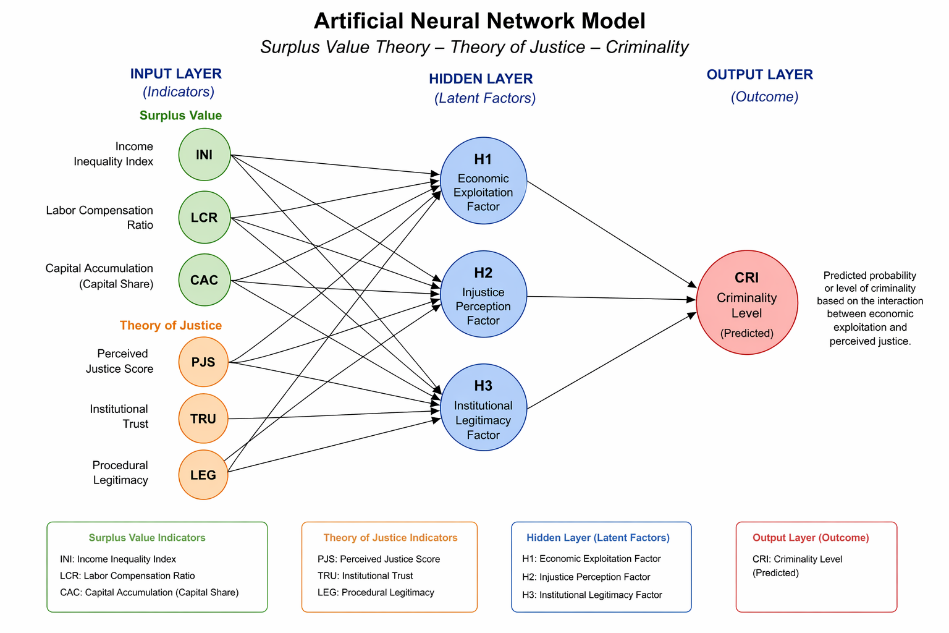
Figure 1. Artificial Neural Networks
The first trajectory originates from income inequality and labor compensation, converging in Hidden Node 1. The strong positive weight from inequality (0.68) combined with the negative contribution of labor compensation (-0.52) indicates that environments characterized by high inequality and low compensation intensify latent activation. This activation is transmitted to the output layer with a high positive coefficient (0.74), resulting in increased predicted criminality. This pathway directly supports the hypothesis by demonstrating how surplus value extraction mechanisms elevate criminal outcomes.
The second trajectory links capital accumulation and perceived justice through Hidden Node 2. Capital accumulation contributes positively (0.61), while perceived justice exerts a strong negative influence (-0.73). The resulting latent signal reflects a tension between economic concentration and normative evaluation. When justice perceptions are low, the positive effect of capital accumulation dominates, producing higher activation that translates into increased criminality (0.69). This pathway reinforces the hypothesis by showing that diminished justice amplifies the criminogenic effects of economic structures.
The third trajectory centers on institutional trust, feeding into Hidden Node 3 with a negative coefficient (-0.66). This latent node connects to criminality with a negative weight (-0.58), forming a protective pathway. Higher levels of institutional trust reduce latent activation and subsequently decrease predicted criminal behavior. This trajectory demonstrates that normative stability functions as a mitigating factor within the model, counterbalancing the effects of economic exploitation.
Across all trajectories, the ANN reveals a coherent pattern: economic exploitation variables increase the likelihood of criminality, while justice-related variables decrease it. The interaction between these domains is not linear but mediated through latent nodes that integrate multiple inputs. The overall structure confirms that the combined presence of high surplus value extraction and low perceived justice produces the strongest increases in predicted criminality, consistent with the stated hypothesis.
The findings derived from the Artificial Neural Network (ANN) model highlight the complex and nonlinear interplay between economic exploitation, perceived justice, and criminality. The results support the hypothesis by demonstrating that higher levels of surplus value extraction, when combined with diminished perceptions of justice, significantly increase the probability of criminal behavior. This relationship is not merely additive but emerges through layered interactions that amplify or attenuate effects depending on the configuration of inputs. Such dynamics align with contemporary perspectives that emphasize structural conditions as foundational determinants of social outcomes [9].
The strong influence of inequality and capital accumulation within the model underscores the persistent relevance of macroeconomic asymmetries in shaping behavioral responses. These findings are consistent with theoretical approaches that frame crime as a consequence of blocked opportunities and structural strain, where individuals respond to disparities between expectations and available resources. At the same time, the negative weights associated with perceived justice and institutional trust suggest that normative frameworks play a critical moderating role. When individuals perceive institutions as fair and legitimate, the likelihood of deviant behavior decreases, even under conditions of economic pressure [10].
The ANN trajectories further reveal that justice-related constructs do not operate independently but interact dynamically with economic variables. This interaction supports integrative frameworks in criminology that combine structural and normative explanations, suggesting that neither domain alone sufficiently explains variations in criminality. Instead, the convergence of economic deprivation and perceived injustice creates conditions under which criminal behavior becomes more probable. The model’s ability to capture these interactions highlights the advantage of ANN approaches over traditional linear models, particularly in contexts involving latent and multidimensional constructs [11].
Another important implication concerns the role of institutional trust as a protective factor. The negative pathway associated with this variable indicates that strengthening institutional legitimacy may offset the criminogenic effects of economic inequality. This aligns with governance-oriented theories that emphasize the importance of transparent, accountable, and inclusive institutions in maintaining social order. From a policy perspective, interventions aimed solely at economic redistribution may be insufficient if they are not accompanied by efforts to enhance perceived fairness and procedural justice [12].
Despite these contributions, the study is not without limitations. The reliance on secondary data and aggregated indicators may obscure micro-level variations and contextual nuances. Additionally, while the ANN model provides strong predictive performance, its interpretability remains constrained compared to more transparent statistical approaches. Future research could address these limitations by incorporating longitudinal designs, expanding the range of indicators, and exploring hybrid models that combine predictive accuracy with explanatory clarity.
In sum, the results reinforce the view that criminality emerges from the intersection of economic and normative dimensions. The ANN model demonstrates that surplus value extraction and perceived justice are deeply interconnected factors whose combined effects shape behavioral outcomes in significant ways. These findings contribute to a more integrated understanding of crime, offering both theoretical insights and practical implications for addressing its structural roots.
This study demonstrated that the integration of economic and normative constructs within an Artificial Neural Network (ANN) framework provides a robust approach for explaining variations in criminality. The results confirmed that the interaction between surplus value extraction and perceived justice is a decisive factor in predicting criminal behavior. Rather than acting independently, these dimensions converge in nonlinear pathways that intensify or mitigate outcomes depending on their configuration. The model successfully captured these dynamics, offering a comprehensive representation of how structural inequality and institutional legitimacy jointly shape social behavior.
In terms of scope, the study contributes to interdisciplinary research by linking economic theory, political philosophy, and criminology through a computational modeling approach. It extends existing knowledge by demonstrating that ANN models can effectively operationalize abstract constructs and reveal complex interactions that are often overlooked in traditional analyses. Additionally, the findings provide a basis for policy-oriented discussions, particularly in contexts where inequality and institutional distrust are prevalent.
However, several limitations must be acknowledged. The use of cross-sectional data restricts the ability to establish causal relationships over time, limiting the temporal depth of the findings. The reliance on aggregated indicators may also mask individual-level variability and contextual differences across regions. Furthermore, while the ANN model offers strong predictive capabilities, its internal structure can be difficult to interpret in comparison to more transparent statistical models, which may constrain its applicability in certain decision-making contexts.
Based on these considerations, future research should incorporate longitudinal designs to capture the evolution of the relationships identified in this study. Expanding the dataset to include more granular and context-specific indicators would enhance the sensitivity and explanatory power of the model. It is also recommended to explore hybrid modeling strategies that combine the predictive strength of ANNs with the interpretability of traditional methods. From a practical standpoint, policymakers should address both economic inequality and institutional legitimacy simultaneously, as interventions targeting only one dimension are unlikely to produce sustained reductions in criminality.
Overall, the study underscores the importance of adopting multidimensional and computational approaches to better understand complex social phenomena. By highlighting the intertwined roles of economic exploitation and perceived justice, it offers a more nuanced foundation for both theoretical development and applied strategies aimed at reducing criminal behavior.
Marx, Karl. Capital: Critique of political economy, volume 1. Princeton University Press, 2024.
Rawls, John. "A theory of justice." In Applied ethics, pp. 21-29. Routledge, 2017.
Merton, Robert K. "Social structure and anomie." In Gangs, pp. 3-13. Routledge, 2017.
Haykin, Simon. Neural networks and learning machines, 3/E. Pearson education india, 2009.
Goodfellow, Ian. "Deep learning." (2016).
Bishop, Christopher M., and Nasser M. Nasrabadi. Pattern recognition and machine learning. Vol. 4, no. 4. New York: springer, 2006.
DeVellis, Robert F., and Carolyn T. Thorpe. Scale development: Theory and applications. Sage publications, 2021.
American Psychological Association. Ethical Principles of Psychologists and Code of Conduct. In A. E. Kazdin (Ed.), Methodological issues and strategies in clinical research (4th ed., pp. 495–512) (2016).
Messner, Steven F., and Richard Rosenfeld. Crime and the American dream. Belmont, CA: Wadsworth/Thomson Learning, 2001.
Tyler, Tom R. Why people obey the law. Princeton university press, 2006.
Hagan, John. Who are the criminals? The politics of crime policy from the age of Roosevelt to the age of Reagan. Princeton University Press, 2012.
Robinson, James A., and Daron Acemoglu. Why nations fail: The origins of power, prosperity and poverty. London: Profile, 2012.