


Amitabh Chandra Dwivedi1*
Department of Zoology, Nehru Gram Bharati (Deemed to be University), Prayagraj, Uttar Pradesh, India.
*Correspondence: Amitabh Chandra Dwivedi, Department of Zoology, Nehru Gram Bharati (Deemed to be University), Prayagraj, Uttar Pradesh, India. E-mail: saajjjan@rediffmail.com
Received: 26 Oct, 2025; Accepted: 17 Nov, 2025; Published: 27 Nov, 2025.
Citation: Amitabh Chandra Dwivedi. “Assessing to invasion potential of two exotic fish species, Cyprinus carpio (Linnaeus, 1758) and Oreochromis niloticus (Linnaeus, 1758) with special reference to ecological changes in the Tons river, Ganga basin, India.” J Environ Toxicol Res (2025):116. DOI:doi.org/10.59462/3068-3505.2.2.116
Copyright: © 2025 Amitabh Chandra Dwivedi. This is an open-access article distributed under the terms of the Creative Commons Attribution License, which permits unrestricted use, distribution, and reproduction in any medium, provided the original author and source are credited.
Abstract
Fishery resource uses/operation is the leading and economic activities for human being globally. Fishes are the top consumers in aquatic ecosystems and their size, age and growth can be concerned as an indicator of resource use efficiency and invasive potential of fishes in the ecosystems. The sample of Cyprinus carpio and Oreochromis niloticus was collected between months March 2019 to February 2021 from Sirsa fish landing centre at Prayagraj, Uttar Pradesh, India. A total of 851 (male 410 and female 441) and 935 (male 452 and female 483) fishes of C. carpio and O. niloticus, respectively individuals were examined during the study period. Size composition of C. carpio and O. niloticus fishes was fluctuated between 93 to 728 mm and 74 to 476 mm (total length), respectively. In case of pooled sample, 271-310 mm size group of O. niloticus fish highest fished while 241-290 mm size group of C. carpio fish maximum fished. In the stock, female fishes contributed greater proportion compared to male in both species. In case of pooled sample, 2+ age class of both fishes contributed maximum proportion with 25.99% in O. niloticus and 22.91% in C. carpio. All these information indicated that the both species powerfully invaded and generate problem for India major carp (IMC) in the Tons river, India.
Keywords
Cyprinus carpio, Oreochromis niloticus, size structure, sex structure, age pyramid.
Introduction
The Cyprinus carpio (Common carp) and Oreochromis niloticus (Nile Tilapia) has of great socio-economic impor tance for the Prayagraj region and keeps active a popu lation of about 1000 to 1300 fishers family at Prayagraj, India. Both species are exotic or non-native fish species for India. Exotic or non-native species continue to be al tering the function and structure of the ecosystem glob ally [1-4]. Invaded non-native fish species can cause sig nificant adverse impacts on ecosystems as like food web and ecosystem functioning and ecological damage [5,6]. These fishes play important role for food security and live lihood for fishers of the Ganga basin, India [7]. The basin have many undeveloped areas and low income commu nity especially Vindhyan region (Central India) [8]. Due to world globalization, an increase in biological invasions es pecially fish species (example fishes namely Oreochromis niloticus, Cyprinus carpio and few ornamental fishes) has proliferated in the few decades. Cyprinus carpio (Common carp) is the only fish which has perhaps a worldwide distribution with dominant spe cies in many countries since the present century [9-11]. The original natural distribution of the species was rest to a narrow belt in Central Asia within latitudes 350 to 500 North and longitudes 300 to 450 East [8,12,13]. In its orig inal habitat common carp is a river fish (Example warm, deep, slow-flowing and still waters such as lowland rivers and large) in the region of the earth with soft bottom sediments which is characterized by a hot summer and a cold winter, scarcity of rain, light seasonal, with the altitude generally over 300 m above sea level [14-16]. Its growth, fecundity and survival rate are superior in the polluted water compared to other carps except Oreochromis niloticus [11,17-19]. It is one of only eight fish on the IUCN list of the world’s worst 100 invaders [20]. Their invasive potential arises in new area or water due to fast growth, early maturity and high fecundity [13, 21-23]. It is the most common cyprinid fish species that generates a significant part of inland freshwater fish production in Indian sub-continents and worldwide [9, 24-26]. Although C. carpio is became one of the most abundant carp in inland water and most important food and game fish species.O. niloticus (Nile Tilapia) is commonly known as Tilapia in the India. They have been transplanted in various aquatic water bodies into a huge number of tropical and sub-trop ical countries in over 100 countries in the globe [27]. It is commercially exploited in the rivers Ganga with 14.56% in 2015-2016 [28] and Yamuna with 24.36% in 2011-2012 at Allahabad [13]. The tilapian species create one of the most productive and internationally traded food fish in the globe [16-31]. They are a chief source of protein in large number of the poor and developing countries. The commodity is not only the second most vital cultured fish globally (next to carp) but also labeled as the most productive aquaculture species of the 21st century [13, 16, 32]. Oreochromis niloticus is among leading cultured species around the world as well as impressively invader in many countries globally. It is a commercially and economical important fish species globally and play important function in the tropical and subtropical aquatic ecosystems in respect of fish productivity and fishers employment. It is form commercial ly catch fishery from the Ganga, Yamuna, Tons, Ken and Paisuni rivers with Cyprinus carpio in central India [8, 13, 16, 28]. In information, O. niloticus is well-known for their plasticity in feeding nature, fast growth, tolerance, high resistance to diseases, survival (Example tolerate a wide range of environmental conditions and ability to feed at dif ferent trophic levels, lowest dissolved oxygen need), size at first maturity and easily breeds. Many researchers have reported that the invasive cichlids (Example Oreochromis niloticus) reducing growth and reproduction especially fe cundity and survival of spawn of native species [33-37]. In Indian subcontinent especially riverine ecosystem, O.niloticus niche overlap mainly to Labeo calbasu, Cirrhinus mrigala and Cyprinus carpio fishes. It tends to quickly gain the competitive advantage because of its hardy nature and feeding plasticity due to these features.
Size composition and structure of fishes are used as a re ferral point for estimating nature of stock, life span, suit ability of habitat, growth pattern and fishing pressure in riverine ecosystem [38-41]. Decline in ecological condi tions and water quality is a typical cause for decreasing of fish size (Example wild stock) from the rivers globally [42-46]. The Sex ratio varies considerably from species to species, but in the majority of species it is close to one. (1.0:1.0). Sex ratio naturally reflects the population den sity. Knowledge of fish sex structure and sex ratio is es sential for fisheries management and conservation, and for fulfilling the information gap in fundamental fisheries research [47-50]. Habitat change and loss of biodiversity is one of the most important derivers for the decreasing of age composition of fishes. Note that altered age composi tion is reported by invasion of non-native fish species [37, 51-53]. Therefore, the present study aimed to update the information on the sex structure and sex ratio of C. carpio and O. niloticus in respect of climate from the Tons river, India. The present study would help the fishery managers and planners in management of the riverine fisheries in the Ganga basin, India. Record and assessment of the pres ent research work is also necessary to formulate informed decisions about restoration and management of the fish ery especially Indian Major Carp (Catla catla, Labe rohita, Cirrhinus mrigala) and rivers.
Material and Methods
The Tons river is essentially a hilly stream water body arising in the Kaimur hills of the Vindhyan range, India. It banks are lined by deep ravines and the bed is rocky. The Tons river lies between latitude 24o 0’ to 25o 16’ 54” North and longitude 80o 26’ 45” to 82o 04’ 57” East. It is tributary of the Ganga river (Map I). The sample was collected during March 2019 to February 2021 from Sirsa fish landing centre at Prayagraj, Uttar Pradesh, India. Fishes were collected using a variety of methods including gill nets, drag nets, cast nets and hook and lines.
A total of 851 (male 410 and female 441) and 935 (male 452 and female 483) of C. carpio and O. niloticus, respec tively individuals were examined during the study period. Size composition of C. carpio and O. niloticus fishes was fluctuated between 93 to 728 mm and 74 to 476 mm (total length), respectively. The size of fishes was measured by measuring scale to nearest mm. The total length (TL) of fishes was measured from tip of the snout to the largest fin rays of caudal fin. The collected data were classified at 50 mm in C. carpio and 40 mm in O. niloticus intervals for formation of groups. The number of samples calculated according to size group then converted into percentage. Age pyramid is prepare by Odum method (1971) [54] and adopted by Nautiyal et al (2024) [51]. The number of each age group was recorded separately for C. carpio and O. ni loticus. The number of fish of each age group was recorded and converted into a percentage to obtain a pyramid. This pyramid represents the status of the fish stock. The sex was determined by microscopic observation of go nads. The female fishes were identified by microscopic ex amination of the gonads as they show sexual dimorphism only in the breeding season. The numbers of fish samples were segregated on the basis of their sex (male and fe male) to determine the percentage composition of each sex in different size groups. This helped to understand the distribution of sexes in different size groups.
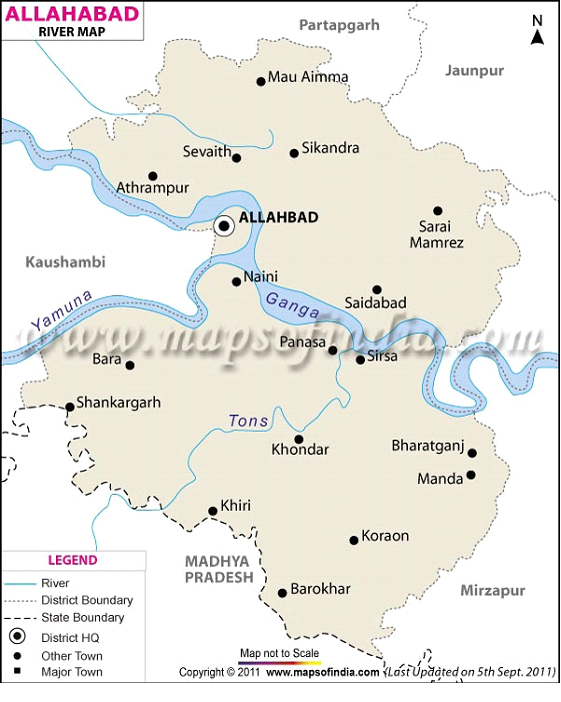
Map 1: Tons river map with Allahabad district now Prayagraj district. The sampling site Sirsa is confluence of Tons river from the Ganga river at Prayagraj, Uttar Pradesh
Result and discussion
A total of 851 (male 410 and female 441) and 935 (male 452 and female 483) fishes of C. carpio and O. niloticus, respectively individuals were examined during the study period in the Tons river at Prayagraj, India. The size composition of C. carpio and O. niloticus fishes was fluctuated between 93 to 728 mm and 74 to 476 mm (total length), respectively.
Size composition and structure of Cyprinus carpio
The maximum total length 728 mm of C. carpio was showed that the ecological condition of the Tones river most suitable for this species. Present fishing pattern is systematic and stock healthy condition with environmentally friendly sourcing of food. Fish exploitation is an eco nomic and livelihood activities governed by social needs and demands. The size composition of C. carpio was var ied from 93 to 728 mm of total length of fishes with greater part between 241 to 290 mm in case of pooled fish sam ples in the lower stretch of the Tons river at Prayagraj, Ut tar Pradesh, India (Figure 1). In case of male and female fishes, size group 251 to 290 mm was also contributed highest proportion with 18.54% and 17.91%, respectively (Figure 1). Minimum exploitation was reported with 0.24% and 0.12% in 691-740 mm size group for male and pooled samples, respectively. While lowest exploitation was re corded for female fishes in 641 to 690 size group mm with 0.91%. The size groups 91-140 mm, 141-190 mm, 191- 240 mm, 291-340 mm and 341-390 mm were contributed in exploited stock with 7.56%, 11.46%, 17.56%, 12.93% and 9.27%, respectively in case of male fishes. In case of female fishes, the size groups 91-140 mm, 141-190 mm, 191-240 mm and 291-340 mm were shared slightly pro portion in fished stock with 6.12%, 10.43%, 17.01% and 12.70%, respectively.
The lower size group (LSG) 93 to 290 mm was contrib uted 55.12%, 51.47% and 53.22% for male, female and pooled fishes, respectively (Figure 2) while middle size group (MSG) 291 to 490 mm shared 34.39%, 36.28% and 35.37%, in case of male, female and pooled samples, Higher size group (HSG) 491 to 740 mm contributed small proportion with 10.48%, 12.24% and 11.40% for male, fe male and pooled stocked, respectively (Figure 2). Overall,lower size group was maximum fished compared to middle and higher size groups from the lower stretch of the Tons river at Prayagraj, India.
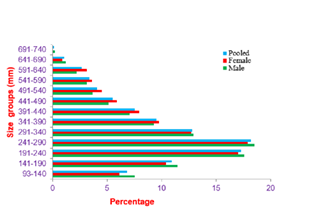
Figure 1: Size composition and structure of Cyprinus carpio from the Tons river, India
The lower size group (LSG) 71 to 230 mm of O. niloticus was shared about 32.73%, 33.11% and 32.92% for male, female and pooled fishes, respectively in the Tons river, India. The middle size group (MSG) 231 to 390 mm contributed 55.16% in male, 58.57% in female and 58.38% in pooled fishes while higher size group (HSG) 391 to 510 mm formed small proportion with 9.05%, 8.27% and 8.65% for male, female and pooled stocked, respectively (Figure 4). Overall, middle size group was maximum fished compared to lower and higher size groups from the lower stretch of the Tons river at Prayagraj, India.
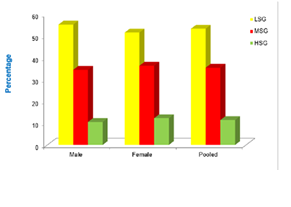
Figure 2: Contribution of different size groups of Cyprinus carpio in Tons river, India
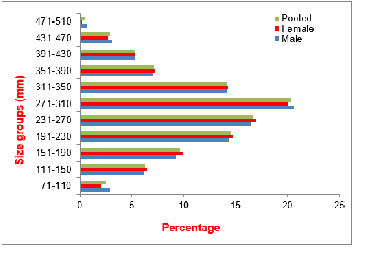
Figure 3: Size composition and structure of Oreochromis niloti cus from the Tons river, India
Size composition and structure of Oreochro mis niloticus
The maximum total length of O. niloticus (476 mm) was indicated that the ecological condition of the Tones river also most suited. Current exploitation pattern is system atic and healthy form. The size composition of O. niloti cus was fluctuated between from 74 to 476 mm of total length in the lower stretch of the Tons river at Prayagraj, Uttar Pradesh, India. The large size of fishes also recorded in the Tons river in respect of river length. The maximum exploitation was noted in 271 to 310 mm size group with 20.57%, 20.08% and 20.32% for male, female and pooled fishes while lowest exploitation was observed with 0.66% in male, 0.20% in female and 0.43% in pooled fishes in 471-510 mm size group (Figure 3).
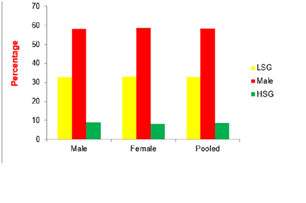
Figure 4: Contribution of different size groups of Oreochromis niloticus in Tons river, India
Size structure of fish varied from place to place and habitat to habitat due to fishing pressure and abundance of stock in freshwater ecosystems. It has been generally estimated that the middle-sized groups are most exploited in riverine or natural water bodies [41, 55-58]. [59] stated that the middle-size group of Labeo calbasu at Allahabad is being exploited more than other size groups. [60] observed that the middle-sized group of Wallago attu was most exploited (58.79%) compared to the small-size group (32.12%) and higher-size group (9.09%) from the Rapti River, In dia. The size compositions of fishes in riverine ecosystem have been declined especially for commercially important fishes.
Age Pyramid of Cyprinus Carpio
During the course of age pyramid study, 935 fish speci mens of C. carpio (452 male and 483 female) were stud ied in lower stretch of the Tons River at Prayagraj, India. The age groups varied from 0+ to 7+. A urn shaped age pyramid was observed in C. carpio for male, female and pooled fishes (Figs 5, 6, 7) The age group 2+ dominated 25.88% in male, 26.09% in female and 25.99% in pooled samples by virtue of numbers. The present studies speci-fied that age class 2+ is more vulnerable to the gear and is dominant in the total catches of C. carpio. Hence, in case of male, the proportion of the 0+ age group (12.61%) was much less than 1+ age group (20.57%) while in case of female, 0+ age group shared 11.76% proportion and 20.96% in 1+ age group (Figure 5). The higher age groups con tributed 5.97% (5+), 3.54% (6+), and 1.11% (7+) in case of male fishes while age groups 5+, 6+ and 7+ shared 6.42%, 3.93% and 0.62%, respectively (Table 1). In pooled samples, the higher age groups contributed 6.20% (5+), 3.74% (6+), and 0.55% (7+). The higher age groups were contributed minute proportion in the total stock in male, female and pooled fishes. The shared distribution of C. carpio fishes was systematic in all age groups and formed healthy stocks in the Tons river, India (Figure 5, 6, 7).
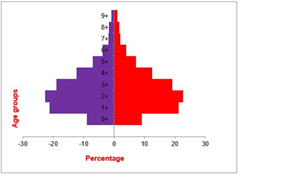
Figure 5: Age pyramid of male Cyprinus carpio in the Tons river,India (Male)
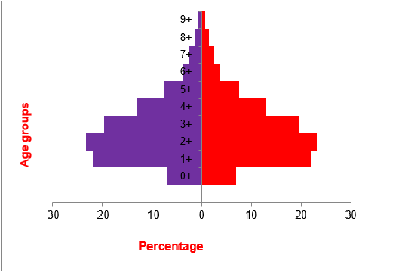
Figure 6: Age pyramid of male Cyprinus carpio in the Tons river, India (Female)
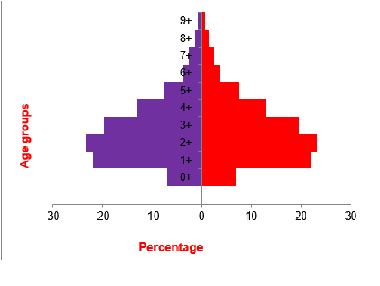
Figure 7: Age pyramid of male Cyprinus carpio in the Tons river, India (Pooled)
| Age groups | No of male | % | No of fe- | % | No of pooled fishes | % |
| male | ||||||
| 0+ | 37 | 9.02 | 31 | 7.03 | 68 | 7.99 |
| 1+ | 87 | 21.22 | 96 | 21.77 | 183 | 21.5 |
| 2+ | 93 | 22.68 | 102 | 23.13 | 195 | 22.91 |
| 3+ | 78 | 19.02 | 86 | 19.5 | 164 | 19.27 |
| 4+ | 51 | 12.44 | 57 | 12.92 | 108 | 12.69 |
| 5+ | 29 | 7.07 | 33 | 7.48 | 62 | 7.28 |
| 6+ | 16 | 3.9 | 16 | 3.63 | 32 | 3.76 |
| 7+ | 8 | 1.95 | 11 | 2.49 | 19 | 2.23 |
| 8+ | 7 | 1.71 | 6 | 1.36 | 13 | 1.53 |
| 9+ | 4 | 0.97 | 3 | 0.68 | 7 | 0.82 |
Table 1: Age composition and contribution of different ages in C. carpio in the Tons river, India
Age pyramid of Oreochromis niloticus During the research work, 851 fish specimens (410 male and 441 female) of O. niloticus were examined for the esti mation of the age pyramid. The age groups of fishes varied from 0+ to 9+. Urn urn-shaped age pyramid was estimated for male, female and pooled fishes (Figure 8-10). The age group 2+ was also dominated by virtue of numbers with 22.68%, 23.13% and 22.91% in case of male, female and pooled fish samples, respectively in the Tons river, India (Figure 8-10). The proportion of the 0+ age group shared in male (9.02%), in female (7.03%) and pooled (7.99%). The 1+ age group contributed slightly lower in case of male, female and pooled samples with 21.22%, 21.77% and 21.50%, respectively. The age groups 1+ and 2+ demonstrated that the small-sized fish dominate the catch of O. niloticus in the stock. The higher age groups contrib uted 2.23% (7+), 1.53% 98+) and 0.82% (9+) in case of pooled fishes (Table 2). The distribution was uneven be tween 0+ to 1+ age groups as the difference was 12.20%, 14.74% and 13.51% in male, female and pooled samples, respectively.
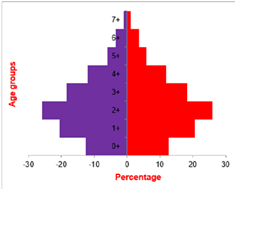
Figure 8: Age pyramid of male Oreochromis niloticus in the Page - 5 Tons river, India (Male)
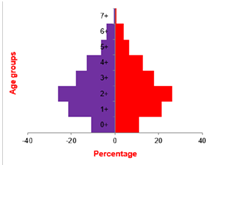
Figure 9: Age pyramid of male Oreochromis niloticus in the Tons river, India (Female)
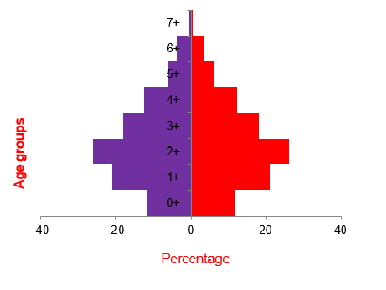
Figure 10: Age pyramid of male Oreochromis niloticus in the Tons river, India (Pooled)
| Age groups | No of male | % | No of fe- | % | No of pooled fishes | % |
| male | ||||||
| 0+ | 57 | 12.61 | 53 | 10.97 | 110 | 11.76 |
| 1+ | 93 | 20.57 | 103 | 21.32 | 196 | 20.96 |
| 2+ | 117 | 25.88 | 126 | 26.09 | 243 | 25.99 |
| 3+ | 83 | 18.36 | 86 | 17.8 | 169 | 18.07 |
| 4+ | 54 | 11.95 | 62 | 12.84 | 116 | 12.41 |
| 5+ | 27 | 5.97 | 31 | 6.42 | 58 | 6.2 |
| 6+ | 16 | 3.54 | 19 | 3.93 | 35 | 3.74 |
| 7+ | 5 | 1.11 | 3 | 0.62 | 8 | 0.55 |
Table 2: Age composition and contribution of different ages in O. niloticus in the Tons river, India
The urn shaped age pyramid was recorded in O. niloticus in the Yamuna river, India while the age group 2+ dominated by virtue of numbers in the species of stock [37]. The urn-shaped age pyramid indicates a low percentage of young individuals in the total stock [54, 60]. The urn-shaped age pyramid was recorded in Cyprinus carpio from the Ganga River at Prayagraj, India [61]. The urn-shaped pyramid indicates a low percentage of young individuals [62]. The rate of fishing is a powerful factor that affects the age composition (for example, age pyramid shape) of the stock [51,63]. Tendency for bell-shaped age pyramid in the Ken River and bell-shaped age pyramid in the Paisuni River and the Tons River were obtained in the case of Tor tor [51]. The age pyramid of C. carpio showed a tendency for urn shape as mature age groups occurred in higher proportion from the Tons river [52].
Sex structure of C. carpio
Sex structure of male and female fishes of C. carpio was estimated observed with 48.18% and 51.82%, respectively in the stock in Tons river, India (Figure 11). The male proportion was recorded maximum with 53.45%, 50.54% and 55.56% in 93-140 mm, 141-190 mm and 641-690 mm size groups, respectively (Figure 12). Although the female amount was recorded highest among in 191-240 mm, 241-290 mm, 291-340 mm, 341-390 mm, 391-440 mm, 441-490 mm, 491-540 mm, 591-640 mm and 591-640 mm size groups with 51.02%, 50.97%, 51.38%, 53.09%, 54.69%, 55.32%, 57.14%, 55.17% and 60.87%, respectively (Figure 12). The female was not reported in 691 to 740 mm size group.
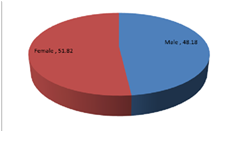
Figure 11: Contribution of male and female of C. carpio in the total stock in the Tons river, India
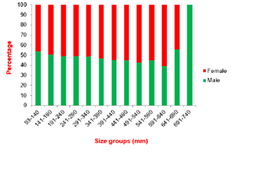
Figure 12: Sex structure of male and female of C. carpio in the Tons river, India
Sex structure of O. niloticus
The male proportion was reported highest with 56.52%, 51.85% and 75.00% in 71-110 mm, 431-470 mm and 471-510 mm size groups, respectively (Figure 13). Although the male proportion was recorded minimum with 45.16% in 381-410 mm size group and highest with 62.50% in 441-470 mm size group of fishes (Figure 13). Sex structure of male and female fishes of O. niloticus was estimated with 48.34% and 51.66%, respectively in the Tons river, India (Figure 14).
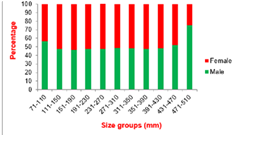
Figure 13: Sex structure of male and female of O. niloticus in the Tons river, India
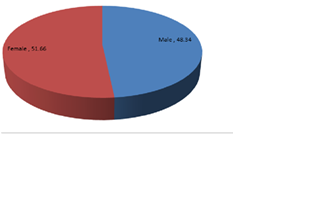
Figure 14: Contribution of male and female of O. niloticus in the total stock in the Tons river, India
The experienced mature female fish stock was healthy in the river in monsoon season but very high fishing pressure we observed in this season. The sex structure is also adaptive to the food supply, which thereby influences the reproductive rate and the variability of the offspring [49, 64]. The sex structure is very important to the reproduction of a population, and consequently there are mechanisms for adjusting this structure to any changes, and especially to changes in food supply, nutrient composition, water quality, concentration of heavy metals and invasion of exotic fish species [66-75]. The sex ratio emerged as a central concept in modern evolutionary ecology. Not only did it provide key links between sexual assortment, population parameters and evolutionary trajectories, but it could also be the center of adaptive allocation strategies where individuals adjusted their relative investment in male and female to match recent and expected fitness [22, 76-77].
It may be concluded that the species, C. carpio and O. niloticus powerfully invaded and generate problem for India major carp (IMC) in the Tons river, India. The maximum size of both species also indicated that the stock is stable condition and ecological condition fully suited to species.