


1Department of Environmental Health, Federal College of Veterinary and Medical Laboratory Technology, NVRI, Vom
2Department of Plant Science and Biotechnology, University of Jos.
Correspondence:Gang Badung Dalyop, Department of Environmental Health, Federal College of Veterinary and Medical Laboratory Technology, NVRI, Vom Email: gangbadung@gmail.com
Received: 17 Nov, 2025; Accepted: 15 Dec, 2025; Published: 22 Dec, 2025.
Citation: Gang BD, Ogbonna AI and Nnebechukwu IA. “Fermentation As A Tool For Enhancing The Sensory Quality Of Indigenous Digitaria Exilis L. (Acha) And Eleusine Coracana (L) Gaertn (Tamba) Flour Meals.” J Nutr Diet Manage (2025):114. DOI: 10.59462/JNDM.3.1.114
Copyright: © 2025 Gang Badung Dalyop. This is an open-access article distributed under the terms of the Creative Commons Attribution License, which permits unrestricted use, distribution, and reproduction in any medium, provided the original author and source are credited.
Digitaria exilis (Acha) and Eleusine coracana (Tamba) consumed by rural communities mainly in the Northern parts of Nigeria are rich sources of nutrients. This study focuses on exploring how meals from different flour blends made from these grains can be more appealing to consumers. The blends consisted of both fermented and non-fermented Digitaria exilis and Eleusine coracana. Ten trained panelists evaluated eight types of food meals made from these achatamba flour blends, which included four blended and four unblended versions. The panel used a 9-point hedonic scale to assess eight sensory attributes: appearance, texture, mouthfeel, taste, smell, flavor, aftertaste, and overall acceptability. The results revealed significant differences (P=0.000) across all blends and parameters. Fermented Acha (FA) had the highest scores for taste (8.67±0.48), aroma (8.60±0.50), and overall acceptability (8.13±0.73). Non-fermented Acha (NFA) and fermented Tamba (FT) received the lowest scores in most parameters. This research demonstrated that fermentation significantly improves the sensory qualities of both Acha and Tamba, particularly in the areas of taste, aroma, and flavor, leading to higher consumer acceptance. This investigation enhances the knowledge of traditional grain processing and contributes to developing functional food options using local grains to improve nutrition and diversify diet choices. It is recommended that consumers should go for fermented grains more than the non-fermented ones.
Fermentation, Sensory Quality, Acha, Tamba, Flour Meals
Cereals are very nutritious and serve as food for both people and animals. Additionally, they are used in various industries to create multiple products, including glucose, adhesives, and alcoholic beverages [1,2]. Acha (Digitaria exilis L.) and Finger Millet (Eleusine coracana L. Gaertn) are important cereal grains that play a significant role in the diets of various communities in Nigeria and throughout West Africa. In a number of rural areas in West Africa, Acha and Finger Millet are enjoyed in different ways, such as in porridges, fermented dishes, and snacks, thanks to their adaptability and simple cooking methods. The importance of these grains for food security has been acknowledged for a long time.
Acha, or “hungry rice,” is a cereal plant that originated in West Africa and is part of the Graminaea family [3]. The two most well-known types are white acha (Digitaria exilis) and brown acha (Digitaria iburua) [3]. In West Africa, women typically cultivate and prepare acha, using it as a special dish for celebrations like weddings and other events [4]. Even though it offers good nutrition and various food uses, acha remains underused [5]. [4] note that acha is important for food security because of its properties that can enhance nutrition. This crop is gluten-free and is usually eaten in its whole form, which makes it a healthy option [6]. [7] argue that acha can greatly support whole grain diets, promote better digestion, improved heart health, and assistance for weight control, diabetes, enhance economic conditions, and improve food security in developing nations while also being rich in essential micronutrients. For example, Acha is valued for being high in essential amino acids, especially methionine and cysteine, which are often lacking in other grains. These amino acids play a crucial role in human health by aiding in protein creation and various metabolic functions. Along with amino acids, Acha also provides a good amount of dietary fibre, iron, along with essential vitamins and minerals.
Likewise, Finger Millet is considered one of the most significant small millets in arid and semi-arid regions. It has a diverse nutritional profile, offering high amounts of protein, fibre, and important micronutrients like calcium, iron, and potassium. These attributes make it nutritionally superior compared to more frequently consumed grains like rice and wheat. Additionally, Finger Millet features a distinct phytochemical makeup, having notable levels of phenolic compounds that provide antioxidant benefits, boosting its role in enhancing health, especially for preventing chronic illnesses and promoting overall wellness. Fermentation leads to alterations in the nutrition of foods. Depending on the kind of microorganism involved and the product being fermented, levels of vitamins and amino acids might go up, go down, or stay the same. Microorganisms provide pleasant tastes, boost the texture, and make foods easier to digest [1]. Fermentation eliminates organisms that cause food to spoil and allows for food preservation [8].
Samples of Acha and finger millet intended for food preparation were sourced from Vom Market, located in the Vwang District, within the Jos South Local Government Area of Plateau State. These samples were authenticated at the National Cereals Research Institute Outstation in Riyom Local Government Area of Plateau State before being transported to the Department of Plant Science and Biotechnology at the University of Jos for the purpose of flour production.
About 2000 g each of acha and finger millet grains was used for this experiment. A weight of 1000 g of each cereal was used for fermentation and the remaining 1000 g of each cereal was retained as the non-fermented portion. The processing and fermentation for both acha and finger millet was conducted through a series of steps: cleaning (sorting)- steeping for 72 hour- drying in an oven at 60 oC for 24 hours- grinding, and finally sieving using a 630 µm mesh size to obtain the flours. Each of the samples-Non Fermented Acha, Fermented Acha, Non Fermented Finger millet, and Fermented Finger millet-was weighed at 500 g and were used for the blended mix.
Four distinct blends were developed apart from the four unblended ones (100%) and blended ones using equal parts (50:50) of fermented and non-fermented acha and finger millet as shown in Table 1. The produced fermented and non-fermented acha and finger millet flour meals are shown in Figures 1-8.
| Samples | NFA% | FA% | NFT% | FT% |
| A | 100 | - | - | - |
| B | - | 100 | - | - |
| C | - | - | 100 | - |
| D | - | - | - | 100 |
| E | 50 | - | 50 | - |
| F | - | 50 | - | 50 |
| G | 50 | 50 | ||
| H | - | - | 50 | 50 |
| NFA = Non fermented Acha, FA=Fermented Acha, NFT=Non fermented Tamba, FA= Fermented Tamba |
||||
Table 1: Unblended and Blended Acha-tamba flours formulation
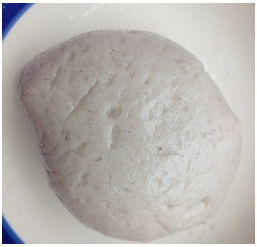
Figure 1: NFA flour meal
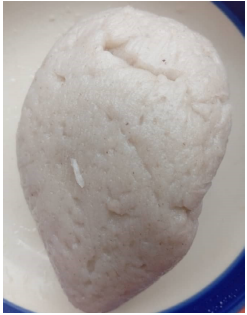
Figure 2:FA flour meal
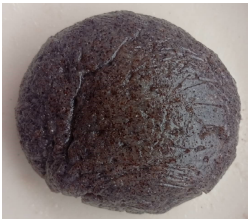
Figure 3: NFT flour meal
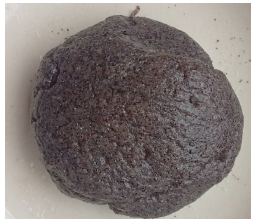
Figure 4: FA flour meal
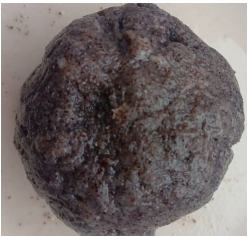
Figure 5: NFA+NFT flour meal
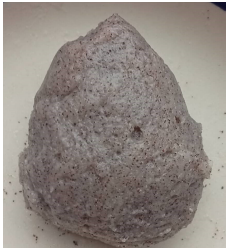
Figure 6: FA+FT flour meal
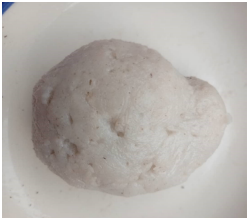
Figure 7: NFA+FA flour meal
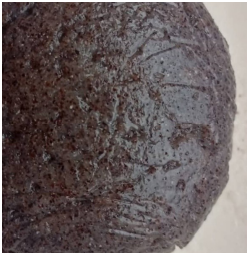
Figure 8:NFT+FT flour meal
The coded flour meals of fermented and non-fermented acha and finger millet were subjected to sensory analysis test within 1 hr of preparation. The sensory evaluation of the samples was done using 10 trained panelists made up of seven staff and 3 students from the Department of Environmental Health Technology, Federal College of Veterinary and Medical Laboratory Technology, Vom, Plateau State for various sensory qualities (appearance, texture, mouth feel, taste, aroma, flavour, after taste and overall acceptability). A 9-point Hedonic scale questionnaire was used where “9” represents extremely like and “1” represents extremely dislike.
All analytical determinations were conducted in triplicates. Data obtained were subjected to analysis of variance (ANOVA) using SPSS 23 version. Means and standard deviations were calculated. Duncan’s Multiple Range Test was used for separation of means where significant differences existed.
The sensory attributes of the eight formulated Acha–Tamba flour foods evaluated by ten panellists are presented in Table 2. There were significant differences (p < 0.05) noted among the samples for every attribute, which included appearance, texture, mouthfeel, taste, smell, flavour, aftertaste, and overall acceptability. The average scores for these items fell between 5.17 ± 2.41 and 8.67 ± 0.48, indicating that the acceptability from the panellists varied considerably across the different recipes.
The appearance of a product greatly influences first impressions and consumer choices. The fermented samples, particularly Fermented Acha (FA), received higher appearance ratings (8.30) which was not significantly different (P < 0.05) from those of NFA+FA (7.70), FT (7.67) and NFA (7.53) among other blends. The least value for appearance (5.57) was recorded for NFA+NFT which was not significantly different (P < 0.05) from that NFT (5.73). The fermentation process involves microbial enzymatic activity that breaks down colour pigments and surface starches, which likely contributes to the improved brightness and uniformity of colour. Results by [9] provided similar findings, showing that fermentation enhanced the visual appeal of cereal-based items through the clearing of pigments and changes brought about by enzymes.
When looking at how hard or soft the product is and its structure during chewing, the high texture rating of FA at 8.07 indicates that fermentation enhanced both cohesiveness and softness of the meal. The process of fermentation helps to improve smoothness and elasticity of the cereal by breaking down tough carbohydrates and causing some gelatinization. [10] observed that the changes in starch and microbial activity enhance the texture of products made from fermented millet and sorghum.
The mouthfeel refers to the sensation food creates when being ingested. The FA meal, scored 8.27±0.69 for mouthfeel thereby achieving the highest rating this suggested that fermentation likely improved both taste and smoothness. During fermentation, microbial action typically reduces the hardness of grains while increasing soluble fibre, which in turn enhances the mouthfeel and creaminess. This finding differs with the findings of [11], who noted that non-fermented controls exhibited greater smoothness and consistency than fermented acha-based products
Taste perception includes a mix of bitter, sour, and sweet flavours. Fermented samples like FA and FT received higher ratings (FA: 8.67 and 8.07) respectively, supporting the view that fermentation enhances flavour through organic acids, amino acids, and flavour precursors. The reduction of anti-nutritional factors such as phytates and tannins also contributed to increased sweetness and decreased bitterness. These findings are in agreement with those of [12,13], which showed that fermentation improves the acceptability of taste in African cereal-based products. A recent study by Unreliability of clustering results in sensory studies and a strategy to address the [14] further supports this, indicating that fermentation transforms carbohydrates into volatile compounds, thereby improving flavor and taste.
The perception of consumers is greatly influenced by smell. Fermented samples presented a more intense and appealing aroma in contrast to non-fermented counterparts. Particularly, FA and FT were notably fragrant, which supports Adeyemi’s claim that this improvement is linked to the production of volatile compounds such as alcohols, esters, and aldehydes during the fermentation process. This was also noted by [15,16].
Taste is a combination of the sensory feelings of smell and flavor. With an 8.37±0.72 rating, FA achieved the highest flavor score, suggesting a good balance of sensory components. [17] observed similar results in their fermented samples, confirming that the activity of microbes enhances both the pleasant smell and flavor complexity in millet and acha mixtures.
Residual taste refers to the lingering flavor experienced after eating. When comparing non-fermented mixes, which often have a bitter or dull taste, the fermented samples-particularly FA- offered a clean and enjoyable aftertaste. This can be attributed to the reduction of bitter phenolics and tannins. As noted by [13], fermentation significantly diminishes these bitter compounds, enhancing the final aftertaste in cereal-based meals.
Overall preference takes into account all sensory factors. FA received the highest rating (8.13±0.73), affirming its superior organoleptic characteristics. In contrast, the non-fermented mixes (NFA+NFT) scored the lowest, highlighting the crucial role of fermentation in enhancing sensory attractiveness. These findings align with more recent research suggesting that fermentation improves the texture, digestibility, and taste of mixed cereal flours used in both baby and adult foods, further supporting earlier studies by [13].
|
Samples |
Mean+SD | |||||||
| Appearance | Texture | Mouth Feel | Taste | Aroma | Flavour | After Taste | Overall Acceptability | |
| NFA | 7.53ab+0.51 | 7.63a+0.62 | 7.77ab+0.68 | 7.77b+0.63 | 7.80b+0.85 | 7.93ab+0.74 | 7.73ab+0.52 | 8.07a+0.91 |
| FA | 8.30a+0.65 | 8.07a+0.94 | 8.27a+0.69 | 8.67a+0.48 | 8.60a+0.50 | 8.37a+0.72 | 8.27a+0.69 | 8.13a+0.73 |
| NFT | 5.73c+2.43 | 5.87b+2.11 | 5.93c+2.45 | 6.73c+2.08 | 7.03c+2.17 | 6.93c+2.24 | 6.70cd+2.42 | 7.03b+2.43 |
| FT | 7.67ab+1.52 | 7.97a+0.89 | 7.80ab+0.99 | 8.07ab+0.83 | 8.07ab+0.94 | 7.37bc+0.93 | 8.03ab+0.89 | 7.93a+0.74 |
| NFA+NFT | 5.57c+2.14 | 5.23b+2.39 | 5.17d+2.41 | 5.77d+2.14 | 5.77d+2.10 | 5.67d+2.19 | 6.10d+2.43 | 6.07c+2.26 |
| FA+FT | 7.40b+0.93 | 7.97a+0.85 | 7.40b+1.00 | 7.60b+1.10 | 7.33bc+1.18 | 7.20bc+1.13 | 7.40bc+0.97 | 7.53ab+0.90 |
| NFA+FA | 7.70ab+0.84 | 7.40a+0.77 | 7.43b+0.97 | 7.73b+1.02 | 7.40bc+0.93 | 7.80ab+1.13 | 7.53ab+0.97 | 7.60ab+1.13 |
| NFT+FT | 7.00b+1.88 | 7.37a+1.03 | 7.73ab+0.64 | 7.73b+0.69 | 7.37bc+0.96 | 7.23bc+1.31 | 7.90ab+0.85 | 7.80ab+0.71 |
| SE | 0.278 | 0.247 | 0.259 | 0.232 | 0.243 | 0.258 | 0.257 | 0.254 |
| p-value | 0 | 0 | 0 | 0 | 0 | 0 | 0 | 0 |
| Values (in the same column) with the same superscript do not differ significantly from each other according to the Duncan multiple range test. WHERE SE = Standard Error; SD = Standard Deviation | ||||||||
Table 2: Sensory Evaluation of Varieties of Acha-Tamba Flour Food
The Table represents the sensory evaluation of eight different blends of Acha and Tamba flour foods, assessed across eight sensory parameters: appearance, texture, mouth feel, Taste, aroma, flavour, aftertaste, and overall acceptability. The findings are based on ratings from ten panellists with results shown as Mean ±Standard Deviation (SD).
In all the sensory evaluations, fermented Acha (FA) emerged as the top choice across all sensory parameters and this illustrates the beneficial effects of fermentation on food quality enhancement. Blends made with fermented flour were found to be more appealing than those with non-fermented options due to their improved softness, appearance, texture, mouth feel, reduced bitternes and better taste, flavour and acceptability. The notable sensory differences between fermented and non-fermented products are reinforced by consistent statistical results (p < 0.05; p = 0.000) across various criteria. In accordance with [11,9], these results promote the inclusion of fermented grains in the preparation of tasty, nutritious, and culturally relevant dishes.