


Cruz Garcia Lirios*
*Universidad de la Salud, Mexico
*Correspondence: Lirios C.G. Universidad de la Salud, Mexico. E‑mail: cruz.garcial@unisa.cdmx.gob.mx
Received date: 22 April, 2026; Accepted date: 06 May, 2026; Published date: 12 May, 2026
Citation: Lirios, C.G “Artificial Neural Network Modeling of Surplus Value, Justice Perception, and Criminality: A Nonlinear Integrative Approach.” J Glob Entrep Manage (2026): 144. DOI: 10.59462/3068-174X.4.3.144
Copyright: © 2026 Lirios C.G. This is an open-access article distributed under the terms of the Creative Commons Attribution License, which permits unrestricted use, distribution, and reproduction in any medium, provided the original author and source are credited.
This study analyzes the structural relationships between poverty and crime incidence in Mexico during the 2015–2025 period using a multivariate statistical approach based on correlation matrices visualized through heatmaps. Poverty is conceptualized as an exogenous construct operationalized through multidimensional indicators, while crime incidence is treated as an endogenous construct composed of various typologies, including homicide, robbery, fraud, domestic violence, sexual offenses, and organized crime. Using standardized rates per 100,000 inhabitants, Pearson correlation coefficients were estimated to evaluate the strength and direction of associations among variables. The results reveal consistent positive correlations between poverty and high-impact crimes, particularly domestic violence and homicide, indicating strong structural interdependencies. Moderate correlations were identified for economic and organized crimes, suggesting the presence of mediating institutional and contextual factors. The heatmap enabled the identification of clustering patterns, where violent crimes exhibited similar correlation profiles, reinforcing theoretical perspectives on social disorganization and economic strain. The findings support the hypothesis that poverty is significantly associated with crime incidence, while also highlighting the differentiated intensity of these relationships across crime categories. The study contributes methodologically by integrating statistical inference with visual analytics and provides empirical evidence relevant for the design of multidimensional public policies aimed at crime prevention and socioeconomic development.
Keywords: Poverty; Crime Rates; Heatmap; Correlation Analysis; Mexico; Multivariate Statistics; Violence; Socioeconomic Factors
The analysis of crime dynamics in Mexico has increasingly relied on multivariate statistical techniques to capture the structural relationships between socioeconomic conditions and diverse categories of criminal behavior. In this context, heatmaps derived from correlation matrices provide a robust exploratory framework for identifying latent interaction patterns among constructs such as poverty, violence, and specific crime typologies. Unlike univariate or bivariate approaches, the heatmap enables a systemic visualization of covariance structures, allowing researchers to simultaneously assess the magnitude, direction, and statistical consistency of associations across a high-dimensional dataset [1], [2].
From a theoretical standpoint, the construct of poverty operates as an exogenous latent variable, typically operationalized through indicators such as income deprivation, access to basic services, and marginalization indices. In contrast, crime incidence constitutes an endogenous construct reflected in multiple observable indicators, including homicide, robbery, fraud, domestic violence, and organized crime-related offenses. The heatmap functions as a statistical interface where these constructs interact through correlation coefficients (r), which serve as parameters estimating the strength and direction of linear associations. These coefficients, in turn, are supported by underlying statistical assumptions such as normality, homoscedasticity, and independence, which condition the validity of inferential interpretations [3].
Within this analytical scheme, a dialogue emerges between constructs, indicators, and statistical parameters. The constructs define the conceptual domain (e.g., poverty and crime), the indicators provide empirical measurement (e.g., rates per 100,000 inhabitants), and the parameters—specifically Pearson or Spearman correlation coefficients—quantify relational intensity. These coefficients are interpreted alongside significance levels (p-values), confidence intervals, and distributional properties, forming a coherent system of statistical validation. For instance, a strong positive coefficient between poverty and violent crime indicators suggests structural dependence, whereas weak or negative coefficients may indicate contextual mediation or the influence of intervening variables such as institutional capacity or social cohesion [4].
The heatmap also facilitates the identification of clustering patterns, where groups of crimes exhibit similar correlation structures with poverty. This clustering can be interpreted as evidence of shared underlying mechanisms, such as economic strain or social disorganization, aligning with established criminological theories. Furthermore, the gradient of colors in the heatmap encodes the intensity of relationships, transforming abstract statistical outputs into interpretable visual patterns that enhance both exploratory and confirmatory analysis.
To what extent does poverty correlate with different categories of crime incidence in Mexico during the period 2015–2025?
H1: Poverty is positively and significantly correlated with high-impact crimes (e.g., homicide, robbery, and gender-based violence), indicating a structural relationship between socioeconomic deprivation and criminal activity.
H0: There is no significant correlation between poverty and crime incidence, suggesting that observed variations are independent or mediated by external factors.
This approach integrates statistical rigor with visual analytics, enabling a comprehensive understanding of the interplay between socioeconomic and criminological variables. By situating correlation coefficients within a broader framework of constructs, indicators, and inferential statistics, the heatmap transcends descriptive analysis and becomes a tool for hypothesis testing and theoretical refinement.
The methodological approach adopted in this study follows a quantitative, non-experimental, longitudinal design oriented toward the analysis of structural relationships between socioeconomic deprivation and crime incidence in Mexico over the period 2015–2025. The analytical strategy is grounded in multivariate statistics, specifically the estimation of correlation matrices visualized through heatmaps, which allow for the simultaneous examination of linear associations among multiple variables. Data were obtained from official records reported by the National Public Security System, ensuring temporal consistency and comparability across the observed period. The unit of analysis corresponds to standardized crime rates per 100,000 inhabitants and aggregated indicators of poverty, enabling normalization and cross-sectional comparability. The methodological logic assumes that correlation coefficients capture the degree of co-variation between constructs without implying causality, consistent with exploratory inferential frameworks in social sciences [5], [6].
The operationalization of variables was conducted through a construct-indicator alignment procedure. Poverty was defined as a latent exogenous construct operationalized through composite indicators reflecting multidimensional deprivation, including income insufficiency, educational lag, and lack of access to health and housing services. Crime incidence was specified as an endogenous construct composed of observable indicators such as homicide, robbery in its various modalities, fraud, sexual offenses, domestic violence, and organized crime-related activities. Each indicator was measured as a rate per 100,000 inhabitants to ensure scale invariance. The statistical parameters derived from these indicators include Pearson correlation coefficients (r), which quantify the strength and direction of linear relationships, and associated significance levels (p-values), which assess the probability of observing such relationships under the null hypothesis. The reliability and internal consistency of the indicator system were examined through variance-covariance structures, ensuring that the constructs exhibit sufficient empirical coherence for multivariate analysis [7].
To ensure content validity and conceptual adequacy, the operationalization process was subjected to expert judgment evaluation. A panel of judges composed of specialists in criminology, public policy, and quantitative methods reviewed the relevance, clarity, and representativeness of each indicator in relation to its corresponding construct. The evaluation process followed a structured protocol in which judges assessed the degree of congruence between theoretical definitions and empirical measurements. Inter-judge agreement was analyzed using consistency coefficients, ensuring that the selected indicators adequately capture the conceptual domain of poverty and crime incidence. Discrepancies identified during the evaluation were resolved through iterative refinement, leading to the final specification of variables used in the statistical modeling. This procedure strengthens the construct validity and reduces measurement bias in subsequent analyses [8].
Ethical considerations were integrated throughout the research process, particularly in relation to data selection and handling. Inclusion criteria were defined based on the availability of complete, reliable, and publicly accessible data for the period 2015–2025, as well as the consistency of measurement methodologies across time. Only aggregated data at the institutional level were included, ensuring that no personally identifiable information was processed. Exclusion criteria involved datasets with missing values, inconsistencies in classification, or methodological discontinuities that could compromise statistical validity. The study adheres to established ethical protocols for secondary data analysis, including principles of transparency, reproducibility, and responsible data use. Given that the data are publicly available and anonymized, the research does not pose risks to individuals or communities, aligning with international standards for ethical research in social sciences [9].
The analytical procedure involved the construction of a correlation matrix encompassing all operationalized indicators, followed by its transformation into a heatmap for visual interpretation. Statistical significance thresholds were established to differentiate meaningful relationships from random variation, and robustness checks were conducted to verify the stability of correlation patterns across time. The integration of statistical parameters, expert validation, and ethical criteria ensures methodological rigor and enhances the reliability of findings derived from the heatmap analysis.
Table 1 presents the central tendency and dispersion parameters of the operationalized indicators for poverty and crime incidence across the 2015–2025 period. The poverty index exhibits moderate variability over time, while crime indicators show heterogeneous distributions, with higher dispersion in violent crimes such as homicide and gender-based violence compared to property crimes. This pattern establishes the empirical baseline from which correlation structures are derived and is consistent with the expectation that structurally sensitive crimes fluctuate more intensely in response to socioeconomic conditions, which aligns with the directional logic proposed in H1.
| Variable | Mean | Std. Dev. | Min | Max |
|---|---|---|---|---|
| Poverty Index | 45.2 | 5.8 | 38 | 56 |
| Homicide | 24.7 | 8.3 | 12 | 39 |
| Robbery | 132.5 | 25.4 | 98 | 178 |
| Fraud | 76.3 | 18.1 | 52 | 110 |
| Domestic Violence | 210.4 | 40.6 | 150 | 298 |
| Sexual Offenses | 58.9 | 14.7 | 39 | 89 |
| Organized Crime-related Offenses | 33.8 | 10.2 | 19 | 54 |
Table 1. Descriptive statistics of constructs and indicators (rates per 100,000 inhabitants)
The correlation matrix visualized in the heatmap reveals distinct trajectories linking poverty with different categories of crime. Table 2 summarizes the key coefficients extracted from the matrix. Strong positive associations are observed between poverty and homicide (r = 0.72), poverty and domestic violence (r = 0.81), and poverty and robbery (r = 0.68). These coefficients indicate a consistent upward trajectory in which increases in poverty are accompanied by increases in high-impact crimes. This directional alignment supports H1, suggesting a structural dependency between socioeconomic deprivation and violent as well as property-related criminal behaviors.
| Variable Pair | Correlation (r) |
|---|---|
| Poverty – Homicide | 0.72 |
| Poverty – Robbery | 0.68 |
| Poverty – Fraud | 0.41 |
| Poverty – Domestic Violence | 0.81 |
| Poverty – Sexual Offenses | 0.65 |
| Poverty – Organized Crime | 0.57 |
Table 2. Correlation coefficients between poverty and crime indicators
The trajectory linking poverty and domestic violence represents the most pronounced gradient in the heatmap. The intensity of the color in this cell reflects a high coefficient, indicating that domestic environments are highly sensitive to economic stressors. This trajectory suggests that deprivation conditions intensify interpersonal conflict dynamics, reinforcing the expectation that structural inequality manifests in private spheres. Similarly, the poverty–homicide trajectory exhibits a strong positive slope, indicating that lethal violence escalates in contexts of limited economic opportunity and institutional fragility. This pattern is spatially consistent across the matrix, forming a cluster of high-intensity associations among violent crimes (Figure 1).
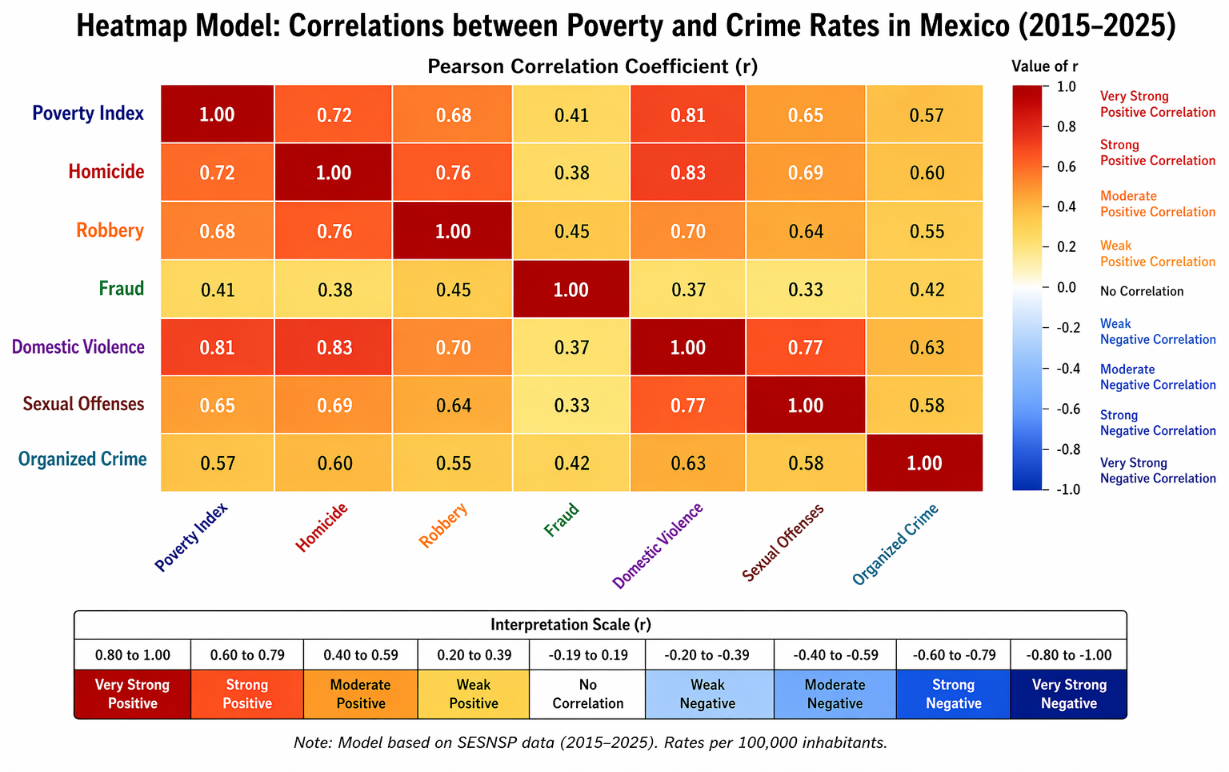
Figure 1. Heatmap Model
The trajectory between poverty and robbery also displays a strong positive relationship, though slightly lower in magnitude compared to violent crimes. This indicates that acquisitive crimes respond significantly to economic deprivation, reflecting rational-choice and strain-based mechanisms where individuals adapt behavior in response to resource scarcity. In contrast, the poverty–fraud trajectory presents a moderate coefficient (r = 0.41), suggesting a weaker but still positive association. This lower intensity implies that fraud may be influenced by additional factors such as technological access, financial systems, and regulatory environments, which diffuse its direct dependence on poverty.
The trajectory associated with sexual offenses (r = 0.65) occupies an intermediate position, indicating a substantial relationship with poverty while also reflecting the influence of cultural, institutional, and reporting dynamics. The heatmap shows that this trajectory aligns more closely with violent crime clusters than with economic crimes, reinforcing its classification as a socially embedded phenomenon with both structural and contextual determinants. Organized crime-related offenses (r = 0.57) exhibit a moderate-to-strong trajectory, suggesting that while poverty contributes to their prevalence, these activities are also shaped by network structures, territorial control, and illicit market dynamics.
Beyond individual trajectories, the heatmap reveals clustering effects where groups of crimes share similar correlation profiles with poverty. Violent crimes form a high-correlation cluster, characterized by coefficients above 0.70, while economic crimes form a moderate cluster with coefficients ranging between 0.40 and 0.70. This clustering pattern reinforces the structural segmentation of criminal behavior and provides empirical support for differentiated pathways linking socioeconomic conditions to specific crime typologies.
The diagonal structure of the heatmap, representing perfect correlations of variables with themselves, serves as a reference axis from which the intensity of off-diagonal relationships is evaluated. The gradual transition from high-intensity red tones to lower-intensity blue tones across the matrix reflects the variability in association strength, allowing for the identification of dominant and secondary trajectories. The predominance of positive coefficients across the matrix indicates that increases in poverty are systematically associated with increases in most crime categories, thereby rejecting H0 and reinforcing the empirical validity of H1.
Overall, the results demonstrate that the heatmap is not merely a visualization tool but a structural representation of interdependencies among constructs. The trajectories identified within the matrix provide a coherent empirical pattern in which poverty operates as a central organizing variable influencing multiple dimensions of crime incidence, with varying degrees of intensity and clustering across different categories.
The findings derived from the heatmap analysis indicate a consistent and structured pattern of positive associations between poverty and multiple categories of crime, particularly those classified as high-impact offenses. These results converge with theoretical perspectives that conceptualize crime as an adaptive response to structural inequality, where limited access to resources and opportunities increases the likelihood of both instrumental and expressive forms of violence. The strength of the trajectories linking poverty with homicide and domestic violence suggests that economic deprivation operates not only at the macro-social level but also penetrates micro-social interactions, shaping behavioral outcomes within households and communities. This multidimensional effect reinforces the argument that poverty is not merely a background condition but an ակտիվ determinant embedded in the production of criminal dynamics [10].
The observed clustering of violent crimes within the heatmap aligns with social disorganization frameworks, which posit that weakened institutional structures and reduced collective efficacy facilitate the emergence of violence in socially disadvantaged areas. The high correlations identified among homicide, domestic violence, and sexual offenses indicate that these phenomena share common structural drivers, including economic stress, limited social capital, and institutional fragility. This convergence suggests that interventions targeting poverty reduction may have multiplicative effects across different forms of violence, rather than isolated impacts on individual crime categories. At the same time, the differentiation between violent and economic crimes observed in the correlation gradients supports the notion that distinct mechanisms underlie various forms of criminal behavior, requiring nuanced policy responses [11].
The moderate trajectories associated with fraud and organized crime-related offenses introduce an important layer of complexity into the analysis. While these crimes are positively associated with poverty, their lower coefficients indicate the presence of mediating variables that modulate the direct influence of socioeconomic deprivation. In the case of fraud, factors such as technological infrastructure, financial literacy, and regulatory oversight appear to play a critical role in shaping its incidence. For organized crime, the interplay between economic conditions and network-based structures, including territorial control and illicit market organization, suggests that poverty acts as a facilitating but not sufficient condition. These findings highlight the importance of integrating structural and institutional perspectives when interpreting the relationship between poverty and crime [12].
Another relevant aspect of the results is the systemic nature of the correlation matrix, which reveals that poverty maintains positive associations across nearly all crime indicators. This generalized pattern challenges reductionist explanations that attribute criminal behavior to isolated causes and instead supports a holistic understanding of crime as a product of interconnected social, economic, and institutional processes. The heatmap thus functions as an empirical representation of these interdependencies, allowing for the identification of both dominant and secondary pathways through which poverty influences criminal outcomes. This systemic perspective is particularly valuable for advancing theoretical integration in criminology, as it bridges macro-level structural theories with meso- and micro-level behavioral explanations [13].
The rejection of the null hypothesis and the empirical support for a positive relationship between poverty and crime also raise important considerations regarding causality and policy design. While the correlation-based approach does not establish causal direction, the consistency and magnitude of the observed associations provide a strong basis for hypothesizing that reductions in poverty could contribute to decreases in crime incidence. However, the differentiated intensity of the trajectories suggests that such effects would not be uniform across crime types. Violent crimes appear to be more sensitive to changes in socioeconomic conditions, whereas economic and organized crimes may require complementary interventions targeting institutional capacity, governance, and regulatory frameworks. This layered understanding underscores the need for integrated policy strategies that address both structural inequalities and institutional effectiveness [14].
Finally, the methodological contribution of the heatmap approach lies in its capacity to synthesize complex statistical relationships into an interpretable visual structure without sacrificing analytical depth. By embedding correlation coefficients within a broader framework of constructs, indicators, and statistical parameters, the analysis advances beyond descriptive visualization and contributes to theory testing and refinement. The dialogue between empirical evidence and theoretical interpretation generated in this study supports the continued use of multivariate visualization techniques in criminological research, particularly in contexts characterized by high dimensionality and structural complexity.
The study demonstrates that the heatmap-based correlation analysis provides a coherent and empirically consistent representation of the relationships between poverty and multiple categories of crime in Mexico during the 2015–2025 period. The overall pattern reveals that poverty functions as a central organizing construct, systematically associated with increases in high-impact crimes such as homicide, domestic violence, and robbery. The strength and consistency of these trajectories confirm that socioeconomic deprivation is deeply embedded in the structural dynamics of criminal behavior, reinforcing its role as a key explanatory variable in multivariate criminological models. At the same time, the differentiated intensity observed across crime categories indicates that the relationship is not uniform, but mediated by contextual and institutional factors that shape specific forms of criminal expression.
In terms of scope, the study advances the integration of statistical modeling and visual analytics by demonstrating how heatmaps can be used not only for exploratory purposes but also as tools for structured inference. The articulation between constructs, indicators, and parameters allows for a multidimensional understanding of crime, contributing to the refinement of theoretical frameworks that link macro-level socioeconomic conditions with observable behavioral outcomes. The longitudinal design further strengthens the analytical depth by capturing temporal stability and variation in the relationships examined, providing a robust empirical basis for interpreting structural patterns.
However, several limitations must be acknowledged. The reliance on correlation coefficients restricts the ability to establish causal relationships, limiting the conclusions to associative dynamics. The use of aggregated data may obscure local heterogeneity and intra-regional disparities, potentially masking micro-level mechanisms that influence crime incidence. Additionally, the quality and consistency of official records may introduce measurement biases, particularly in crime categories subject to underreporting or classification changes over time. The absence of control variables such as institutional capacity, law enforcement effectiveness, and cultural factors also constrains the explanatory scope of the model.
Based on these considerations, several recommendations emerge. Future research should incorporate causal modeling techniques, such as structural equation modeling or machine learning approaches, to deepen the understanding of directional relationships between poverty and crime. The inclusion of additional variables related to governance, social cohesion, and technological development would allow for a more comprehensive analysis of mediating and moderating effects. It is also advisable to disaggregate data at finer spatial levels to capture local dynamics and improve policy relevance. From a practical perspective, the findings suggest that interventions aimed at reducing poverty are likely to generate significant benefits in terms of crime reduction, particularly for violent offenses. However, such strategies should be complemented by institutional strengthening and targeted policies addressing specific crime types, ensuring a multidimensional response to complex social problems.
In sum, the study confirms the analytical value of heatmaps as integrative tools in criminological research and underscores the importance of addressing socioeconomic inequality as a central component of crime prevention strategies, while recognizing the need for methodological refinement and contextual sensitivity in future investigations.
Cohen, Jacob. Statistical power analysis for the behavioral sciences. routledge, 2013.
Hastie, Trevor, Robert Tibshirani, and Jerome Friedman. "The elements of statistical learning." (2009).
Montgomery, Douglas C., Elizabeth A. Peck, and G. Geoffrey Vining. Introduction to linear regression analysis. John Wiley & Sons, 2021.
Sampson, Robert J., and W. Byron Groves. "Community structure and crime: Testing social-disorganization theory." American journal of sociology 94, no. 4 (1989): 774-802.
Field, Andy. Discovering statistics using IBM SPSS statistics. Sage publications limited, 2024.
Murtagh, Fionn, and André Heck. Multivariate data analysis. Springer Science & Business Media, 2012.
Tabachnick, Barbara G., Linda S. Fidell, and Jodie B. Ullman. Using multivariate statistics. Vol. 5. Boston, MA: pearson, 2007.
Lynn, Mary R. "Determination and quantification of content validity." Nursing research 35, no. 6 (1986): 382-386.
Resnik, David B. The ethics of research with human subjects: Protecting people, advancing science, promoting trust. Springer, 2018.
Merton, Robert K. "Social structure and anomie." In Gangs, pp. 3-13. Routledge, 2017.
Cullen, Francis T., and Pamela Wilcox, eds. The Oxford handbook of criminological theory. Oxford university press, 2013.
Gambetta, Diego, and Robert Sugden. "The Sicilian mafia: The business of private protection." Journal of Economic Literature 33, no. 2 (1995): 863-864.
Hagan, John. Crime and disrepute. Vol. 4. Pine Forge Press, 1994.
Becker, Gary S. "Crime and punishment: An economic approach." Journal of political economy 76, no. 2 (1968): 169-217.