


Thomas J. Webster1-3*, Per A. Löthman4,5, and Thiago D. Stocco6
1Division of Pre-College and Undergraduate Studies, Brown University, Providence, RI USA
2School of Biomedical Engineering and Health Sciences, Hebei University of Technology, Tianjin, China
3School of Engineering, Saveetha University, Chennai, India
4European University of Applied Sciences Hamburg (Euro-FH); Hamburg, Germany
5University of Bayreuth, Chair of Additive Processes for Tissue Reconstruction (“Organ Printing”), Bayreuth, Germany
6BioRegenera.Lab, Bioengineering Program, Scientific and Technological Institute, Brasil University, São Paulo, SP, Brazil
*Correspondence: Thomas J. Webster, Division of Pre-College and Undergraduate Studies, Brown University, Providence, RI USA, E-mail: websterthomas02@gmail.com
Copyright: © 2025 Thomas J. Webster. This is an open-access article distributed under the terms of the Creative Commons Attribution License, which permits unrestricted use, distribution, and reproduction in any medium, provided the original author and source are credited.
Citation: Thomas, J. Webster, Löthman A. Per and Stocco D. Thiago “The Role of Financial Technology in Enhancing the Application of Cloud Accounting in Banks”. J Nanotech Nanobiotech (2025): 115. DOI: 10.59462/JNNB.1.1.101
Received date: 15 January, 2025; Accepted date: 29 January, 2025; Published date: 31 January, 2025
On December 3, 2024, a webinar among world leaders representing 4 continents in the field of nanotechnology and nanobiotechnology held the inaugural webinar for the Journal of Nanotechnology and Nanobiotechnology. Below represents a summary of topics covered which includes how nanotechnology has positively impacted tissue engineering (by Prof. Thiago Stocco), results from the implantation of nanomaterials in humans showing tremendous success (by Prof. Thomas J. Webster), and the emerging fied of BioMechatronics (not to be confused with biomechatronics) which will bring us into the next generation of medicine (by Prof. Per A. Löthman). The webinar is available for anyone to watch at the journal’s website at: https://www.scitechjournals.com/journal-of-nanotechnology-and-nanobiotechnology.
Nanotechnology and Tissue Engineering (Prof. Thiago D. Stocco)
Tissue engineering is an interdisciplinary field aimed at creating biological substitutes to repair or replace damaged tissues [1]. It addresses critical challenges such as the global shortage of donor tissues and the limited regenerative capacity of tissues like articular cartilage and ligaments. The success of this field relies on three main pillars: cells, which provide biological activity; scaffolds, which serve as a structural framework for cell attachment, proliferation, and tissue formation; and, in some cases, bioactive factors, such as growth factors, that regulate cellular behavior and tissue development. These components work synergistically to achieve functional tissue regeneration [1,2]. At the core of tissue engineering lies the development of scaffolds, which are indispensable for the success of engineered constructs. Scaffolds provide the necessary environment for cells to adhere, proliferate, and form new tissue [3].
Nanostructured scaffolds have emerged as a transformative solution in tissue engineering due to their ability to closely mimic the natural extracellular matrix (ECM). The ECM is inherently a nanofibrous network, and nanostructured scaffolds replicate this architecture with high fidelity. Compared to conventional scaffolds, nanostructured scaffolds offer a significantly larger surface area, enhancing cell adhesion and interaction. This biomimicry creates a microenvironment conducive to tissue regeneration. Nanofibrous scaffolds, in particular, exhibit several distinct advantages. Their fibrous architecture can be aligned to guide cellular organization, which is essential for tissues such as muscles and tendons. The interconnected porosity of these scaffolds promotes efficient nutrient and waste exchange, supporting cell viability. Additionally, their high surface area enhances cell attachment and proliferation, and their mechanical properties can be tailored to meet the specific demands of the target tissue [4].
Despite these advantages, nanofibrous scaffolds face certain limitations that must be addressed to maximize their potential. One of the primary challenges is their lack of a truly complex three-dimensional (3D) architecture, which is critical for replicating the structural features of some tissues, such as cartilage, bone, meniscus, and intervertebral discs. Furthermore, these scaffolds often exhibit limited integration with vascular networks, a critical aspect for sustaining large tissue constructs. The mechanical properties of nanofibrous scaffolds may also fall short of the requirements for load-bearing tissues, and scaling fabrication processes for larger or more intricate constructs remains challenging [4,5].
To address these limitations, we have been exploring the integration of nanofibrous scaffolds with 3D bioprinting technologies. 3D bioprinting allows for the precise deposition of biomaterials and cells in layered patterns, enabling the creation of highly complex, patient-specific structures with excellent spatial control [6]. By combining the biomimetic architecture of nanofibrous scaffolds with the versatility of 3D bioprinting, it is possible to develop scaffolds that are not only functional but also highly biomimetic. This convergence opens new opportunities for advancing tissue engineering. Recent studies conducted by our group have demonstrated the potential of integrating bioprinted hydrogel layers with nanofiber membranes. In one study, we utilized bioprinted GelMA hydrogel layers intercalated with PLA/Laponite nanocomposite nanofiber membranes [7]. In another, type I collagen hydrogel layers were combined with PCL nanofiber membranes [8]. Both approaches yielded promising results, particularly in terms of scaffold performance, structural integrity, and biomimicry. These findings highlight the potential of this integrated approach to address the limitations of standalone nanofibrous scaffolds.
Future research in this field is increasingly focused on integrating advanced nanostructures into hybrid scaffold systems. For instance, the incorporation of nanofibers directly into hydrogels has emerged as a promising approach to combine the mechanical robustness of nanofibers with the ECM-mimicking properties of hydrogels [9,10]. By optimizing these hybrid systems, it may be possible to develop scaffolds that address the limitations of standalone nanofibrous scaffolds while enhancing their functional performance.
Overall, nanostructured scaffolds represent a cornerstone of new tissue engineering, offering unparalleled potential for creating biomimetic environments that support tissue regeneration. Continued advancements in fabrication techniques, material functionalization, and hybrid systems are poised to push the boundaries of what is achievable in this field, unlocking new possibilities for addressing some of the most pressing challenges in regenerative medicine – which brings us to recent promising results of implanting nanomaterials into humans which will be described next by Prof. Thomas J. Webster’s part of the webinar.
Do you have the energy ? Surface energy that is. (Prof. Thomas J. Webster)
In his part of the webinar, Prof. Thomas J. Webster started by outlining the many problems with our global healthcare system which was highlighted by COVID [11]. Specifically, he discussed that although viruses have plagued human health for centuries, for some reason, we were ill prepared for SARS-CoV-2 with our only healthcare solution telling people to stay at home and do not interact with others. This was a failure of our traditional healthcare system that everyone seems to have forgotten he lamented. He went on to describe how COVID highlighted traditional problems in our healthcare system that existed before COVID and continue to exist today including overcrowded hospitals; barriers even finding healthcare (including but not limited to financial, geographical, and psychological barriers); medical devices that fail including that traditional medicine has not produced any medical device that are 100% successful in the body; an over dependence on drugs to fix everything despite well-known trends of antibiotic resistance bacteria (which is predicted to kill one person every 3 seconds by 2050 [12] – a battle we are clearly loosing through our conventional antibiotic techniques), chemotherapeutic resistance cancer cells, and the opioid epidemic; treating every patient the same which contradicts well known facts in medicine such as differences in immune system differences based on sex, race, age, and more;a medical system which reacts to your problems rather than predicts your problems; increasing costs, increasing global population; and most depressingly, a declining average global life expectancy which existed in some parts of the world even before COVID [13,14].
However, with such disappointment in our traditional healthcare system, as Prof. Webster describes, there is promise. Promise in nanotechnology. He described while nanotechnology may seem like a mystery to some, it has already proven in humans the ability to eliminate implant failure [15]. Among many example, he described his start-up company formed in 2005 from his anodized nanotexturing technology (Nanovis [16]) has over 30,000 nanotextured pedicle screws currently inserted into the spines of humans with no failures according to the FDA MAUDE database; traditional orthopedic implants have been reported to fail up to 60%, especially in cancer patients.
But most importantly, Prof. Webster reported that he knows why [17-24]. When many researchers in the healthcare field simply report clinical results, he highlighted that his research group has found the underlying cause for zero implant failures in nanotextured implants: surface energy (Figure 1) [17-24]. Surface energy is a term that few even know or even think about. A term that seems so simple, yet has proven to be so important for eliminating implant failures. And nanotechnology, or nanotextured surfaces, can be used to change surface energy [17-24]. Prof. Webster described his early research back in the 1990s which showed that nanotextured implants can be designed to be either hydrophilic or hydrophobic [24]. He then proved through what is now called the “Webster equation” that such changes in surface energy can promote or inhibit proteins to either promote or repel cellular functions important for reducing infection, limiting inflammation, and growing healthy tissues [23]. The Webster equation can also be used to predict the size of nanotextured features that can eliminate implant infection and this has been proven in humans [23]. Nanotextured implants have also improved vascular stents, cardiovascular patches, bladder biomaterials, reverse stroke, and cell encapsulation devices used to treating diabetes to just name a few clinical applications as he described [17-24].
However, he ended his presentation with a thought-provoking vision that in the future, we have to stop implanting static medical devices. Our bodies are dynamic and so should our medical devices. Thus, he proposed an implantable nanosensor used in conjuction with hip implants where such sensors can determine and quantify the type of cell (such as bacteria, inflammatory cell, or bone-forming cells) that attaches to the surface, and through an AI generated algorithm, it can control such cell presence through predictions of implant success or failure [25]. As he stated, only until we create and implant nanosensors in the body will we finally be able to see an increase in life expectancy – which brings up to BioMechatronics (not to be confused with Biomechatronics) which will be described next by Prof. Per A. Löthman.
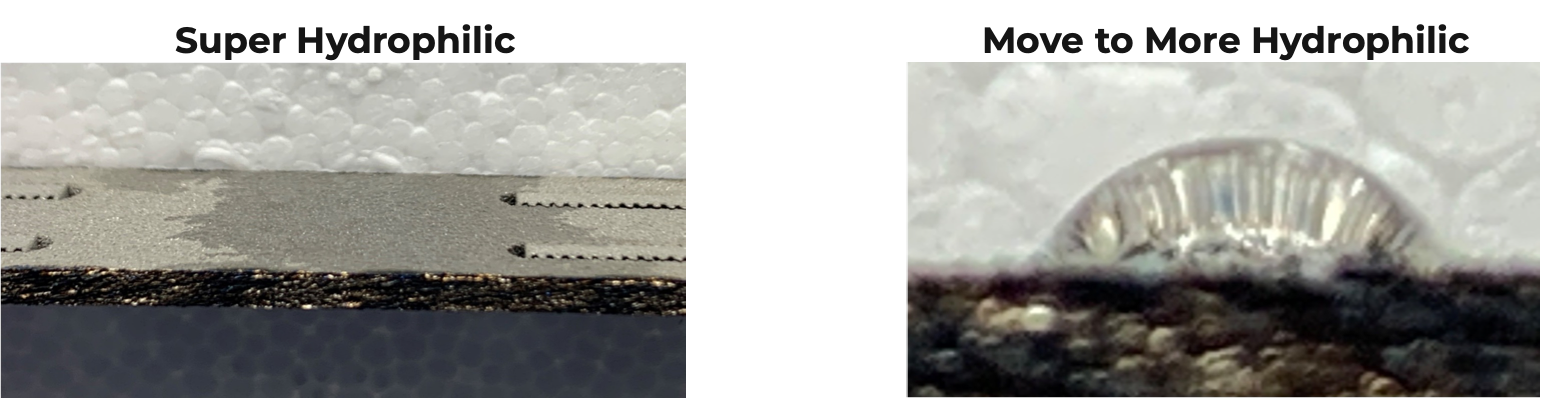
Figure 1. Nanotexture control of surface energy. Surface energy is demonstrated here through water contact angles where one type of nanotexture on the left increases surface energy (super hydrophilic) and a different type of nanotexture on the right (move to more hydrophilic) decreases surface energy on the same implants chemistry.Through the control of surface energy using nanotextures, Prof. Webster has shown that one can eliminate implant failures in humans [17-24].
BioMechatronics – a novel perspective in Nanobiotechnology (Prof. Per A. Löthman)
The term biomechatronics, originally also written as bio-mechatronics, describes an interdisciplinary and multidisciplinary research and development area that combines biological and mechatronic systems in the broadest sense, although in most cases the biological/medical part plays a subordinate role. As we will see later, by definition, mechatronics and engineering are the focus and the goal, and not interdisciplinarity per se. Biomechatronics was introduced with the establishment of mechatronics and the brand "mechatronics" in 1982. Hugh Herr at the Massachusetts Institute of Technology (M.I.T.), Cambridge, USA, successfully introduced the term biomechatronics as a supplement to the term biomimetics for research and development of mechatronic technologies. Hugh Herr has also successfully represented the term biomechatronics internationally for well over 30 years, mainly through patents [26-41].
At the time of the rise of mechatronics, the term biomechatronics in the broadest sense referred to the interaction between mechatronics (and not the entire engineering sciences) and the life sciences. For Hugh Herr, the importance of mechatronics for medicine was crucial (or rather: the importance of medicine for mechatronics), thus initially narrowing the term down to nothing more than a subfield of biomedical engineering, and this is how it is still understood today [42–45]. However, Hugh Herr based his work in medicine on biomimetics (or bionics) - systematic transfer of knowledge inspired by the processes, materials and phenomena in nature, into innovative technical products and processes. At least a quarter of his publications deal directly with biomimetics, which is unfortunately largely ignored. Biomechatronics uses biomimetics, for example in the context of human-machine interaction, and has increasingly been restricted to biomimetics.
In contrast to biomimetics, biomechatronics is mainly rooted in engineering and is not actually an interdisciplinary research area. Nevertheless, Hugh Herr can be considered the person who established biomechatronics as a term, but did not define it precisely or apply it consistently [46]. Since then, numerous authors have tried to formulate a precise definition. Unfortunately, the majority of them failed to some extent, either because they artificially restricted the term to a very specialized subfield that is typically closely related to their own research topic or subject, or because they unfortunately did not fully recognize a subtle ambiguity in the degree of unification of biological and synthetic systems, here in particular mechatronic systems.
One definition of biomechatronics is [47]:"Biomechatronics is the development and improvement of mechatronic products and processes using biological and medical knowledge".This definition reflects what was already mentioned above, that at the beginning of biomechatronics it was almost identical to biomimetics and that biomechatronics lacks interdisciplinarity. It remains an engineering science.
Biomechatronics focuses on technologies for human prostheses and supports, particularly "robots" or "exoskeletons" that are either attached to or wrapped around the human body, as well as on technologies for rehabilitation. It is a more directly “human-centered” mechatronics and, as described above, refers to “macroscopic” products, inventions and research areas such as prostheses, orthotic or exoskeleton devices (“devices”), crutches, intelligent wheelchairs, prostheses with variable mechanical impedance, artificial ankle-foot systems, series elastic actuator components for active ankle-foot orthosis, powered ankle-foot prostheses, biomimetic joint actuators, adaptive prosthetic knee, biomimetic transfemoral prosthesis, transdermal optogenetic peripheral nerve stimulation or protetic limbs, wheelchairs and other mobility aids, robotic elbow sleeves, soft robotic gloves, rotational orthoses, upper and lower limb prostheses, motorized orthoses or hip braces, waist support, lumbar support, motorized knee, ankle, shoulder, Elbow, wrist, hand and finger splints, robotic gloves, exoskeletons, exomusculatures, exosuits, to name just a few of the many examples that mainly come from Hugh Herr's patents. It becomes clear that motion simulation, motion modeling and biomechanics play an important role in classical biomechatronics, and thereby underlines the classification of biomechatronics as an important subfield of biomedical engineering.
Classic biomechatronics still plays an important role in research and development today and has resulted in several products, particularly in the rehabilitation sector. Thanks to biomechatronics, the quality of life of many people with disabilities has increased considerably and the development of biomechatronics continues to be of crucial importance for the corresponding development areas.
But there are also increasingly modern approaches and development trends in mechatronics where biomechatronics is being re-thought. The definition of the "system" or "mechatronic basic structure" is being reconsidered in the light of the new orientation and a new type of integrative interdisciplinarity is emerging. "BioMechatronics" is a redefinition, reorganization and reorientation of mechatronics that is less "macroscopic" and "external" than classic biomechatronics. It is an independent, new field. BioMechatronics is essentially scale-independent, includes both the micro and nanoscale, but often starts from the macroscopic level, and thus the molecular and cellular level, with applications in biotechnology and medicine frequently occurring, with biological-medical systems themselves being classified as BioMechatronic systems. Closely related or adjacent disciplines here are nanotechnology, microsystems engineering, microtechnology, nanomedicine, bionanotechnology, biofabrication and biophysics, molecular biology, cell biology, bioelectronics, organ on chip, neuroscience, micro- and nanorobotics and much more. The spelling "BioMechatronics" (capital "B" and capital "M") underlines the modern orientation and interpretation of mechatronics in the biological-medical environment. The capitalization of the initial letters underlines the importance of both disciplines and avoids the relative dominance of mechatronics in the original definition of biomechatronics in which the biological component plays a maximum role in improving already existing mechatronic products. BioMechatronics is considered to have significant potential [47, 48].
A crucial difference to biomechatronics is that living systems themselves are also considered biomechatronic systems and that biology cannot be limited to improving already existing mechatronic products as described in the definition above.
The role of BioMechatronics is inclusive and especially the focus includes regulatory, sensing, actuating, mechanics and electronics expand the classical nanotechnology into a more comprehensive systems approach.
The webinar and topics above highlight the unprecedented impact nanotechnology has had specifically in health, and what the future holds for BioMechatronics. For such researchers who remember when nanotechnology was just being defined, or when pundits claimed that nanotechnology is just hype and will never amount to anything useful, this webinar represents a key milestone to stop for a moment and appreciate the countless researchers from around the world who have turned this simple idea of assembling materials one atom at a time into advances helping to cure cancer, eliminate infection, and improve tissue growth. It is no wonder why Richard Feyman claimed over 60 years ago “There is plenty of room at the bottom”, which still holds true today. A field that has proven its worth with a future just as bright.
Khademhosseini, A., and R. Langer. "A Decade of Progress in Tissue Engineering." Nat. Protoc. (2016): 1775–1781.
Paternoster, J.L, and J.J. Vranckx. "State of the Art of Clinical Applications of Tissue Engineering in 2021." Tissue Eng. Part B Rev. (2022): 592–612.
Francis, A.P, A.R. Augustus, S. Chandramohan and S.A. Bhat et al. "A Review on Biomaterials-Based Scaffold: An Emerging Tool for Bone Tissue Engineering." Mater. Today Commun. (2023): 105124.
Stocco, T.D, N.J. Bassous, S. Zhao and A.E.C. Granato et al. "Nanofibrous Scaffolds for Biomedical Applications." Nanoscale (2018): 12228–12255.
Suamte, L, and P.J. Babu. "Electrospun-Based Functional Scaffolds for Biomedical Engineering: A Review." Nano TransMed (2024): 100055.
Deo, K.A, K.A. Singh, C.W. Peak and D.L. Alge, et al. "Bioprinting 101: Design, Fabrication, and Evaluation of Cell-Laden 3D Bioprinted Scaffolds." Tissue Eng. Part A (2020): 318–338.
de C.S. e Silva, M, G.F. de Sousa, M. das Virgens Santana and W.G. Tsumura, et al. "Tailoring Mechanical Properties of Printed GelMA Scaffolds with Multilayers of PLA/Laponite Nanocomposite Fibers." Mater. Lett. (2024): 136314.
Stocco, T.D, M.C. Moreira Silva, M.A.F. Corat and G. Gonçalves Lima, et al. "Towards Bioinspired Meniscus-Regenerative Scaffolds: Engineering a Novel 3D Bioprinted Patient-Specific Construct Reinforced by Biomimetically Aligned Nanofibers." Int. J. Nanomedicine (2022): 1111–1124.
Zhang, Z, Q. Li, M. Hatakeyama and T. Kitaoka. "Injectable Cell-Laden Hydrogels Fabricated with Cellulose and Chitosan Nanofibers for Bioprinted Liver Tissues." Biomed. Mater. (2023): 045018.
Ko, Y.G, and O.H. Kwon. "Reinforced Gelatin-Methacrylate Hydrogels Containing Poly(Lactic-Co-Glycolic Acid) Nanofiber Fragments for 3D Bioprinting." J. Ind. Eng. Chem. (2022): 147–155.
Webster, T. "How Entrepreneurship and Industry Saved COVID Fighting Nanotechnology?" Open Access Government (2023): 142–143.
Webster, T. “The Broken Healthcare System & Can Nano Medicine, Virtual Healthcare Correct It?” The Ones Changing the World, (2025).
Antibiotic Prescribing and Use. https://www.cdc.gov/antibiotic-use/antibiotic-resistance.html, accessed 7 Jan 2025.
Life Expectancy in the U.S. Dropped for the Second Year in a Row in 2021. accessed 06 June 2024.
Jones III, A.A.D, G. Mi, and T.J. Webster. "A Status Report on FDA Approval of Medical Devices Containing Nanostructured Materials." Trends in Biotechnology (2019): 117–120.
Nanovis Technology. "Nanovis Celebrates 20,000 Technology Devices Implanted in Patients."
Seil, J.T, and T.J. Webster. "Antimicrobial Applications of Nanotechnology: Methods and Literature." Int. J. Nanomedicine (2012): 2767–2781.
Webster, T.J, C. Ergun, R.H. Doremus and R.W. Siegel, et al. "Specific Proteins Mediate Enhanced Osteoblast Adhesion on Nanophase Ceramics." J. Biomed. Mater. Res. Part A (2000): 475–483.
Li, B, and T.J. Webster. "Bacteria Antibiotic Resistance: New Challenges and Opportunities for Implant-Associated Orthopedic Infections." J. Orthopaedic Res. (2018): 22–32.
Puckett, S.D, E. Taylor, T. Raimondo and T.J. Webster. "The Relationship Between the Nanostructure of Titanium Surfaces and Bacterial Attachment." Biomaterials (2010): 706–713.
Webster, T.J, L.S. Schadler, R.W. Siegel and R. Bizios. "Mechanisms of Enhanced Osteoblast Adhesion on Nanophase Alumina Involve Vitronectin." Tissue Engineering (2001): 291–301.
Miller, D.C, A. Thapa, K.M. Haberstroh and T.J. Webster. "Endothelial and Vascular Smooth Muscle Cell Function on Poly(Lactic-Co-Glycolic Acid) with Nano-Structured Surface Features." Biomaterials (2004): 53–61.
Khang, D, S.Y. Kim, P. Liu-Snyder and G.T.R. Palmore, et al. "Enhanced Fibronectin Adsorption on Carbon Nanotube/Poly (Carbonate) Urethane: Independent Role of Surface Nano-Roughness and Associated Surface Energy." Biomaterials (2007): 4756–4768.
Webster, T.J, R.W. Siegel and R. Bizios. "Design and Evaluation of Nanophase Alumina for Orthopaedic/Dental Applications." Nanostructured Materials (1999): 983–986.
Sirivisoot, S, C. Yao, X. Xiao and B.W. Sheldon, et al. "Greater Osteoblast Functions on Multiwalled Carbon Nanotubes Grown from Anodized Nanotubular Titanium for Orthopedic Applications." Nanotechnology (2007): 365102.
Herr, H.M. "Crutch with Elbow and Shank Springs." U.S. Patent 19940257285, (1994).
Herr, H. "Variable-Mechanical-Impedance Artificial Legs." U.S. Patent 20030613499, (2003).
Herr, H. "Exoskeletons and Orthoses: Classification, Design Challenges and Future Directions." J. Neuroeng. Rehabil. (2009): 21.
Herr, H. "Welcome to the Bionic Dawn." NEW Sci. (2015): 24–25.
Herr, H.M. "Mechanisms and Methods for a Mechanical Interface Between a Wearable Device and a Human Body Segment." WO Patent 2015US47442, (2015).
Herr, H.M, S.K. Au, P. Dilworth and D.J. Paluska. "Artificial Ankle-Foot System with Spring, Variable-Damping, and Series-Elastic Actuator Components." U.S. Patent 20060495140, filed July 29, 2006.
Herr, H, J. Blaya and G.A. Pratt. "Active Ankle Foot Orthosis." U.S. Patent 20030671329, (2003).
Herr, Hugh M., Matthew Eli Carney, Emily Ann Rogers, and Lucy Wei Du. "Neural efferent and afferent control of spring equilibrium, damping, and power in backdrivable and non-backdrivable series-elastic actuators comprising variable series stiffness mechanisms." U.S. Patent 11,278,235, issued March 22, 2022.
Au, Samuel K., and Hugh M. Herr. "Powered ankle-foot prosthesis." IEEE Robotics & Automation Magazine 15, no. 3 (2008): 52-59.
Herr, H.M, J.A. Weber and R.J. Casler. "Biomimetic Joint Actuators." WO Patent 2012US28774, filed March 12, 2012.
Herr, H.M, A. Wilkenfeld and O. Bleck. "Speed-Adaptive and Patient-Adaptive Prosthetic Knee." U.S. Patent 20010823931, (2001).
Herr, H.M, C. Williams, C.E. Barnhart and Z. Han, et al. "Biomimetic Transfemoral Prosthesis." WO Patent 2012US63395, (2012).
Herr, H and S. Yeon. "Electromyography Sensor." WO Patent 2020US54904, filed October 9, 2020.
Herr, H.M, J.A. Weber and R. Casler. "Transdermal Optogenetic Peripheral Nerve Stimulation." U.S. Patent 20090552028, (2009).
Herr, H.M, Z. Han, C.E. Barnhart and R. Casler. "Prosthetic, Orthetic or Exoskeleton Device." WO Patent 2013US45356, (2013).
Brody, H. "10 Emerging Technologies." Technol. Rev. (2005): 33–46.
Garza-Ulloa, J. "Chapter 1—Introduction to Biomechatronics/Biomedical Engineering." In Applied Biomechatronics Using Mathematical Models, 1–51.
Liu, P.X, and J. Gu. "Introduction: Advances of Biorobotics and Biomechatronics." Int. J. Robot. Autom. (2007): 100.
Brooker, G.M. "Introduction to Biomechatronics." In Introduction to Biomechatronics, edited by G.M. Brooker, (2012):1–8.
Witte, H. "The Interplay of Biomimetics and Biomechatronics." Biomimetics (2022): 96.
Witte, H, M. Fremerey, S. Weyrich and S. Mampel, et al. "Biomechatronics is Not Just Biomimetics." In RoMoCo ‘13: Workshop Proceedings, (2013):74–79.
Löthman, P.A. "The ‘Bio’ of Bio(m)Mechatronics, Let’s Put the ‘Bio’ into Mechatronics!" Inaugural Webinar of the Journal Nanotechnology and Nanobiotechnology, (2024).
Löthman, P.A. "BioMechatronics – A Manifesto." 2025 TechConnect World Innovation Conference and Expo, Austin, Texas, (2025).