


Farouk Kamal Eldin, MD*
Assistant Professor of Anaesthesia, Faculty of medicine, Ain shams university Cairo, Egypt.
*Correspondence: Farouk Kamal Eldin, Assistant Professor of Anaesthesia, Faculty of medicine, Ain shams university Cairo, Egypt. Email: dr.faroukkamal@ med.asu.edu.eg Received: 05 March 2024; Accepted: 10 April 2024; Published: 12 April 2024 Copyright: © 2024 Kamal Farouk. This is an open-access article distributed under the terms of the Creative Commons Attribution License, which permits unrestricted use, distribution, and reproduction in any medium, provided the original author and source are credited.
Received: 05 March 2024; Accepted: 10 April 2024; Published: 12 April 2024
Citation: Kamal Farouk. “Narrating Myocardial Protection: A Comprehensive Review of Cardioplegia Strategies” Cardiovascul Dis Ther (2024): 103. DOI: 10.59462/CVDT.1.1.103
Copyright: © 2024 Kamal Farouk. This is an open-access article distributed under the terms of the Creative Commons Attribution License, which permits unrestricted use, distribution, and reproduction in any medium, provided the original author and source are credited.
This article comprehensively reviews cardioplegia strategies and their efficacy in protecting the myocardium during cardiac surgery. The article discusses the history of cardioplegia, including the development of various techniques and the drawbacks of hyperkalemic solutions. The article also describes the pathophysiology of myocardial ischemia during aortic cross-clamp placement and how it can lead to myocardial injury and cell necrosis. The use of hypothermia and cardioplegia is explored as potential myocardial protection strategies. The article concludes that although myocardial injury can occur during cardiopulmonary bypass, the incidence of frank myocardial infarction is relatively low. The article emphasises the importance of myocardial protection strategies to minimise the risk of myocardial damage during cardiac surgery. However, be aware that each cardioplegic solution has wide variations in the composition and protocols. I tried to narrate the composition with references and some modifications for each.
SAPHO syndrome • Myocardial infarction • Cardiac involvement
The SAPHO syndrome accompanied by myocardial infarction, provides a reference for clinical diagnosis.
SAPHO (synovitis, acne, pustulosis, hyperostosis, and osteitis) syndrome is a rare chronic inflammatory disease involving bone, joints, and skin. It shares some characteristics with other diseases such as spinal arthritis [1], which causes manifestations of involvement other than joints, including some problems of kidneys, and intestinal tract, but occasionally rare cases of heart involvement. Herein, we present a case of a male patient with SAPHO syndrome complicated by myocardial infarction (MI).
This case report details the clinical presentation of a 41-year-old male with a three-year history of hypertension and SAPHO syndrome (Synovitis, Acne, Pustulosis, Hyperostosis, and Osteitis). In 2019, the patient presented with chest wall pain and palmoplantar pustulosis (Figure 1A and 1B). Whole-body bone scintigraphy via technetium 99m-methyl diphosphonate (99mTc-MDP) revealed increased radionuclide uptake in the bilateral first thoracic and costal joints (Figure 1C). Following nonsteroidal medication, the patient experienced pain relief. In June 2023, the patient developed chest pain after alcohol consumption, lasting for two hours with relief upon positional change, accompanied by profuse sweating, nausea, and vomiting.
Diagnostic assessments included electrocardiographic findings of ST-segment elevation in the inferior leads. Cardiopulmonary function evaluations indicated elevated levels of creatine kinase-MB, troponin I, and myoglobin, leading to a diagnosis of acute inferior myocardial infarction. Additionally, the patient exhibited persistently high levels of sensitive C-reactive protein (3.74 mg/l) and an erythrocyte sedimentation rate (ESR) of 21 mm/h on multiple occasions. Coronary angiography and angioplasty were performed, followed by adalimumab treatment, resulting in myocardial infarction resolution and pain relief. Coronary angiography revealed a stenosis of the left coronary artery (Figure 1D), which became normal after the placement of the coronary stent (Figure 1E, F). Followed by adalimumab treatment, myocardial infarction resolution, and pain relief.
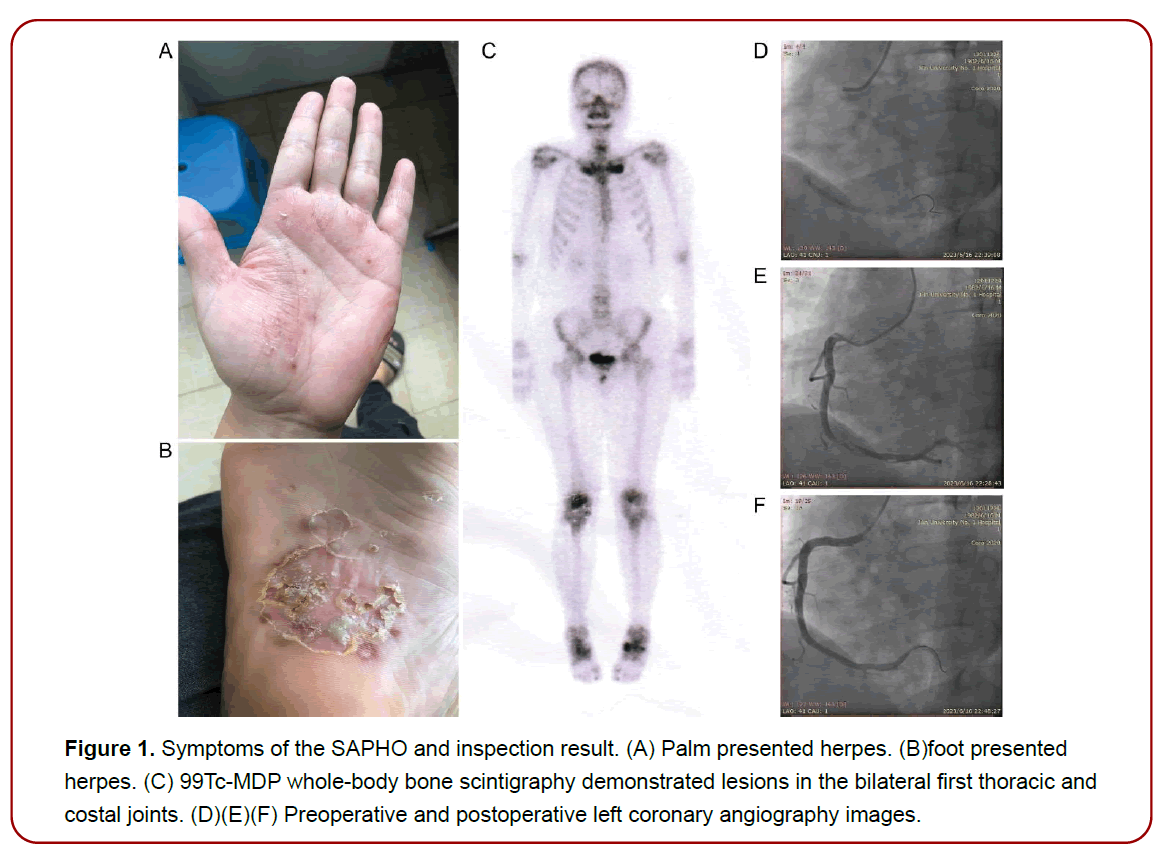
Figure 1. Symptoms of the SAPHO and inspection result. (A) Palm presented herpes. (B)foot presented herpes. (C) 99Tc-MDP whole-body bone scintigraphy demonstrated lesions in the bilateral first thoracic and costal joints. (D)(E)(F) Preoperative and postoperative left coronary angiography images.
SAPHO syndrome is characterized as a chronic inflammatory ailment, to our knowledge. We believe that the patient’s MI may be affected by SAPHO syndrome associated with ankylosing spondylitis and psoriasis. Studies suggest that compared with the normal, patients with ankylosing spondylitis and psoriasis have a higher risk of angiocardiopathy [2,3]. SAPHO syndrome may conduct PSTPIP2 inflammasome [4] which induces the immune system defect and can increase the level of inflammatory factors such as IL-8, IL-18, and TNF- α [5], leading to an increase in the risk of cardiovascular diseases. However, SAPHO syndrome may increase cardiovascular risk is not appreciated, and there are few case reports of cardiac involvement, except for one case of heart failure. More importantly, the inflammation triggered after MI may increase the risk of the SAPHO syndrome, causing severe pain, whereas the SAPHO may increase the risk of cardiac involvement.
The pathogenesis of SAPHO syndrome remains unclear, and some habits may have an impact on the disease. Presently, smoking and alcohol consumption may lead to the deterioration of SAPHO syndrome, and cause the recurrence of the rash [6]. Moreover, we find that myocardial infarction is also influenced by smoking and alcohol consumption [7]. In conclusion, we consider that when a patient presents SAPHO syndrome, habits like smoking and alcohol consumption which increase the likelihood of MI should be avoided, and biological agents play an important role in preventing from occurring cardiovascular diseases.
All authors have made a substantial contribution to the conception and design, or the acquisition of data, or the analysis and interpretation of data, as well as to the drafting or critical revision of the manuscript, and accept public responsibility for portions of the content.
This work was supported by the Zhejiang Provincial Key Laboratory of Traditional Chinese Medicine Cultivation for Arthritis Diagnosis and Treatment (grant number: C-2023-W2083).
The authors declare they have no conflicts of interest.
The datasets analyzed for this study are available from the corresponding author Dr. Chen Li (casio1981@163.com) upon reasonable request.
All the patients have signed the written informed consent.