


David Bloch*
*The SALT ARCHIVE is an independent research unit at 19 ADGordon Telaviv 6340727 Israel.
*Correspondence: David Bloch, Male, The SALT ARCHIVE is an independent research unit at 19 ADGordon Telaviv 6340727 Israel. E-mail: commonsalt@outlook.com
Received: 13 Oct, 2025; Accepted: 24 Oct, 2025; Published: 05 Nov, 2025.
Citation: David Bloch. “The Toxicity of Monopoly: From Common Salt, Oil and Gas, and Now Earth Materials.” J Environ Toxicol Res (2025):118. DOI:doi.org/10.59462/3068-3505.2.2.118
Copyright: © 2025 David Bloch. This is an open-ac cess article distributed under the terms of the Cre ative Commons Attribution License, which permits unrestricted use, distribution, and reproduction in any medium, provided the original author and source are credited.
Abstract
From the earliest Neolithic salt-harvesting communities to today’s global mineral cartels, humanity’s dependence on finite resources has repeatedly fostered monopolistic control, economic distortion, and social inequity. This paper traces the historical continuum of resource monopolies-beginning with common salt, once essential for human survival and state revenue; through oil and gas, the strategic engines of industrial and geopolitical dominance; and into the emerging age of earth materials, where critical minerals and rare elements underpin renewable technologies and digital economies. Each phase reveals a recurring pathology: the concentration of resource ownership transforms necessity into leverage, reshaping societies, wars, and world orders. By examining the “toxicity” of monopoly-not only in economic terms but also in environmental and ethical dimensions-this study argues that the extraction and control of essential materials generate systemic fragility analogous to biological toxicity: accumulation leads to dysfunction. The paper proposes that unless transparency, circularity, and decentralised stewardship replace extractive monopolism, the new mineral age risks replicating the same cycle of dependency and coercion that defined the salt and petroleum eras. Ultimately, The Toxicity of Monopoly reframes resource history as a metabolic narrative where the pursuit of control over the elements sustaining life becomes both fuel and its recurring poison.
Keywords
Monopoly- Resources- Eustatic Sea Level-Salt -War -Rare Earth -Qanat Power
Introduction
From early Neolithic salt pans to modern mineral syndi cates, humanity’s metabolism has revolved around the monopolisation of necessity. This working paper traces a long continuum from common salt as the first controlled commodity, through oil and gas extracted beneath salt giants, to the rare-earth brines now sustaining the digi tal-green economy. Each epoch repeats a structural pa thology: control of a vital material becomes toxic to both ecology and equity.
Common Salt is a necessity of human and animal life, and many people are addicted to using more of it than they need. Its sources solar evaporation and a very small number of quarries, are surprisingly limited, a fact that has shaped history in many curious respects [1-3].
Common Salt And The Rise Of Mother Mo nopoly
Long before coins, contracts, or kings, salt was the first measurable necessity that humans learned to monopolise. Its value did not derive from rarity but from control over access. During the late Pleistocene-Holocene transition, as post glacial eustatic sea levels rose and fell by more than 100 meters, new coastlines first exposed or later sub merged the saline Sabkha coastal flats upon which early communities depended [4,5]. The rhythmic flooding and evaporation cycles of these marginal seas particularly the Mediterranean with its minimal tide, became nature’s primitive refinery - depositing crystalline salt where evaporation exceeded inflow [4]. These fluctuations and their impact on salt-pan operability are illustrated in [Figure 1]. When sea levels fell during glacial maxima, coastal flats exposed desiccated flats into salt pans and lagoons serv ing early mankind with his most scarce commodity. As they rose again, these same Sabbkha basins were inundated, their salt crusts redissolved or were buried as giants be neath marine sediments [5]. In such oscillations, salt mi grated between visibility and concealment - between the commons and the controlled.
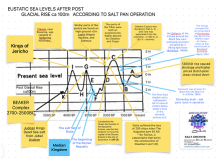
Figure 1: Eustatic sea levels after the post-glacial rise (~100 m) and their relationship to salt pan operation and human civilization development.
Hunters and gatherers migrating inland followed ani mals to salt licks and a more efficient herding technique followed. Göbekli Tepe, standing on an upland ridge of southern Anatolia, likely experienced these fluctuations indirectly [6-8]. Archaeological speculation suggests that the so-called “abattoir layer” - thick with animal bones and burnt residues - was a thriving center of civilizations first abattoir industry dependant upon osmotic dehydrating common salt for preserving meat and tanning behemoth skins. The site perhaps fell to disuse because salt became scarce as a stronger monopoly took over. Manipulation of inland endorheic saline soils and evaporative concentration of brines using Qanat leaching could have changed hands, necessitating both ritual closure and physical burial [1,4,6,9]. Thus, early Neolithic peoples may have been not only hunters and masons but managers of salt metabolism - the first technology of agriculture to irrigate and grow crystals of salt in Sabkha fields by Qanat-Karez harvesting as depicted in [Figure 2].
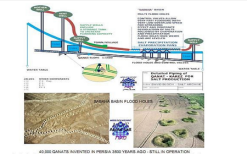
Figure 2: Ancient QANAT design to supply watershed streams to Sabkha endorheic basins [Salt Archive]
Salt monopoly was therefore born of hydrology: whoever commanded the field pans, wells, or sabkhas commanded life itself. The earliest Asian empires taxed salt precisely because it could not be substituted. Its control prefigured every later regime [7].
Oil and Gas: The Rebirth of the Salt Giant
The second phase of monopoly emerged when the buried salts of deep time metamorphosed into geological scaf folds for energy. Energy from wood, peat, then coal, and finally oil/gas was needed to break the salt monopoly and make it cheaply available to all. Beneath the recent dis coveries, the great salt giants-halite domes formed from evaporitic seas during the Mesozoic-lay the thermal ba sins in which hydrocarbons accumulated. These domes acted as impermeable traps, folding upward under tecton ic pressure and capturing the migrating organic fluids that became petroleum and gas [Figure 3] [5]. A tea-pot effect continually renews the organic accumulation in the gravi tating saturated brines on the sea beds bringing doubt to the finite fossil argument.
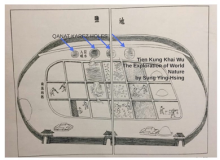 Figure 3: Halite dome structure illustrating salt traps for oil and gas, with Qanat Karez holes shown.
The parallel is almost moral. Ancient salt, once the medium of preservation, became the membrane that sealed car bon for future exploitation. When modern drilling pierced these domes, humanity inverted the Neolithic order: rath er than harvesting salt to preserve life, we released oil to consume it.
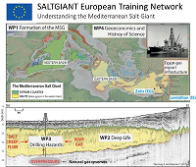 Figure 4: Overview of the Mediterranean Salt Giant basins and related drilling hazards and energy infrastructure.
Monopoly again followed geology. Regions endowed with vast pre-salt or post-salt formations-Texas, the Persian Gulf, Siberia, Brazil-became centres of economic gravity. The control of subterranean energy reproduced the same social alchemy once applied to salt: necessity rendered strategic; abundance made scarce through ownership. The salt giant became the literal and figurative guardian of civilisation’s energy metabolism; its toxicity measured not in sodium but in carbon (Figure 4,5)
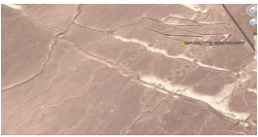
Figure 5: Google Maps airphoto showing QANAT lines and salt deposits from ancient water management systems.
Earth Materials: Endorheic Extraction and the Return of Brine
In the twenty-first century, the logic of monopoly migrates once more-this time into the desert interiors of closed orendorheic basins where the minerals of the renewable age are dissolved [10,11]. Lithium, boron, and rare-earth elements now leach from brines rather than wells, their recovery dependent on controlled evaporation not unlike the ancient saltworks [4].
Many of these basins-Chile’s Salar de Atacama, China’s Qaidam, Iran’s Dasht-e Kavir-exist at the termini of ancient qanat and karez irrigation systems. These underground channels, first engineered in the early first millennium BCE, transported groundwater from mountain aquifers to arid plains, maintaining a delicate balance between recharge and discharge [9]. Today, similar hydraulics serve the extraction of rare-earth brines: artificial qanats pump from deep aquifers to solar ponds where evaporation con centrates the desired ions. The resemblance is not merely technical-it is civilisational. Once again, a fluid essential to life is being fractionated for commerce, and once again,the hydrological commons becomes a monopoly [4,6]. These endorheic operations mirror the early Neolithic salt pans yet amplify their ecological cost. The removal of brine upsets groundwater gradients, leading to salinization, hab itat loss, and social displacement. The “green transition,” if pursued through extractive concentration, risks repeating the metabolic imbalance that toppled earlier empires of salt and oil and now gas.
Conclusion: The Lesson For The World Econ omy
Across ten millennia, monopoly and power behave as a geological process as much as an economic one-layer upon layer of extraction, compression, and entrapment. From Göbekli Tepe’s nearby endorheic basins buried salts to the domed giants of petroleum and the lithium lagoons of the Atacama, civilization oscillates between the visibility of the commons and the concealment of control. Each epoch believes it has transcended the last; yet every essential element becomes, in time, the next toxic inheri tance. The challenge ahead is not to abolish resource de pendence but to democratise its metabolism-to design an open system where salt, energy, and now earth materials circulate without coercion. Two presently managed wars, about price controls of Gaza off-shore gas and Ukraine’s Carparthagan gas are serious blemishes to the world economy. Only then may the history of monopoly end with out poisoning its future clouds. Normal vapors are those molecules that originated from a living cell, from a plant leaf.
References