


Rakesh M. Patel1*, Dr. Ms. Pragna A. Vadher2, Dr. Gunamani B. Deheri3
1Department of Mathematics, Government Science College, Gandhinagar, India
2Principal, Government Science College, Idar, India
3Asso. Prof. (Retd.), Department of Mathematics, S. P. University, V. V. Nagar, India
*Correspondence: Rakesh M. Patel, Department of Mathematics, Government Science College, Gandhinagar, India, E-mail: rmpatel2711@gmail.com
Received date: 19 Mar, 2026; Accepted date: 13 April, 2026; Published date: 22 April, 2026
Citation: Rakesh M Patel, Dr. Pragna A V, and Dr. Gunamani B D et al. “Tribological Assessment of Porous Kozeny–Carman Short Bearings Under Viscosity Variation and Elastic Roughness Deformation.” J. Nanotechnol. Nanobiotechno (2026): 103. DOI: 10.59462/3071-1983.2.1.103
Copyright: © 2026 Rakesh M Patel. This is an open-access article distributed under the terms of the Creative Commons Attribution License, which permits unrestricted use, distribution, and reproduction in any medium, provided the original author and source are credited
This study presents a comprehensive analysis of a porous, rough, elastic short bearing operating under ferrohydrodynamic lubrication with viscosity variation. Rosensweig’s viscosity formulation is incorporated to represent magnetoviscous effects, while the Neuringer–Rosensweig model governs magnetic fluid flow in a porous medium. A stochastic averaged modified Reynolds equation is developed to capture the combined influences of porosity, deformable surface roughness, viscosity variation, and elastic deformation. Numerical solutions are obtained using a finite-difference approach to evaluate the pressure profile and corresponding load carrying capacity (LCC). The results reveal that elastic deformation, porosity, and positively skewed roughness significantly reduce LCC, whereas transverse and negatively skewed roughness textures enhance performance. Viscosity variation and magnetization can partially counteract performance losses when deformation is small and the bearing aspect ratio is optimally chosen. The study highlights the complex interplay between microstructural porosity, surface topology, and magnetoviscous effects, offering design insights for optimizing advanced ferrofluid-lubricated bearing systems.
Keywords: Ferrohydrodynamic lubrication (FHD), Rosensweig magnetoviscosity (RMV), Porous short bearing (PSB), Deformable roughness (DR), Load carrying capacity (LCC), Kozeny–Carman model (KCM), Elastic deformation (ED), Stochastic roughness modeling (SRM), Modified Reynolds’ equation (MRE)
Subject Classification:
(Aligned with MSC 2020 standards): 74A55 — Theories of friction (tribology), 74M15 — Contact problems including roughness, adhesion, and surface effects, 76Dxx — Incompressible viscous fluids, 76Z05 — Applications of fluid mechanics to physics (including magnetic fluids), 00A71 — Theory of mathematical modeling, 00A72 — Simulation and computational methods.
Nomenclature
Geometrical Parameters
|
Symbol |
Description |
|
x, z |
Coordinate directions along the bearing length and width |
|
L |
Length of the bearing in the x-direction |
|
B |
Breadth/width of the bearing in the z-direction (B ≪ L) |
|
h |
Film thickness between bearing surfaces |
|
hˉ |
Mean film thickness |
|
hs |
Random roughness height component (Christensen & Tonder model) |
|
δ |
Elastic deformation of the porous facing |
|
u |
Sliding velocity of the upper bearing surface |
Porous Structure Parameters
|
Symbol |
Description |
|
kp |
Permeability of porous matrix (Kozeny–Carman / Irmay models) |
|
ϕ |
Porosity of the porous layer |
|
β |
Kozeny–Carman empirical constant |
|
σ |
Standard deviation of roughness height distribution |
|
S |
Skewness parameter (positive/negative roughness) |
Fluid and Ferrofluid Properties
|
Symbol |
Description |
|
ρ |
Density of ferrofluid |
|
μ |
Dynamic viscosity of ferrofluid |
|
μ0 |
Magnetic permeability of free space |
|
η |
Effective viscosity (Rosensweig’s modified model) |
|
η0 |
Base viscosity of carrier liquid |
|
C1, C2 |
Rosensweig viscosity variation constants |
|
Symbol |
Description |
|
χ |
Magnetic susceptibility |
|
q |
Fluid velocity vector in the film region |
Magnetic Field Parameters
|
Symbol |
Description |
|
B |
Magnetic field intensity |
|
k |
Dimensionless constant controlling magnetic field strength |
|
M |
Magnetization of ferrofluid |
|
θ |
Magnetic field inclination angle (oblique field) |
Lubrication & Governing Equation Parameters
|
Symbol |
Description |
|
p |
Film pressure |
|
∂p/∂x |
Pressure gradient in x-direction (neglected for short bearing) |
|
(⋅)ˉ |
Stochastic average (Christensen–Tonder theory) |
|
Eq. (2) |
Generalized stochastic averaged modified Reynolds equation |
|
ϵ |
Roughness parameter, ratio of roughness amplitude to mean film thickness |
Dimensionless Quantities
|
Symbol |
Description |
|
xˉ = x/L |
Dimensionless axial coordinate |
|
zˉ = z/B |
Dimensionless transverse coordinate |
|
hˉ = h/h0 |
Dimensionless film thickness |
|
pˉ = p/p0 |
Dimensionless pressure |
|
Λ |
Elasticity parameter |
|
Ψ |
Permeability or porosity parameter |
|
α |
Viscosity variation parameter |
|
βm |
Magnetization parameter |
Short Bearing Approximation
|
Symbol |
Description |
|
∂p/∂x ≈ 0 |
Axial pressure gradient neglected (Prajapati, 1995) |
|
p = p(z) |
Pressure varies only across the width in short bearing theory |
Bearings constitute the backbone of numerous engineering systems—ranging from industrial machinery and automotive components to aerospace mechanisms and power generation equipment—by supporting rotating shafts and enabling smooth, controlled motion. Their operational reliability, efficiency, and load-handling capacity directly influence the performance and longevity of mechanical systems. Consequently, enhancing bearing performance through advanced lubrication techniques, material innovations, and refined modeling approaches has remained a critical area of tribological research for decades. A significant advancement in lubrication science has been the incorporation of magnetic fluids (ferrofluids), whose rheological and flow properties can be dynamically modulated through externally applied magnetic fields [1]. Classical studies by [2-4] established the fundamental physics of ferrohydrodynamics, describing how magnetic polarization and magnetoviscous effects influence lubrication films under varying field intensities. Recent investigations continue to demonstrate the advantages of ferrofluid lubrication in enhancing load-carrying capacity, suppressing instabilities, and reducing frictional losses in both slider and journal bearings [5-9]. The ability of ferrofluids to respond instantaneously to magnetic stimuli makes them particularly suitable for high-performance and adaptive bearing systems. In parallel, porous bearings have gained considerable attention due to their ability to regulate lubricant supply, filter contaminants, and maintain stable pressure distribution. Early works by [10,11] revealed that porous media significantly influence hydrodynamic and magnetohydrodynamic lubrication characteristics by modifying the flow resistance within the bearing clearance. Subsequent studies demonstrated that porous structures not only enhance lubrication under varying operating conditions but also help mitigate adverse effects of surface irregularities, wear debris, and cavitation [12-16]. These findings established porous-material-based bearings as robust and self-regulating lubrication devices suitable for next-generation tribological applications. Another essential factor influencing bearing performance is the viscosity variation of lubricants, especially magnetic fluids. Viscosity is highly sensitive to temperature gradients, shear rates, and magnetic field strength, making its accurate modeling vital for predicting film thickness and pressure generation [17]. Foundational works by [18,19] highlighted the significant role of temperature-dependent viscosity variation in hydrodynamic behavior. Later research has further explored magnetic-field-induced viscosity variation using Rosensweig’s model, emphasizing the control it offers over lubrication characteristics in both long and short bearing configurations [20-24]. These investigations underline the potential of magnetoviscous effects to enhance load-carrying capacity, damping, and operational stability under diverse loading and environmental conditions. Additionally, elastic deformation of bearing surfaces is an unavoidable phenomenon under operational loads. Such deformation alters the hydrodynamic pressure distribution, modifies the lubrication film profile, and significantly affects the overall load-carrying capacity and stiffness of the bearing. Early analysis by [25] showed that deformation must be carefully incorporated into lubrication models to avoid misleading predictions of bearing performance. More recent studies, including those by [26], have demonstrated that when deformation interacts with surface roughness, viscosity variation, and magnetic effects, the resultant tribological behavior becomes highly nonlinear and sensitive to material and operating parameters. This underscores the importance of advanced coupled modeling approaches that integrate roughness, elasticity, and fluid–structure interactions. Given the above developments, the present work seeks to undertake a Kozeny–Carman-based comparative analysis of a magnetic-fluid-lubricated grounded short bearing that incorporates viscosity variation, porous medium effects, and deformable roughness. The Kozeny–Carman formulation is particularly suitable for characterizing porous flow resistance and enables a rigorous study of how porosity interacts with magnetoviscous effects and elastic deformation to determine the bearing’s performance [27,28]. By combining stochastic roughness modelling [29-31], Rosensweig-type viscosity variation, and elastic deformation effects, the proposed analysis aims to provide deeper insights into the complex multiphysics governing modern ferrofluid-based short bearings. The findings of this study are expected to contribute significantly to the optimized design of adaptive, high-efficiency bearings for advanced mechanical systems.
Mathematical Analysis:
Figure (A) to (C) determines the slider bearing surfaces of short bearing travels with uniform velocity u in x – direction with the inclusion of different porous structures. L and B are length and breadth of the short bearing in z direction with B << L respectively. Following the discussion [32], the effect of ∂p/∂x is neglecting.
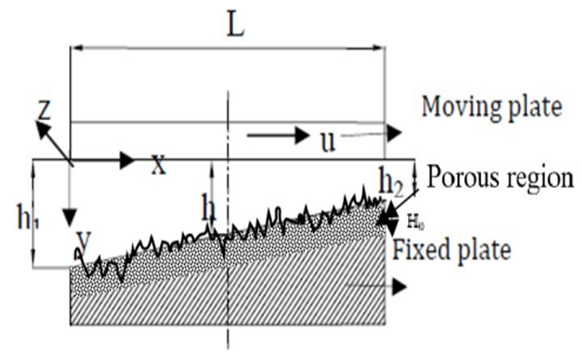
Figure 1: Geometry of bearing system
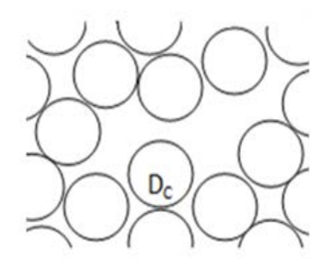
Figure 2: Kozeny-Carman’s model of porous sheets
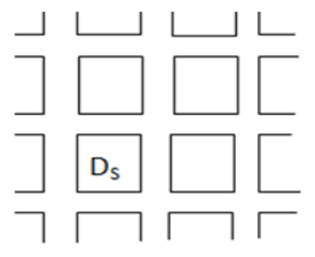
Figure 3: Irmay’s model of porous sheets
In veiw of [33], magnetic field remains oblique to the starter. As mentioned in [15,34] the magnitude of the magnetic field is taken as

where k is a suitably chosen constant from dimensionless point of view [13], so as to manufacture a magnetic field with desired strength. Under the usual assumptions of hydrodynamic lubrication with the laminar flow [26], the following model of [34] for the film thickness has been considered as
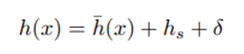
where h¯ is the mean film thickness, δ being local deformation of the porous facing and hs, the part due to surface roughness measured from the mean level h + δ, is hypothetical to be stochastic in nature and governed by the theory of [29,30,31]. A model was developed for the simple steady flow of ferrofluid by [15,23] in the presence of a slowly changing external magnetic field and proposed following equation:
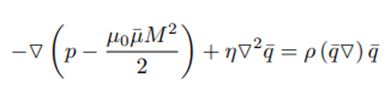
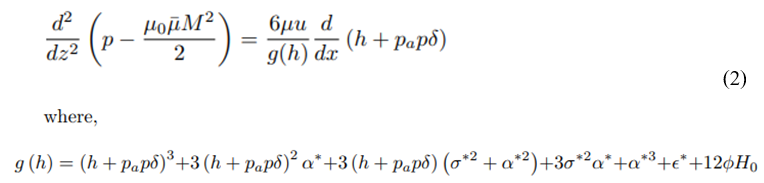
where ρ, q, µ0, µ, η¯ and p represent the fluid density, the fluid velocity in the film region, magnetic susceptibility of the magnetic field, free space permeability, viscosity of fluid and the film pressure respectively. Under hydro-magnetic lubrication theory, stochastically averaging and adopting the properties of magnetic fluid lubrication [13,34,35], the generalized Reynolds equation is comes out as
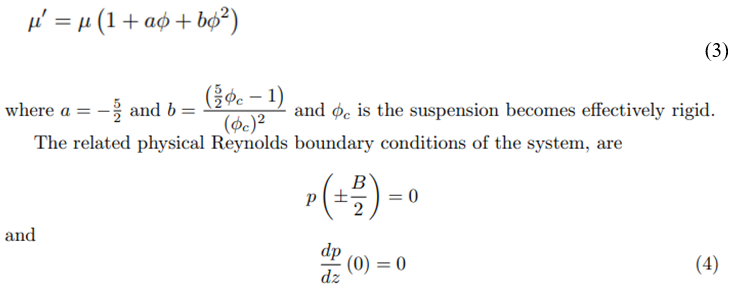
As per the information available in the literature, it is possible for the viscosity of the lubricant to vary within the lubricant film [17]. Moreover, the viscosity near the bearing surfaces could differ due to the interactions of additives and surfactants with these surfaces. [3] made modifications to Einstein’s viscosity equation, specifically introducing a quadratic correlation that accurately describes higher concentrations. In such cases, it is possible to consider a two-constant expression, precisely to as:
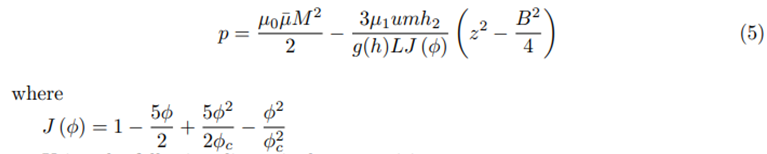
Solving equation (2) under boundary conditions (4), one can obtain the expres sion for dimensional pressure distribution with variation in viscosity suggested by [3],
Using the following dimensionless quantities,
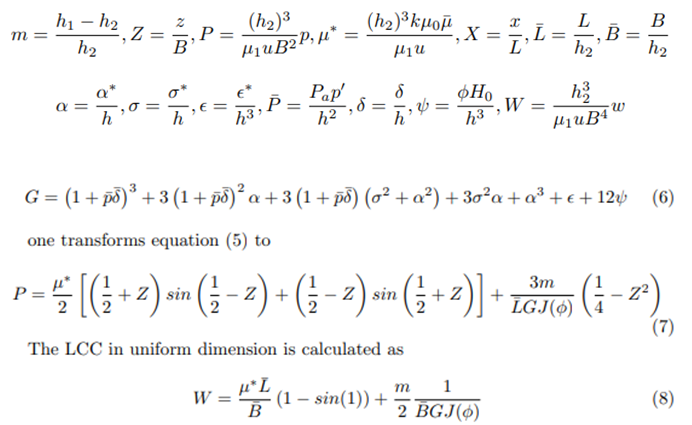
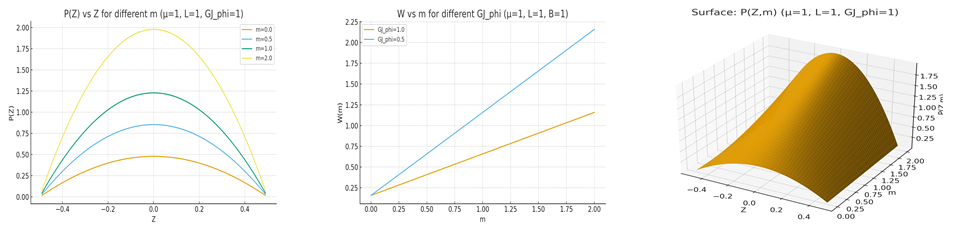
The present study analyzes the performance of a magnetic fluid-based porous rough short bearing system by incorporating Rosensweig’s viscosity variation, elastic deformation, porosity, and surface roughness effects. The pressure distribution derived from Equation (7) and the non-dimensional load-carrying capacity (LCC) from Equation (8) clearly establish that magnetization enhances the bearing performance significantly. This advantage surpasses the outcomes reported by earlier studies involving conventional lubricants and constant-viscosity models. Graphical results confirm that magnetization exhibits a positive correlation with key design parameters such as viscosity variation, porosity, aspect ratio, and elastic deformation. The enhancement in LCC can be attributed to the increased viscosity of the magnetic fluid under magnetization [5]. While viscosity variation and aspect ratio improve the LCC, increases in deformation and porosity reduce it. Importantly, magnetization and viscosity variation jointly compensate for the adverse effects of porosity and deformation, particularly under negatively skewed roughness and lower deformation levels. The comparative assessment with prior works, including those by [22,26], validates the significant contribution of this study toward improving the efficiency and robustness of short bearing systems. The findings reinforce the importance of adopting magnetic fluids with variable viscosity for high-performance bearing applications.
Based on the findings and limitations identified, several directions for future research emerge:
Influence of Operating Conditions:
Future studies may incorporate varying temperature fields, dynamic loading, and external magnetic field strengths to better assess real-world performance and thermal–magnetic coupling effects.
Optimization of Porous Media and Magnetic Fluids
Further investigation is needed to optimize:
Pore structure and permeability of the porous matrix,
Magnetic particle concentration,
Viscosity–magnetization dependency functions, to maximize bearing efficiency.
Advanced Roughness and Deformation Models
The current model can be extended by including:
Three-dimensional roughness distributions,
Nonlinear or viscoelastic deformation behavior,
Anisotropic surface properties, to capture complex tribological interactions more accurately.
Stability and Dynamic Response Analysis
Analyzing the dynamic stability, vibration characteristics, and transient behavior of magnetic fluid-lubricated short bearings will enhance their applicability in high-speed rotating machinery.
Experimental Validation
Constructing prototype short bearings and conducting experiments under controlled magnetic fields would strengthen the practical relevance of the theoretical predictions.
Integration with Smart and Adaptive Systems
Future designs may use:
Active magnetic control,
Sensor-integrated porous bearings,
Adaptive viscosity magnetic fluids, to create intelligent bearing systems capable of self-adjustment under variable operational demands.
Funding: This research did not receive any specific grant from funding agencies in the public, commercial, or not-for-profit sectors.
Author Contributions: Contributed the conception, analysis, writing, and revision of this manuscript.
Conflict of Interest: The author declares no known competing financial interests or personal relationships that could have influenced the work reported in this paper.
Data Availability Statement: The data utilized in this study were obtained from publicly available online sources and appropriately cited where applicable.
Institutional Review Board Statement: Not applicable.
Informed Consent Statement: Not applicable.
Ethics Statement: This research did not involve any human participants, animal testing, or ethical concerns.
Disclosure of AI Use: Artificial intelligence (AI) tools (e.g., ChatGPT) were used to a limited extent, solely for language refinement, technical editing, and formatting assistance. The intellectual content and interpretations remain entirely those of the authors.
Berkovsky, B. M., Vitaliĭ Fedorovich Medvedev, and Mikhail Samuilovich Krakov. "Magnetic fluids: engineering applications." (1993): 243-243.
Tipei, Nicolae. "Theory of lubrication with ferrofluids: application to short bearings." (1982): 510-515.
Rosensweig, R. E. "1985Ferrohydrodynamics."
Wu, C. W., & Bogy, D. B. (1993). Elastohydrodynamic lubrication of textured surfaces. ASME Journal of Tribology, 115(4), 735–742.
Patel, R. M., G. M. Deheri, and Pragna A. Vadher. "Performance of a magnetic fluid-based short bearing." Acta Polytechnica Hungarica 7, no. 3 (2010): 63-78.
Shah, R. C., and R. Bhat. "Magnetic fluid based porous inclined slider bering with velocity slip." International Journal of Applied Mechanics and Engineering 8, no. 2 (2003): 331-336.
Ram, Paras, Anil Kumar, Oluwole Daniel Makinde, Punit Kumar, and Vimal Kumar Joshi. "Performance analysis of magnetite nano-suspension based porous slider bearing with varying inclination and slip parameter." Diffusion Foundations 11 (2017): 11-21.
Patel, Nimeshchandra S., D. P. Vakharia, G. M. Deheri, and H. C. Patel. "Experimental performance analysis of ferrofluid based hydrodynamic journal bearing with different combination of materials." Wear 376 (2017): 1877-1884.
Ram, Paras, Anil Kumar, and Devender. "Comparative analysis and interrelation between haematite suspension based sliders of various configurations influenced with squeeze effects and film ratio under slip conditions." Lubrication Science 34, no. 6 (2022): 414-427.
Bhat, M. V., and G. M. Deberi. "Squeeze film behaviour in porous annular discs lubricated with magnetic fluid." Wear 151, no. 1 (1991): 123-128.
Lin, Jaw-Ren. "Optimal design of one-dimensional porous slider bearings using the Brinkman model." Tribology International 34, no. 1 (2001): 57-64.
Prakash, J., & Tiwari, K. (1972). Lubrication of a porous bearing with a stochastic model of surface roughness. Wear, 19(2), 255–266.
Shah, R. C., and R. Bhat. "Magnetic fluid based porous inclined slider bering with velocity slip." International Journal of Applied Mechanics and Engineering 8, no. 2 (2003): 331-336.
Ahmad, N., and J. P. Singh. "Magnetic fluid lubrication of porous-pivoted slider bearings with slip velocity." Proceedings of the Institution of Mechanical Engineers, Part J: Journal of Engineering Tribology 221, no. 5 (2007): 609-613.
Patel, Jimit R., and G. M. Deheri. "A comparison of porous structures on the performance of a magnetic fluid based rough short bearing." Tribology in industry 35, no. 3 (2013): 177.
Joshi, Vimal Kumar, Paras Ram, Dharmendra Tripathi, and Kushal Sharma. "Numerical investigation of magnetic nanofluids flow over rotating disk embedded in a porous medium." Thermal Science 22, no. 6 Part B (2018): 2883-2895.
Kuzma, D. C. (1968). Effects of viscosity variation on hydrodynamic lubrication. ASME Journal of Lubrication Technology, 90(1), 81–86.
Sinha, Prawal, Chandan Singh, and K. R. Prasad. "Effect of viscosity variation due to lubricant additives in journal bearings." Wear 66, no. 2 (1981): 175-188.
Sinha, Prawal, P. Chandra, and S. S. Bhartiya. "Thermal effects in externally pressurized porous conical bearings with variable viscosity." Acta mechanica 149, no. 1 (2001): 215-227.Keywords: pregnancy, autoimmune hepatitis, maternal mortality
Siddangouda, A., T. V. Biradar, and N. B. Naduvinamani. "Combined effects of surface roughness and viscosity variation due to additives on long journal bearing." Tribology-Materials, Surfaces & Interfaces 7, no. 1 (2013): 21-35.
Naduvinamani, N. B., and Archana K. Kadadi. "Effect of viscosity variation on the micropolar fluid squeeze film lubrication of a short journal bearing." Advances in Tribology 2013, no. 1 (2013): 743987.
Patel, Jimit R., and Gunamani Deheri. "Viscosity variation effect on the magnetic fluid lubrication of a short bearing." Journal of the Serbian Society for Computational Mechanics 13, no. 2 (2019): 56-66.
Patel, Jimit, and G. M. Deheri. "Influence of viscosity variation on ferrofluid based long bearing." Reports in Mechanical Engineering 3, no. 1 (2022): 37-45.
Patel, Niru C., Jimit R. Patel, and G. M. Deheri. "An effect of a porous structure, slip velocity and Rosensweig’s viscosity on the ferrofluid based squeeze film in porous curved annular plates." Journal of Nanofluids 12, no. 2 (2023): 498-505.
Prakash, J., and H. Peeken. "The combined effect of surface roughness and elastic deformation in the hydrodynamic slider bearing problem." ASLE transactions 28, no. 1 (1985): 69-74.
Shimpi, Mukesh E., Jimit R. Patel, and G. M. Deheri. "Mixed influence of Elastic deformation and variation in Viscosity on the Ferrofluid based porous rough short bearing." Turkish Online Journal of Qualitative Inquiry 12, no. 7 (2021).
Kozeny, Josef. "Ueber kapillare leitung des wassers im boden." Sitzungsberichte der Akademie der Wissenschaften in Wien 136 (1927): 271.
Carman, Philip Crosbie. "Flow of gases through porous media." (No Title) (1956).
Elrod, H. G., & Ng, C. W. (1967). A theory for the lubrication of rough surfaces. ASME Journal of Lubrication Technology, 89(3), 451–460.
Tzeng, S. T., and Edward Saibel. "Surface roughness effect on slider bearing lubrication." Asle Transactions 10, no. 3 (1967): 334-348.
Christensen, Helge. "Stochastic models for hydrodynamic lubrication of rough surfaces." Proceedings of the institution of mechanical engineers 184, no. 1 (1969): 1013-1026.
Prajapati, B. L. (1995). Ph.D. Thesis: Hydrodynamic and Electromagnetohydrodynamic Lubrication. S.P. University, India.
Agrawal, V. K. "Magnetic-fluid-based porous inclined slider bearing." Wear 107, no. 2 (1986): 133-139.
Christensen, H., and K. Tonder. "The hydrodynamic lubrication of rough bearing surfaces of finite width." ASME Journal of Lubrication Technology 93, no. 3 (1971): 324-329..
Neuringer, Joseph L., and Ronald E. Rosensweig. "Ferrohydrodynamics." The Physics of Fluids 7, no. 12 (1964): 1927-1937.