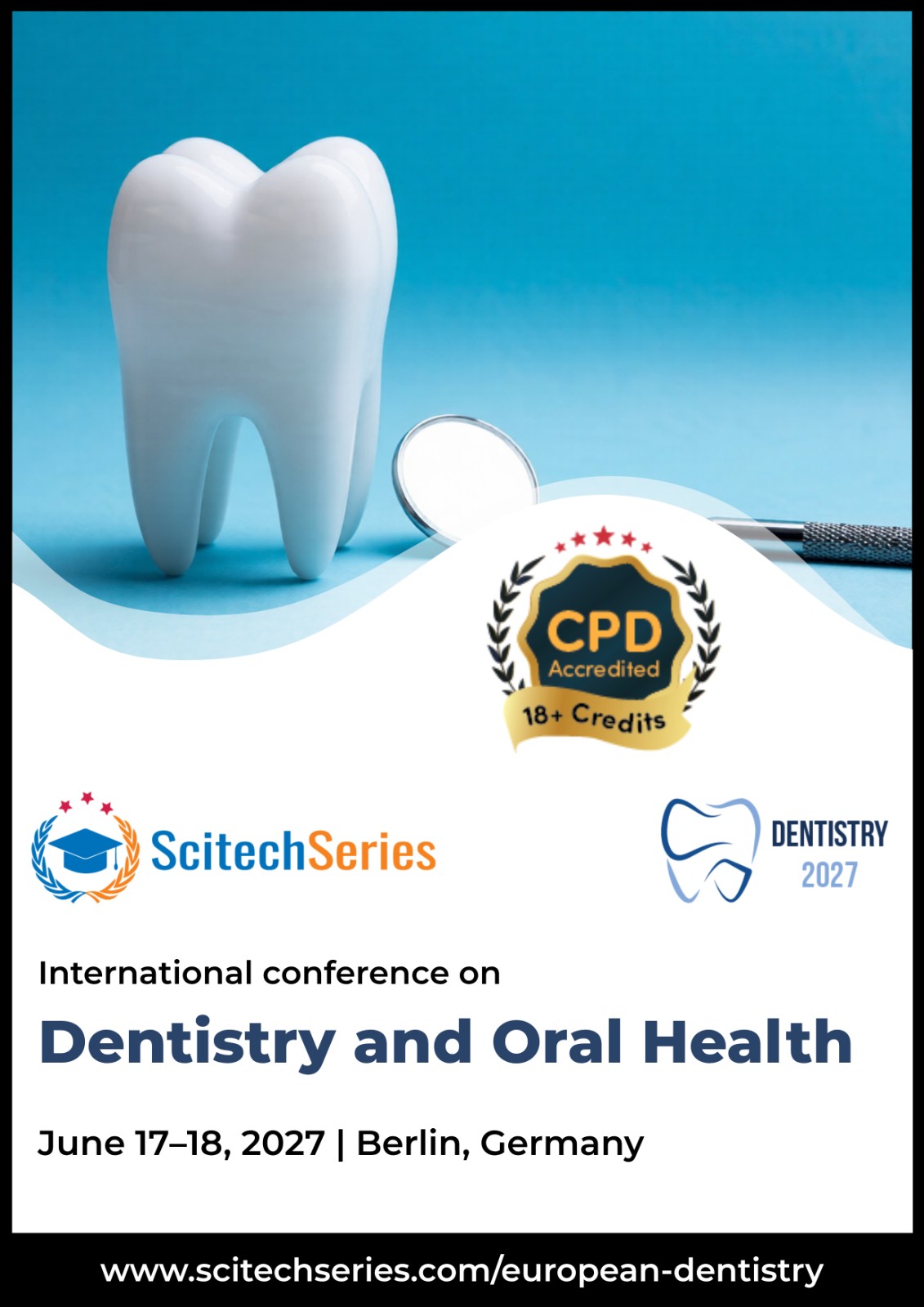


May 20–21, 2026 | Barcelona, Spain
Ahmed Abdellatif Mosleh Abdelfatah
Tanta University, Egypt
Ahmed Abdellatif, is currently working as a Lecturer of Oral and Maxillofacial Surgery, Faculty of Dentistry, Tanta University. My PhD from Tanta University was in 2022. In addition, my publica tions include: “Fixation of Man dibular Symphyseal or Para sym physeal Fractures with Curved 3-Dimensional Titanium Strut Plate” (Egyptian Dental Journal, April 2015). “Pathognomic oral profile of Lubinsky- MacGibbon syndrome for lowering the risk of progressive renal failure: rare case report” (Journal of Research and Dental Science, 2022).”Ar throscopic Assisted Release of Lateral Pterygoid Muscle versus Retrodiscal Scarification in the Treatment of Internal Derange ment of Temporomandibular Joint”Journal of Cranio-Maxillo facial Surgery, Volume 51, Issue 5, May 2023, Pages 303-308.a.
Background: Restoring edentulous patients with dental implants in cases of varying degrees of bone atrophy presents a significant challenge in oral implantology. The long-term success and stability of implants largely depend on the quality and quantity of the supporting bone and surrounding soft tissue. When bone volume is insufficient for implant placement, various bone augmentation techniques and materials can be employed. Among these, guided bone regeneration using the bone shell technique (Khoury technique) is widely utilized for three-dimensional bone augmentation.
Objective: To evaluate bone gain using Cone Beam Computed Tomography (CBCT) in cases where the Khoury technique is applied with either autogenous bone blocks or allograft bone blocks in the atrophic anterior maxilla for implant installation.
Materials and Methods: Twenty patients with an atrophic anterior maxilla were randomly assigned into two equal groups (10 patients each), based on the graft material used: autogenous bone or allograft bone. The treatment was conducted in three stages: bone augmentation, implant installation, and prosthetic loading. Patients were assessed both clinically and radiographically using panoramic X-rays and CBCT scans immediately after surgery and at 4 months postoperatively.
Results: Both groups showed a significant increase in alveolar bone width compared to preoperative values. All 20 implants were placed with adequate primary stability, measured using Osstell. After six months of osseointegration, secondary stability-also measured by Osstell-demonstrated good results in both groups.
Conclusion: Both autogenous and allograft bone grafts significantly increased alveolar bone width. The allograft group demonstrated a slightly greater overall width increase, with comparable implant stability between the two groups.
Trial Registration: This trial is retrospectively registered at the Pan African Clinical Trial Registry under ID PACTR202407576478340 on 30/07/2024.