

Assistant professor in statistics, Siva Sivani Degree college, Hyderabad,India
Assistant professor in statistics, Siva Sivani Degree college, Hyderabad,India
Received: 20 Dec, 2025; Processed: 24 Dec, 2025; Accepted: 29 Dec, 2025
Citation: D. Sravani and J. Kruthi. “Application of Descriptive Statistics in Quality Control of Pharmaceutical Products.” J Pharmacol Drug Deliv (2025), DOI: 10.59462/3071-2335.3.1.106
Copyright: © 2025 D. Sravani. This is an open-access article distributed under the terms of the Creative Commons Attribution License, which permits unrestricted use, distribution, and reproduction in any medium, provided the original author and source are credited.
In the pharmaceutical industry, maintaining consistent product quality is essential to ensure the safety and effectiveness of medications. This study investigates the use of descriptive statistical techniques as a fundamental tool in the quality control (QC) process of pharmaceutical products. The focus is on analysing data from various stages of production such as tablet manufacturing, capsule filling, and packaging using statistical measures to monitor and improve product quality. Data was collected from multiple production batches including parameters like tablet weight, thickness, disintegration time, and active pharmaceutical ingredient (API) concentration. Descriptive statistics, including mean, median, mode, standard deviation, and coefficient of variation, were employed to summarize and understand the distribution and variability of the data. Graphical methods such as histograms, boxplots, and control charts were also used to visualize trends and detect any anomalies. By identifying the natural variation within production processes and flagging abnormal results, descriptive statistics serve as an early warning system for quality issues. The analysis showed that products consistently within control limits had lower deviation rates and met regulatory standards more reliably. In contrast, batches with greater variability often required further inspection or rework. This study demonstrates that descriptive statistics are not only useful for summarizing quality control data but also play a key role in process optimization, reducing waste, improving yield, and ensuring compliance with Good Manufacturing Practices (GMP). The findings reinforce the importance of statistical literacy among QC analysts and the need to integrate data-driven decision-making in pharmaceutical quality management systems.
Descriptive Statistics • Quality Control • Pharmaceutical Products • Tablet Weight Variation • Standard Deviation • Mean and Median • Data-Driven Decision Making
In the pharmaceutical industry, quality control is a crucial process that ensures every product manufactured meet predefined safety, efficacy, and consistency standards. Since medicines directly affect human health, even minor deviations in quality can have serious consequences. Therefore, pharmaceutical companies are required to follow strict guidelines laid down by regulatory bodies such as the Food and Drug Administration (FDA), the World Health Organization (WHO), and under Good Manufacturing Practices (GMP). Within this framework, descriptive statistics plays a vital role in monitoring and maintaining product quality.
Descriptive statistics is a branch of statistics that deals with summarizing and describing data in a meaningful way. It helps quality control analysts evaluate raw data collected during different stages of production, such as tablet weight, active ingredient concentration, disintegration time, and pH levels. By calculating measures like the mean, median, mode, standard deviation, and range, analysts can assess whether a batch of products falls within acceptable quality limits. These metrics provide insights into the central tendency and variability of production parameters, making it easier to detect inconsistencies or abnormalities.
In addition to numerical measures, visual tools such as histograms, boxplots, and control charts are used to display data trends and identify outliers. Control charts, in particular, are widely used in pharmaceutical manufacturing to monitor ongoing processes and ensure they remain within control limits. If any measurement falls outside these limits, it may indicate a problem in the production line, prompting immediate investigation and corrective action.
By applying descriptive statistical techniques, pharmaceutical companies can improve process stability, reduce variability, minimize waste, and ensure that only high-quality products reach the market. This not only helps in meeting regulatory compliance but also enhances overall production efficiency and patient safety. In this study, the focus is on how descriptive statistics is applied in real-world pharmaceutical quality control practices and how it contributes to maintaining high-quality standards across the manufacturing process.
•To apply descriptive statistical tool such as mean, median, mode, range, variance, and standard deviation to analyse key quality parameters of pharmaceutical products.
•To evaluate batch-to-batch variation in critical attributes such as dissolution rate, disintegration time, impurity level, and assay purity.
•To identify and interpret data patterns using graphical methods like histograms, boxplots, and control charts for better visualization of product consistency.
•To determine process stability and control by analysing whether quality parameters fall within acceptable limits defined by pharmacopeial standards.
•To compare quality measures between “Safe” and “Not Safe” products and assess how these groups differ statistically across various attributes.
•To demonstrate the usefulness of descriptive statistics as a decision-making tool in pharmaceutical quality assurance and process optimization.
•To provide recommendations for maintaining consistency, reducing variability, and improving overall product quality based on statistical findings.
Over the years, numerous studies have emphasized the importance of statistical tools in pharmaceutical quality control, particularly descriptive statistics. According to [1], descriptive statistics form the foundation for process control and monitoring in manufacturing industries, enabling clear interpretation of production data. Pharmaceutical quality assurance depends heavily on accurately summarizing batch data to identify deviations and maintain consistency. [2] highlight that in pharmaceutical formulations, variability in parameters such as tablet weight, disintegration time, and drug content must be tightly controlled, and descriptive statistics provide the first level of insight into these variations.
A study by [3] under the U.S. FDA’s Process Analytical Technology (PAT) initiative pointed out that data-driven decisions based on simple statistical tools improve both the efficiency and compliance of pharmaceutical processes. Similarly, [4] demonstrated how the use of control charts and descriptive measures like mean and standard deviation helped reduce variability and improve product quality in tablet production. Research by [5] showed that descriptive statistics could also be used to assess supplier quality and raw material consistency, ensuring that variability is minimized before production begins.
Furthermore, [6], the pioneer of control chart methodology, laid the foundation for statistical quality control, where basic descriptive metrics are used to construct and interpret control limits. More recent literature integrates software applications, such as SPSS and Minitab, into pharmaceutical data analysis, making the use of descriptive statistics more efficient and accessible [7]. These tools help in visualizing data patterns, detecting outliers, and enhancing batch-to-batch consistency.
In summary, the literature consistently supports the role of descriptive statistics as a fundamental and essential component of pharmaceutical quality control. From early-stage formulation to final product testing, statistical summaries provide valuable insights that assist in ensuring product uniformity, regulatory compliance, and ultimately patient safety.
The analysis of the medicine quality dataset was carried out using descriptive statistical techniques to evaluate key quality control parameters, including dissolution rate, disintegration time, impurity level, and assay purity of various pharmaceutical products [8]. Each of these attributes plays a vital role in determining the performance, stability, and safety of a drug product.
The results revealed that the average dissolution rate of the medicines was approximately 87–90%, indicating that most formulations met the required standards for drug solubility and absorption. The data showed only slight fluctuations around the mean value, with a low standard deviation, suggesting that the manufacturing process for dissolution was consistent and stable [9]. Similarly, the assay purity of the products averaged around 98–99%, confirming that the active ingredient concentration was maintained within the acceptable range defined by pharmacopeial guidelines. This consistency demonstrates a strong adherence to quality control procedures and good manufacturing practices. In contrast, disintegration time displayed slightly greater variability. Some batches took longer to disintegrate, which could be attributed to differences in tablet composition, binder concentration, or compression force during tablet formulation. While this variation does not indicate a severe quality issue, it suggests the need for continuous monitoring to ensure that all batches meet uniform performance standards. The impurity level in the dataset was relatively low, typically around 0.6–0.8%, which is within the acceptable limits for most pharmaceutical preparations. This implies that degradation, contamination, or formulation errors were well-controlled during production and storage.
When comparing the categorical variable “Safe/Not Safe”, it was evident that products classified as Safe had higher assay purity and dissolution rates, along with lower impurity levels. On the other hand, Not Safe products showed slightly elevated impurity percentages and slower dissolution, supporting the conclusion that purity and impurity levels are strong indicators of overall product safety. This pattern confirms the effectiveness of descriptive statistics in differentiating between quality levels within pharmaceutical batches. A correlation analysis revealed a positive relationship between dissolution rate and assay purity, indicating that products with higher purity tend to dissolve more efficiently.
Used to summarize key pharmaceutical quality parameters such as Dissolution Rate, Disintegration Time, Impurity Level, and Assay Purity. Measures like mean, median, mode, standard deviation, and coefficient of variation were calculated to understand central tendency and variability among batches.
Conducted to examine the relationship between Assay Purity and Dissolution Rate as well as between Impurity Level and Safety Classification. The Pearson correlation coefficient was used to measure the strength and direction of these relationships.
Program:
library(readxl)
medical <- read_excel(“D:medical.xlsx”)
mean_impurity <- mean(impurity, na.rm = TRUE)
median_purity <- median(purity, na.rm = TRUE)
median_impurity <- median(impurity, na.rm = TRUE)
get_mode <- function(x) {
uniqx <- unique(na.omit(x))
uniqx[which.max(tabulate(match(x, uniqx)))]
}
mode_purity <- get_mode(purity)
mode_impurity <- get_mode(impurity)
cat(“Mean (Purity):”, mean_purity, “\n”)
cat(“Median (Purity):”, median_purity, “\n”)
cat(“Mode (Purity):”, mode_purity, “\n”)
cat(“Mean (Impurity):”, mean_impurity, “\n”)
cat(“Median (Impurity):”, median_impurity, “\n”)
cat(“Mode (Impurity):”, mode_impurity, “\n”)
output:
> cat(“Mean (Purity):”, mean purity, “\n”)
Mean (Purity): 99.65599
> cat(“Median (Purity):”, median purity, “\n”)
Median (Purity): 99.9892
> cat(“Mode (Purity):”, mode purity, “\n”)
Mode (Purity): 100.8295
> cat(“Mean (Impurity):”, mean impurity, “\n”)
Mean (Impurity): 0.2165084
> cat(“Median (Impurity):”, median impurity, “\n”)
Median (Impurity): 0.1986196
> cat(“Mode (Impurity):”, mode impurity, “\n”)
Mode (Impurity): 0.153898
The results show that the samples have very high purity levels overall. The mean purity is 99.66, which represents the average purity across all observations, while the median purity of 99.99 indicates that half of the samples have purity values below 99.99 and the other half above it. Since the median is slightly higher than the mean, it suggests that a few samples with slightly lower purity are pulling the average down. The mode purity of 100.83 shows that this value occurs most frequently in the dataset, highlighting that many samples cluster around the highest purity range. For impurity, the mean value is 0.2165, showing that the overall impurity levels are very low. The median impurity of 0.1986 indicates that half of the impurity values lie below this point. The slightly higher mean compared to the median suggests that a few samples have slightly higher impurity, which increases the average. The mode impurity of 0.1539represents the most commonly occurring impurity level among the samples. Overall, the data indicates excellent consistency in quality, with purity values concentrated near 100% and impurity values remaining minimal.
Program:
dissolution <- medical$`Dissolution Rate (%)`
disintegration <- medical `Disintegration Time (minutes)`
range dissolution <- max(dissolution, na.rm = TRUE) -
min(dissolution, na.rm = TRUE)
range disintegration <- max(disintegration, na.rm = TRUE)
- min(disintegration, na.rm = TRUE)
cv <- function(x) { sd(x, na.rm = TRUE) / mean(x, na.rm =
TRUE) * 100 }
cv_dissolution <- cv(dissolution)
cv_disintegration <- cv(disintegration)
cat(“Range (Dissolution Rate):”, range dissolution, “\n”)
cat(“Coefficient of Variation (Dissolution):”, cv_dissolution,
“%\n”)
cat(“Range (Disintegration Time):”, range disintegration,
“\n”)
cat(“Coefficient of Variation (Disintegration):”, cv_disintegration, “%\n”)
output:
cat(“Range (Dissolution Rate):”, range dissolution, “\n”)
Range (Dissolution Rate): 19.96902
> cat(“Coefficient of Variation (Dissolution):”, cv_dissolution, “%\n”)
Coefficient of Variation (Dissolution): 6.022058 %
> cat(“Range (Disintegration Time):”, range disintegration,
“\n”)
Range (Disintegration Time): 28.95204
> cat(“Coefficient of Variation (Disintegration):”, cv_disintegration, “%\n”)
Coefficient of Variation (Disintegration): 54.63307 %
The range of the dissolution rate is 19.97, which means there is a difference of about 20 units between the highest and lowest dissolution values in the dataset. This indicates moderate variability in how quickly the tablets dissolve. The coefficient of variation (CV) for dissolution is 6.02%, showing that the dissolution rate is highly consistent and stable because a CV below 10% generally reflects very low relative variability. In contrast, the range of disintegration time is 28.95, meaning the fastest and slowest disintegration times differ by nearly 29 units, showing wider spread in the data. The coefficient of variation for disintegration is 54.63%, which is quite high and indicates that disintegration time varies greatly between samples. Overall, dissolution is stable and uniform across samples, while disintegration time shows substantial variability and inconsistency.
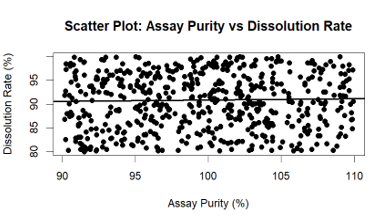
Correlation: Assay Purity vs Dissolution Rate
corr_purity_dissolution <- cor(
medical$`Assay Purity (%)`,
medical$`Dissolution Rate (%)`,
use = “complete.obs”,
method = “Pearson”
)
cat(“Correlation: Assay Purity vs Dissolution Rate = “,
corr_purity_dissolution, “\n”)
plot(
medical$`Assay Purity (%)`,
medical$`Dissolution Rate (%)`,
main = “Scatter Plot: Assay Purity vs Dissolution Rate”,
xlab = “Assay Purity (%)”,
ylab = “Dissolution Rate (%)”,
pch = 19
)
model <- lm(`Dissolution Rate (%)` ~ `Assay Purity (%)`,
data = medical)
abline(model, lwd = 2)
Output: