


Ansam Mohamed Abdelrahman Mohamed1*, Ahmed B. A. Elamin1; Aaya Elmouez Ahmed1; Abdul Jabbar Mohammed Yasser Adi1, Adiba Rakhange1, Ahmad Haitham Otour1, Ahmed Mohammad Ismail Darweesh1, Maryam Ali Alowais1
1Mohammed Bin Rashid University of Medicine and Health Sciences, Dubai Health, Dubai, United Arab Emirates
*Corresponding Author::Ansam Mohamed Abdelrahman Mohamed, Mohammed Bin Rashid University of Medicine and Health Sciences, Dubai Health, Dubai, United Arab Emirates. E-mail: ansamm72@gmail.com
Received: 07 August 2026; Accepted: 14 August 2026; Published: 17 August 2026.
Citation: Ansam Mohamed Abdelrahman Mohamed. “First Case of Sandhoff Disease with Comorbid Bipolar Disorder in the United Arab Emirates.” J Neur Imag Neur Med (2026): 114. DOI: 10.59462/JNINM.4.1.114
Copyright: © 2026 Mohamed A.M.A. This is an open-ac¬cess article distributed under the terms of the Creative Commons Attribution License, which permits unrestricted use, distribution and reproduction in any medium, provided the original author and source are credited.
Abstract
Sandhoff disease is a rare autosomal recessive lysosomal storage disorder caused by HEXB mutations that lead to progressive accumulation of GM2 gangliosides and neurodegeneration. Motor deficits, cognitive decline, and seizures are well recognized, but comorbid psychiatric presentations particularly mania are rarely reported and can obscure or delay diagnosis. We describe a 38-year-old woman with a long-standing diagnosis of Bipolar I Disorder with mixed features who presented with a five-day history of escalating manic and psychotic symptoms, including expansive and irritable mood, impulsivity, persecutory delusions, and auditory hallucinations, against a background of progressive ataxia, dysarthria, and functional decline since childhood. Neurological examination revealed cerebellar signs and hyperreflexia, and computed tomography of the brain showed cerebellar atrophy. Whole-exome sequencing identified a homozygous pathogenic HEXB missense variant, confirming a diagnosis of late-onset Sandhoff disease. She was treated with risperidone, lorazepam, and up-titrated sodium valproate, with resolution of the acute manic episode and subsequent stabilization on a combined psychotropic and rehabilitative regimen. This case, believed to be the first reported instance of Sandhoff disease with bipolar disorder in the United Arab Emirates, illustrates the variable neuropsychiatric presentation of late-onset GM2 gangliosidosis and underscores the value of a multidisciplinary, metabolic-genetic work-up in patients with atypical or treatment-resistant psychiatric presentations accompanied by progressive neurological signs.
Keywords: Sandhoff disease; GM2; Gangliosidosis; HEXB mutation; Bipolar disorder; Adult-onset Neurodegeneration, Neuropsychiatric manifestations
Introduction
Sandhoff disease is a subtype of late-onset GM2 gangliosidosis, a lysosomal storage disease resulting from mutations in the HEXB gene on chromosome 5q13, which encodes the β-subunit of the enzymes β-hexosaminidase A (HEXA) and β-hexosaminidase B (HEXB) (1). These enzymes are essential for breaking down GM2 gangliosides, glycosphingolipids found primarily in neuronal cells. Mutations in HEXB lead to accumulation of GM2 gangliosides within lysosomes, disrupting neuronal function and causing progressive neurodegeneration [1,2].
The other subtype of late-onset gangliosidosis, late-onset Tay-Sachs disease, results from mutations in the HEXA gene. Patients with Tay-Sachs disease experience symptoms similar to those of Sandhoff disease, although neuropsychiatric symptoms are more prevalent in Tay-Sachs disease. This autosomal recessive disease underscores the critical role of HEXB in maintaining neuronal health [3,4].
Sandhoff disease is rare, with an estimated prevalence of 1 in 1,000,000 individuals, and affects males and females equally. The Creole population of Argentina, Métis communities in Saskatchewan, Canada, and individuals of Lebanese descent have the highest reported rates of the disease [5]. Infants with Sandhoff disease often appear normal at birth but begin to exhibit motor deficits and developmental abnormalities by three to six months of age [4,6]. As the disease progresses, additional features appear, including hypotonia, developmental regression, loss of motor skills, and exaggerated startle responses [4]. Other typical findings include progressive weakness, cognitive decline, seizures, and loss of vision and hearing; a “cherry-red spot” on ophthalmological examination of the macula is a distinctive finding [5]. In late-onset Tay-Sachs disease, neuropsychiatric manifestations and cerebellar dysfunction occur more frequently, although motor symptoms such as dysphagia and developmental delay occur at similar rates in both conditions.
Diagnosis is usually clinical, supported by enzymatic testing demonstrating reduced β-hexosaminidase A and B activity in peripheral blood leukocytes or fibroblasts [4]; identification of the causative HEXB variant by genetic testing is confirmatory. Electrophysiological studies often reveal abnormal motor and sensory nerve conduction, and neuroimaging typically shows brain atrophy and white matter abnormalities [5].
Bipolar disorder is a major global health concern, affecting an estimated 46 million people worldwide, and is characterized by alternating episodes of depression, mania, or hypomania [7]. Although primarily a psychiatric condition, bipolar disorder has been linked to neurodegenerative disease: approximately 40% of patients with Sandhoff disease have been reported to experience psychiatric symptoms such as bipolar episodes and psychosis [8].
Sandhoff disease is a rare GM2 gangliosidosis that primarily affects the nervous system and can present with a broad spectrum of motor and cognitive symptoms across the lifespan [9]. In our patient, Sandhoff disease coincided with an established diagnosis of bipolar disorder, offering an opportunity to describe the neurological features of late-onset Sandhoff disease in the context of coexisting psychiatric illness, and, to our knowledge, to report the first such case documented in the United Arab Emirates [10].
Case Description We present the case of a 38-year-old Iranian woman with Bipolar I Disorder with mixed features, diagnosed in 2008 and maintained on escitalopram, risperidone, and sodium valproate. She presented to the emergency department with a five-day history of escalating manic symptoms progressing to agitation, including increased energy, expansive and irritable mood, decreased need for sleep, and talkativeness with flight of ideas. She also displayed impulsive spending through online shopping, persecutory delusions toward her family, and auditory hallucinations. Her medical history included a diagnosis of ataxia in 2019 and a recent diagnosis of Sandhoff disease confirmed by genetic testing. Whole-exome sequencing performed on blood samples from the proband revealed a homozygous missense variant in HEXB on chromosome 5, positive for the infantile, juvenile, and adult forms of Sandhoff disease (Table 2).
|
Gene (Genomic |
DNA Change, |
Zygosity |
dbSNP ID |
In silico |
Allele |
First VAR |
Disorder |
Variant |
|
HEXB (Chr5:74016473) |
c.1514G>A, |
Homozygous |
rs121907983 |
SIFT: |
0.0036% |
Not present |
Sandhoff disease, infantile, juvenile, and adult forms (268800, AR) |
Pathogenic |
Table 2. Primary molecular genetic finding identified by whole-exome sequencing
Based on genome build 37 (GRCh37). SIFT/PolyPhen-2: computational tools predicting variant deleteriousness. Allele frequency based on gnomAD v2.1.1 (controls). Variant classification based on ACMG criteria. AR, autosomal recessive.
The patient is the child of first-degree consanguineous parents, with a strong history of consanguinity throughout both parents’ families. She was born at full term via standard delivery, the second of four siblings, and reached appropriate early developmental milestones, walking and talking by age one. At age 11, her health began to deteriorate: her motor movements slowed, she had difficulty sitting and standing, and she began dropping objects due to impaired grasp. Her family noted abnormal facial muscle movement, and her speech and voice progressively deteriorated. At age 13, she developed ataxia with progressive leg weakness that now necessitates wheelchair use. Since late adolescence she has required multiple psychiatric hospital admissions each year, averaging three per year since the early 2000s, with manic relapses occurring approximately every three months.
She also experienced mild memory impairment that affected her academic performance; no formal intelligence quotient testing has been performed. She remained self-sufficient at home until age 29, after which functional decline necessitated daily caregiver assistance. Family history was notable for multiple congenital anomalies, including a cousin diagnosed with Joubert syndrome.
On this presentation she also reported mild memory impairment, slurred speech, bladder incontinence, constipation, and intermittent pins-and-needles paraesthesia lasting 5-10 minutes without associated rash. On neurological examination she was conscious and fully oriented to time, place, and person. She had gaze-evoked nystagmus on horizontal gaze; other cranial nerves were intact, with no facial weakness and normal extraocular movements. Upper and lower limb tone was mildly reduced with decreased muscle bulk. Motor power was 5/5 in neck flexors and extensors; 5/5 proximally and distally in the right upper limb; 4/5 proximally and distally in the left upper limb; and 4/5 proximally and distally in both lower limbs. Reflexes were hyperactive bilaterally with bilateral upgoing plantar responses. Bilateral finger-nose ataxia, more pronounced on the right, and an ataxic gait were noted; pinprick sensation was intact bilaterally.
|
Age / Date |
Clinical event/care milestone |
|
Birth |
Born at full term to consanguineous parents; normal early development |
|
Age 1 |
Achieved independent walking and speech |
|
Age 11 |
Onset of motor slowing, gait and sitting difficulty, impaired grasp, facial and speech changes |
|
Age 13 |
Onset of ataxia and progressive leg weakness; eventual wheelchair dependence |
|
2008 |
Diagnosed with Bipolar I Disorder with mixed features; started on escitalopram, risperidone, and sodium valproate |
|
Late adolescence - 2000s onward |
Recurrent psychiatric hospitalizations (~3/year); manic relapses roughly every 3 months |
|
Age 29 |
Loss of independence in activities of daily living; began requiring daily caregiver assistance |
|
2019 |
Formal clinical diagnosis of ataxia |
|
Pre-admission |
Whole-exome sequencing identifies homozygous HEXB missense variant; genetic diagnosis of Sandhoff disease confirmed |
|
Index admission, Day 0 |
Presents to emergency department with 5-day history of escalating mania, psychosis, and agitation |
|
Index admission |
Neurological examination shows cerebellar signs and hyperreflexia; CT brain shows cerebellar atrophy (Figure 1); |
|
Index admission |
Started on risperidone and lorazepam; sodium valproate up-titrated; escitalopram discontinued |
|
Day 6 |
Discharged on risperidone, lorazepam, and sodium valproate with clinical improvement |
|
Post-discharge |
Depressive symptoms emerge; escitalopram restarted, then interrupted at home and not resumed by caregiver |
|
Post-discharge |
Travels to Iran for 6 months of rehabilitation and physiotherapy while continuing other medications |
|
Follow-up |
Returns and resumes outpatient follow-up; family reports sustained psychiatric stability on current regimen |
Table 1. Timeline of clinical events across the episode of care.
Diagnostic Assessment, Therapeutic Intervention, and Follow-Up
Diagnostic assessment
The differential diagnosis for this presentation included Bipolar I Disorder, current episode manic with psychotic features; bipolar affective disorder, mixed episode; and mood disorder secondary to a general medical condition (Sandhoff disease). These possibilities were evaluated in light of her mood lability, psychotic symptoms, and known underlying metabolic disorder. Laboratory testing for vitamin levels, alpha-fetoprotein, ceruloplasmin, and vasculitis screening was unremarkable. Computed tomography of the brain revealed cerebellar atrophy (Figure 1), consistent with a chronic, likely developmental, posterior fossa process. Diagnostic confirmation of Sandhoff disease relied on demonstration of reduced β-hexosaminidase activity together with identification of the homozygous pathogenic HEXB variant on whole-exome sequencing (Table 2); no notable access, financial, or cultural barriers were encountered in obtaining testing. Given the progressive, multisystem nature of late-onset Sandhoff disease, the expected course is one of gradual neurological decline, although the rate and severity are variable and psychiatric symptoms may fluctuate independently of neurological progression.
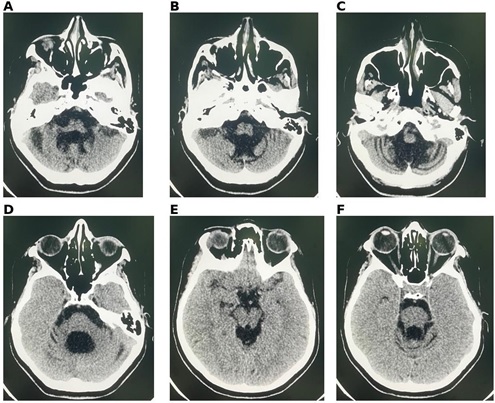
Figure 1. Computed Tomography imaging of the brain demonstrating cerebellar vermis atrophy and generalized cerebellar volume loss, with significant dilatation of the fourth ventricle and prepontine cistern (A-F).
Therapeutic intervention
The patient was admitted under psychiatry with a diagnosis of bipolar disorder, current episode manic, severe, with psychotic features. She was started on risperidone and lorazepam, sodium valproate was up-titrated to a higher dose, and escitalopram was discontinued given the risk of destabilizing her manic state. She was discharged after six days on risperidone, lorazepam, and sodium valproate (as Depakene Chrono, extended release), with improvement in her mental state.
Follow-up and outcomes
At discharge the patient had begun to develop depressive symptoms, and escitalopram was restarted as part of her previously effective regimen, with a plan for close, frequent follow-up given the risk of a switch to mania. However, her father did not resume the escitalopram after it was interrupted at home. She subsequently travelled to Iran for six months of rehabilitation and physiotherapy while continuing her other medications, before returning to resume follow-up with our team. At her most recent outpatient review, her father and sister reported that she remained psychiatrically stable on this regimen, with good tolerability and no new adverse or unanticipated events reported since discharge.
Discussion
Adult-onset Sandhoff disease can be challenging to diagnose. Early signs may include ataxia, lower- limb weakness, and gait disturbance that gradually worsen; speech and swallowing difficulties may follow, further impairing quality of life [11]. The coexistence of Sandhoff disease with bipolar disorder complicates management, as each illness may exacerbate the other’s symptoms. Neuropsychiatric manifestations of late-onset GM2 gangliosidoses described in the literature include disorganized thinking, delusions, ideas of reference, and visual or auditory hallucinations, frequently accompanied by affective disturbance or behavioral change [8,12].
Our patient presented with manic symptoms, persecutory delusions, auditory hallucinations, and a history of self-harm. Although many patients with primary psychiatric disorders respond to standard neuro pharmacological therapy, response may be less predictable in those with underlying neurodegenerative or lysosomal storage disease, often requiring prolonged, multidisciplinary management [12,13]. Notably, some antipsychotics, including haloperidol and chlorpromazine, have been associated with worsening neurological symptoms and disease progression in lysosomal storage disorders, possibly reflecting increased neuronal vulnerability in the setting of pre-existing neurodegeneration, and should be avoided [13]. Depression and anxiety are also common comorbidities across the course of late-onset GM2 gangliosidoses [12]. This case illustrates that, when faced with a mixed neuropsychiatric presentation, clinicians should consider rare metabolic causes of psychiatric illness.
Diagnosis of Sandhoff disease is supported by low HEXA and HEXB activity together with identification of the causative HEXB variant. Our patient carried a homozygous HEXB mutation, while her siblings were heterozygous carriers. Her CT findings of cerebellar and cerebral atrophy are consistent with those previously reported in adult-onset GM2 gangliosidoses [5,8].
Management requires a personalized approach combining neuroprotective strategies with psychotropic treatment that controls psychiatric symptoms while limiting neurological deterioration. Antipsychotic medications may carry an increased risk-to-benefit ratio in these patients, as dopamine-blocking agents have been reported to worsen neurological dysfunction in lysosomal storage disorders [12,13]. In some patients, electroconvulsive therapy and benzodiazepines may offer safer, more effective alternatives for psychiatric symptoms associated with metabolic disease [12]. A multidisciplinary team of neurologists, psychiatrists, geneticists, and specialized nurses is essential to address both the physical and emotional needs of these patients. Further research into the intersection of neurodegenerative and psychiatric illness is needed to refine diagnosis and enable more tailored treatment, including systematic evaluation of pharmacological and non-pharmacological interventions.
Strengths and Limitations
The principal strength of this report is a genetically confirmed diagnosis in an adult patient with a well- documented, decade-long psychiatric history, allowing detailed correlation between neurological progression and psychiatric course; to our knowledge, this is the first reported case of Sandhoff disease with comorbid bipolar disorder from the United Arab Emirates. Limitations include the inherent constraints of a single-patient case report, which cannot establish causality or be generalized beyond this patient; reliance on family-reported developmental and psychiatric history, which may be subject to recall bias; the absence of formal neuropsychological or intelligence quotient testing; and incomplete follow-up data during the patient’s period of rehabilitation abroad.
In summary, Sandhoff disease is challenging to diagnose without appropriate metabolic and genetic testing. Its symptoms and signs require prompt intervention to improve the patient’s quality of life while limiting adverse complications. A multidisciplinary approach is essential in managing such patients, with careful consideration of the effects of neuromodulating medications on underlying neurodegeneration.
Patient Perspective
Because of the patient’s cognitive and communication difficulties, her perspective on treatment was conveyed through her father and sister, her primary caregivers, during outpatient follow-up. They reported that, despite the initial distress caused by her acute psychiatric admission, she tolerated the adjusted medication regimen well and preferred to continue treatment and rehabilitation at home surrounded by family, including during her period of physiotherapy in Iran. The family expressed relief at the psychiatric stabilization achieved and emphasized the importance of consistent medication adherence and close follow-up in maintaining her wellbeing and functional independence at home.
Author Contributions
All authors conceptualization, data curation, investigation, project administration, supervision, writing original draft, review and editing.
During the preparation of this manuscript, the author(s) used Claude (Anthropic) to assist with language editing, formatting, and improving readability. The author(s) reviewed and edited the output and take full responsibility for the final content of the manuscript.
Acknowledgments: None
Funding: The authors did not receive funding for this article
Conflict of Interest
The authors declare that the research was conducted in the absence of any commercial or financial relationships that could be construed as a potential conflict of interest.
References
1. Mahuran, Don J. "Biochemical consequences of mutations causing the GM2 gangliosidoses." Biochimica et Biophysica Acta (BBA)-Molecular Basis of Disease 1455 (1999): 105-138.
2. Inui, K., E. E. Grebner, L. G. Jackson, and D. A. Wenger. "Juvenile GM2 gangliosidosis (AMB variant): inability to activate hexosaminidase A by activator protein." American journal of human genetics 35 (1983): 551.
3. Pennybacker, Mark, Bernd Liessem, Heidi Moczall, Cynthia J. Tifft, Konrad Sandhoff, and Richard L. Proia. "Identification of domains in human β-hexosaminidase that determine substrate specificity." Journal of Biological Chemistry 271 (1996): 17377-17382.
4. Maegawa, Gustavo HB, Tracy Stockley, Michael Tropak, Brenda Banwell, Susan Blaser, Fernando Kok, Roberto Giugliani, Don Mahuran, and Joe TR Clarke. "The natural history of juvenile or subacute GM2 gangliosidosis: 21 new cases and literature review of 134 previously reported." Pediatrics 118 (2006): e1550-e1562.
5. Zhang, Wen, Huasong Zeng, Yonglan Huang, Ting Xie, Jipeng Zheng, Xiaoyuan Zhao, Huiying Sheng, Hongsheng Liu, and Li Liu. "Clinical, biochemical and molecular analysis of five Chinese patients with Sandhoff disease." Metabolic brain disease 31 (2016): 861-867.
6. Bley, Annette E., Ourania A. Giannikopoulos, Doug Hayden, Kim Kubilus, Cynthia J. Tifft, and Florian S. Eichler. "Natural history of infantile GM2 gangliosidosis." Pediatrics 128 (2011): e1233-e1241.
7. Merikangas, Kathleen R., Hagop S. Akiskal, Jules Angst, Paul E. Greenberg, Robert MA Hirschfeld, Maria Petukhova, and Ronald C. Kessler. "Lifetime and 12-month prevalence of bipolar spectrum disorder in the National Comorbidity Survey replication." Archives of general psychiatry 64 (2007): 543-552.
8. Godbole, Neha P., Elizabeth Haxton, Olivia E. Rowe, Joseph J. Locascio, Jeremy D. Schmahmann, Florian S. Eichler, Eva‐Maria Ratai, and Christopher D. Stephen. "Clinical and imaging predictors of late‐onset GM2 gangliosidosis: A scoping review." Annals of clinical and translational neurology 11 (2024): 207-224.
9. Karimzadeh, Parvaneh, Narjes Jafari, Habibeh Nejad Biglari, Sayena Jabbeh Dari, Farzad Ahmad Abadi, Mohammad-Reza Alaee, Hamid Nemati et al. "GM2-Gangliosidosis (Sandhoff and Tay Sachs disease): diagnosis and neuroimaging findings (an Iranian pediatric case series)." Iranian journal of child neurology 8 (2014): 55.
10. Lopshire, Mariah C, Cynthia Tifft, John Burns, Rebecca Gould, Riliang Zheng, and Isabela Batsu. "The diagnostic journey for patients with late-onset GM2 Gangliosidoses." Molecular genetics and metabolism reports 37 (2023): 101014.
11. Xiao C, Tifft C, Toro C. “Sandhoff Disease.” GeneReviews (2022) PMID: 35420740.
12. Toro, Camilo, Mosufa Zainab, and Cynthia J. Tifft. "The GM2 gangliosidoses: Unlocking the mysteries of pathogenesis and treatment." Neuroscience letters 764 (2021): 136195.
13.Cox, Timothy M. "Lysosomal diseases and neuropsychiatry: opportunities to rebalance the mind." Frontiers in Molecular Biosciences 7 (2020): 177.