


Ravi Kumar Chittoria 1*,Kanav Gupta2,Nagarjun S Ghatti3
1 Senior Professor and Associate Dean (Academic), Head of IT Wing and Telemedicine Department of Plastic Surgery and Telemedicine JIPMER, Puducherry, India
2Senior Resident Department of Plastic Surgery JIPMER Puducherry, India
3Observer, Department of Plastic Surgery JIPMER Puducherry, India
Received: 18 Nov 2025; Accepted: 05 Dec 2025; Published: 16 Dec 2025
Citation: Ravi Kumar Chittoria, Kanav Gupta, Nagarjun S Ghatti. “Role of Cyclical Negative Pressure Wound Therapy in Pressure Sore Grade IV.” J Aesthetic Surg Med (2025): 110. DOI: 10.59462/3068-5311.2.1.110
Copyright: © 2025 Ravi Kumar Chittoria..This is an open-access arti cle distributed under the terms of the Creative Com mons Attribution License, which permits unrestricted use, distribution, and reproduction in any medium, provided the original author and source are credited.
The application of “negative pressure” has evolved to a cornerstone in the treatment of acute and chronic wounds in almost all specialties. Continuous Intermittent, cyclic are the three types of Negative pressure Wound Therapy (NPWT). The cyclic NPWT system is similar to the intermittent mode in terms of using the same maximal sub atmospheric pressure, but the pressure never reaches zero in the cyclic mode. Cyclic application of “negative pressure” results in a superior local enhancement of cutaneous microcirculation with regards to blood flow and consecutive tissue oxygenation. In this article, cyclic NPWT was compared with other NPWT.
Negative Pressure Wound Therapy, Cyclic, Wound.
Since the introduction of the negative pressure wound therapy (NPWT) system by Morykwas and Argenta, it has been applied to a number of wounds and has become an influential and effective technique for healing simple and complex wounds. The conventional NPWT system adopts either ‘intermittent’ or ‘continuous’ mode.
While the continuous mode constantly applies a sub-atmospheric pressure of −125 mmHg, the intermittent mode creates a sub-atmospheric pressure of −125 mmHg for 5 minutes and a 2-minute resting phase of 0 mmHg.
In experiments performed on animal models, the intermittent mode showed increased perfusion level and formation of granulation tissue in the wound area compared with the continuous mode. [1,2] Despite the effectiveness of intermittent mode in wound healing, it has been avoided in clinical application because of the pain occurring every few minutes during the initiation phase of the system to reach −125 mmHg. Thus, ‘cyclic’ mode would minimize the pain while maintaining the superior efficacy of the intermittent mode.
The cyclic NPWT system is similar to the intermittent mode in terms of using the same maximal sub at mospheric pressure, but the pressure never reaches zero in the cyclic mode. So, it continuously creates certain pressure gradient that oscillates between −125 mmHg and the preset sub atmospheric pressure. The cycle runs based on the changes in sub atmospheric pressure, not time, and thus its frequency reflects the wound volume.
The study is done in a tertiary care hospital in South India. The subject is A 55-year-old female known diabetic uncontrolled and parotid carcinoma with an alleged history of lower limb weakness with incontinence of stools and urine. She developed ulcers in the sacral and greater trochanter regions (Fig 1). The patient had undergone multiple dressings of functional regenerative therapy with scaffold and cyclical NPWT post debridement (Fig 2). Cyclical NPWT five applications were done.
Fig 1:wound time of admission
Results
Cyclical NPWT is useful in improving the wound healing of pressure sore in patient as we have seen in this study (Fig 3,4).
Fig 2:after applying CRONPWT
Results
Cyclical NPWT is useful in improving the wound healing of pressure sore in patient as we have seen in this study (Fig 3,4).
Fig 3:Wound after the CRONPWT Treatment
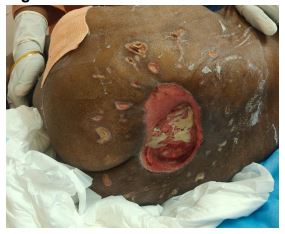
Fig 4:Wound after the CRONPWT Treatment
Over the past decades, the application of “negative pressure” has evolved to a cornerstone in the treatment of acute and chronic wounds in almost all specialties. Various available synonyms reflect the past developments and current applications of the technique involving, among others, “Vacuum-assisted closure” (VAC), “Negative Pressure Wound Therapy” (NPWT), “closed incision Negative Pressure Therapy” (ciNPT), or “Negative Pressure Wound Therapy with instillation” (NPWTi). [3] All but ciNPT are used for treatment of open wounds and exert the known beneficial effects of “negative pressure” therapy on wound healing, i.e., sufficient temporary wound closure, promotion of wound bed granulation, mechanical contraction and stabilization of wound margins, and efficient reduction of bacterial load. Wound bed perfusion represents another key factor in wound healing. Effects of “negative pressure” on wound bed perfusion have lately been widely discussed.
Results from different research groups have partly shown diverging results which could seriously question the hypothesis of an enhancement of local and adjacent wound bed perfusion due to application of a negative pressure dressing. [4,5] Actual doubt was risen based on the physically driven understanding of a compression of underlying tissues through application of a negative pressure dressing, particularly, on the capillary network that is subjected to surface pressure. Consecutively, occlusion of microvessels would result in a diminished rather than enhanced capillary blood flow, causing local hypoxia and, probably, ischemia. Moreover, the utilization of an otherwise broadly used technique for perfusion analysis, laser-doppler velocimetry, was questioned to be flawed due to the impact of “pressure-artifacts” [6], therefore resulting in a false-positive sign of an enhancement in perfusion underneath an applied NPWT dressing.
On the contrary, current research regarding perfusion alterations due to ciNPT and the application of negative pressure wound therapy over closed incisions found that blood flow and consecutive tissue oxygenation acutely improved upon treatment. [7-9] Additionally, NPWT was also successfully applied in free tissue transfer, with a reduction of postoperative tissue damage instead of an increment. [10] No adverse effects of negative pressure were found. In a previous analysis, we used continuous laser-doppler flowmetry combined with white-light spectroscopy for a comprehensive real-time analysis of microcirculatory changes under an NPWT dressing. [8] Application of an intermittent negative pressure resulted in a stepwise increase in local tissue perfusion with a consecutive enhancement of tissue oxygen saturation
Within this preclinical study on acute changes of cutaneous microcirculation under an applied NPWT dressing, we observed a significant increase of local perfusion dynamics with consecutive improvement of tissue oxygen saturation. Interestingly, all three compared modes of application, continuous, intermittent, and cyclic, resulted in locally enhanced microcirculation of a greater or lesser extent.
In the comparison of different application modes, we observed superior effects on local and remote cutaneous perfusion in the cyclic group.
The continuous mode represented the most common setting in clinical wound care according to a published meta-analysis [11], in which discontinuous applications were rarely reported. [11]
Notably, continuous treatment represents the generally accepted standard of care despite already available early evidence of superior capabilities of an intermittent NPWT treatment with respect to formation of granulation tissue or angiogenesis. Most likely, this is attributable to the fact that intermittent activation of “negative-pressure,” which causes repeated spikes in surface pressure to the wound, is believed to be unpleasing.
Lately, the introduction of the “cyclic-mode” appears as a promising compromise combining both the satisfaction of patients and superior wound treatment. [12] Pain levels were generally low in cyclic NPWT.
In human cutaneous microcirculation, resting capillary pressure was reported in a range from 10.5 to 22.5 mmHg or even 41.0 mmHg [13,14]. Thus, applied surface pressure of ~30.0 mmHg via a NPWT dressing could potentially result in an occlusion of cutaneous capillaries. Given the finding that capillary pressure also increases in response to a higher venous pressure, at least a sub-total occlusion of the dermal microvasculature due to the intervention can be assumed. [15] Overall, the mechanisms of cutaneous vascular response to certain stimuli are complex, especially concerning vasodilation and improvement of local flow. [16] Repeated capillary (subtotal) occlusion represents a strong stimulus for the affected tissue. Both post-occlusive reactive hyperemia (PORHA) and increased mechano-humoral transduction to the vascular bed result in alterations of intravascular shear stress and could be accountable for superior effects in the intermittent and, particularly, in the cyclic group. [17,18] We also assessed changes of cutaneous microcirculation on the contralateral thigh and found stronger effects in the cyclic group. Previous studies on Remote Ischemic Conditioning (RIC), showed alterations in the applied stimulus can influence the triggered improvement of cutaneous perfusion. [19,20] Duration of applied pressure, number of repeated cycles, and body site are important variables to optimize the conditioning effect on the improvement of remote microcirculation.
Cutaneous capillary network can be investigated with regards to blood flow (BF), velocity (VELO), postcapillary oxygen saturation (StO2), and relative hemoglobin content (rHb). [11]
Regardless of the application of different pressure levels, intervals of suction and cutaneous blood flow below the foam dressing was significantly enhanced in all three types.
Corresponding to enhancements in cutaneous BF, StO2-values steadily increased when suction was active.
Both parameters were significantly altered due to the NPWT stimulus.
As expected, reported levels of discomfort were nominal. No statistic difference was found in comparison of maximum values between groups (p > 0.05).
Applied suction caused significant changes in the surface pressure (sp) of the underlying skin.
Cutaneous microcirculation of the contralateral thigh was also affected by NPWT treatment. It shows virtually a linear increase in BF 90 min in all three types.
An ideal application of a NPWT dressing must respect the individual circumstances of each patient and treated wounds with respect to comorbidities, location of the wound, and tissue composition. [21]
Cyclic application of “negative pressure” results in a superior local enhancement of cutaneous microcirculation with regards to blood flow and consecutive tissue oxygenation. Beyond that, repeated alterations between different levels of “negative pressure” due to cyclic application represent a greater stimulus for remote conditioning effects, indicating a superior local interaction with the underlying tissue. Further research is warranted to investigate the correlation between local perfusion enhancements and granulation tissue formation due to cyclic NPWT in humans.