


Smrutirekha Mishra, Barsha Bhushan Swain and Pradipta Kumar Mohapatra*
Department of Botany, Ravenshaw University, Cuttack, India
Received: 01 May 2024; Processed: 30 May 2024; Accepted: 04 June 2024
Citation: Mishra S, Swain BB and Mohapatra PK. “Enrichment Augments Tolerance of Synechocystis sp. PCC 6803 to Imidacloprid.” J Environ Toxicol Res (2024): 105. DOI: 10.59462/3068-3505.1.1.105
Copyright: © 2024 Mohapatra PK. This is an open-access article distributed under the terms of the Creative Commons Attribution License, which permits unrestricted use, distribution, and reproduction in any medium, provided the original author and source are credited.
In recent times, the abundance of the residual level of pesticides in soil has increased due to intensive farm practices. The current uses of pesticides have threatened the soil microflora, pollinators, and succeeding crops. Imidacloprid (IM) has been linked to the decline in the density and diversity of beneficial insects. However, the toxicity of this insecticide to soil cyanobacteria is not well-explored. On the other hand, soil algae and cyanobacteria contribute a significant part of labile organic carbon for the soil microbial nourishment as well as participate actively in the soil nutrient cycle. Therefore, the present study aimed at evaluating the toxicity of IM to the ubiquitously distributed soil cyanobacterium Synechocystis sp. PCC 6803 and explored the possibility of application of tolerant cyanobacteria for enhanced tolerance and rapid pesticide metabolism. The wild (W) strain and a tolerant (T) strain (developed and maintained in our laboratory) were exposed to two selected concentrations (1 mM and 2 mM) of IM for 24 hours. The insecticide caused significant inhibition of the growth and pigment content of both strains and resulted in the accumulation of pheophytin a and fluorescing chlorophyll catabolites as the degradation products. The rate of degradation of chlorophyll a (Chl a) was significantly higher than carotenoids (Car) in the W strain but in the T strain such difference was insignificant. There was also a reduction in cellular level of proteins and carbohydrates and a high rate of lipid peroxidation, which was found to be IM concentration as well as strain-dependent. The T strain had a higher level of esterases and phosphatases and these two enzymes have high expression of activity in both strains upon IM treatment. At both the applied concentrations, the T strain removed more and accumulated less of the insecticide residues than of the W strain. The study showed that the T strain has near complete tolerance to 1 mM of IM and can be used for the removal of IM with further optimization of the growth conditions.
Imidacloprid, Synechocystis, Tolerance, Pigments , Esterases, Phosphatases, Degradation
Chemical pesticides are of critical importance in intensive farming systems’ agricultural productivity. Neonicotinoids (NEOs) are the 4th generation insecticides that are being used widely replacing the traditional pesticides such as organophosphates, organochlorines and carbamates for on-field pest and disease control. NEOs are widely used in agriculture because of their low toxicity to non-target organisms, and presumably acceptable environmental implications. At lower concentrations, NEOs stimulate the nervous system of insects through their strong binding to nicotinic acetylcholine receptors (nAChRs) but at greater doses they cause receptor blockage, paralysis, and death [1-4]. The characteristic mode of action makes the NEOs distinguishable due to which the target pests show no cross-resistance to the traditional and conventional pesticides. NEOs have several advantages over usual pesticides in having broad spectrum of action, and long term effects even at lower concentrations, providing high degree of crop safety via the systemic activity in plants [5,6]. However, one major factor contributing to the global decline of biodiversity, especially in the agricultural ecosystems, is the excessive use of pesticides. The extensive and imprudent application of pesticides, including NEOs, in the agricultural lands with poor knowledge on their fate have resulted in a variety of toxicity to non-target animals [7,8], microbes [9-12] and plants [13]. Neonicotinoids, being the most popular class of pesticides used in agriculture, are thought to pose serious threats to freshwater and terrestrial ecosystems on global scale.
Acetamiprid, clothianidin, imidacloprid, dinotefuran, thiacloprid and thiamethoxam are the most common neonicotinoid insecticides used worldwide. Imidacloprid (IM) [1,(6-chloro-3-pyrinidyl) methyl- 4,5 – dihydro -N- nitro- 1H- imidazole-2-amine] is a dominant NEO introduced in 1990s for on-field pest control. It is recommended for application in rice, other cereals, cotton, pulses, vegetables and fruits [14,15]. However, it is observed that the high stability (up to 19 years; [16]), high water solubility (0.185-38.93 g/L at 20 0C) and environmental persistence (half life: 4-1089 days; [17]) has increased its probability of reaching to various components of the ecosystem and causing toxicity to soil microbes including bacteria, soil algae and cyanobacteria [18]. The acute and chronic toxicity of IM to 49 species of aquatic insects and crustaceans have been reported [19-21]. It is reported that long-term exposure to concentrations as low as 0.035 μg/L can significantly affect sensitive species [20], but there is insufficient studies on short-term exposure to high concentrations, especially at the time of application. Similarly the ability of bacteria and fungi from contaminated habitats to degrade insecticides and other toxic chemicals have been reported [22-26] but the studies on algae, and cyanobacteria are limited. Soil algae and cyanobacteria not only have great photosynthetic ability, but also are essential for soil formation, stabilization, organic matter accumulation, nutrient mobilization and bioremediation. Their morphological development restricted at the cellular level helps them to tolerate, adapt and thrive in the changing environmental conditions [27].
Thus, they are also considered as the efficient removers of organic pollutants and pesticides. They are highly adaptive to desiccation and can grow luxuriantly tolerating arid to saline environments. The unique “carbon concentration mechanisms” of algae helps them to flourish even in the low CO2, hypoxic and anaerobic conditions, even in the sub-soil environment [28,29]. Role of microalgae in the elimination of pesticides present in soil have been studied in laboratories and field conditions [27,30,31]. However, majority of current investigations have employed bacteria or fungi to break down insecticides and no study has examined the removal of IM by microalgae. It has been reported that several effective and promising cyanobacterial taxa, including Anabaena, Leptolyngbya, Microcystis, Nostoc, Spirulina, and Synechocystis, can withstand and break down a variety of pesticides and herbicides [10,11,32]. The rice field cyanobacterium Synechocystis sp. strain PUPCCC 64 was found capable of degrading chlorpyrifos [33] and anilofos [34].
The research on the enhanced removal of toxicants by enriched strains of microbes is also few. We have reported that enrichment of the fungus Aspergillus niger ATCC16404 with malathion not only enhanced the degradation of malathion but also of other OP insecticides. Chlorpyrifos enrichment has caused a broad spectrum tolerance of the cyanobacterium Anabaena sp. PCC 7119 to dimethoate [35] and malathion (unpublished findings). However, there is insufficient research on pattern of tolerance of soil cyanobacteria subjected to IM treatment. The development and stability of tolerance of the cyanobacterium Synechocystis sp. PCC 6803 through IM enrichment has not been properly studies. Therefore, the work presented in this paper addressed the following two objectives; i) growth and metabolic efficiency of the wild and IM enriched strains of Synechocystis sp. PCC 6803 on acute exposure to IM, and ii) the enzymatic basis of tolerance and IM degrading ability of the strains. We have made a comaparative analysis of the wild and the tolerant strains with an aim for further application of the tolerant strain in residual toxicity management.
The test organism and growth conditions
The stock cultures of the wild (W) and the IM tolerant (T) strains of Synechocystis sp. PCC 6803 were grown in 2 L borosilicate conical flasks containing 1.5 L normal BG 11 medium [36] at 25 ± 20C and illuminated, from the top, at an irradiance of 60 μE/m2s at culture level. For growing the T strain, the said medium was added with 1 mM IM. The IM tolerance was developed in our laboratory by continuous exposure of the strain to gradually enhanced concentrations of IM and was maintained in IM supplemented medium for experimental use. The cultures were continuously sparged by sterile air (1000 mL/min) from an air pump (Venus aqua AP-208, Mumbai, India). The exponential growth phase of the stocks was maintained by subculturing every two weeks and cells from 10 days old stocks were used for the experiments. For treatment, the cells were grown in 100 mL borosilicate conical flasks containing 70 mL of culture with an initial absorbance of 0.30 at 678 nm (1.387 ± 0.053 mg Chl a/L). The cultures were treated with 1 and 2 mM of IM (commercial formulation IMIDA 30.5 SC, Katyayani Organics, Bhopal, India) from a freshly prepared stock solution (100 mM). Six different sets viz., i) the wild control (W0), ii) the tolerant control (T0), iii) the wild strain with 1 mM IM (W1), iv) the tolerant strain with 1 mM IM (T1), v) the wild strain with 2 mM IM (W2), and vi) the tolerant strain with 2 mM IM (T2) were taken. The treated cultures were incubated in the conditions mentioned above for one day and then the observations were taken.
Extraction and quantification of photosynthetic pigments and their degradation products
The extraction of Chl a and carotenoids (Car) was done with ice cold methanol (95%; 40C) as per the methods described by Swain et al. [35]. The quantification of Chl a and Car was made following the equations of Moran [37] and Chemovitz et al. [38], respectively. For quantification of pheophytin, the pigment extracts were acidified with 0.1 N HCl to a pH of 2.0, incubated in dark for 2 min and the absorbance was taken at 665 nm. The quantification was done following the equations of Geider and Osborne [39]. The fluorescing chlorophyll catabolites (FCC) were quantified by measuring the fluorescence emission of the homogenized culture at 450 nm on excitation at 360 nm with the help of a fluorescence spectrophotometer (FluoroMax-4, Horiba Scientific, Kyoto, Japan).
Extraction and quantification of carbohydrates and proteins
Extraction of carbohydrate was made by anthrone reagent method [40]. Cells from 5 mL of culture was added with 4 mL of freshly prepared anthrone reagent and passed through the extraction procedure as described by Mohapatra [41]. After extraction, the absorbance of the supernatant was measured at 630 nm, against a blank prepared through the same procedure. The absorbance values were quantified (mg/L) using the regression equation of a glucose standard. For extraction of protein, the pellet, after extraction of photosynthetic pigments, were washed and added with 4 mL of alkaline extraction reagent (200 mM NaCO3, 0.95 mM C4H4O6KNa, 100 mM NaOH, 27 μM CuSO4.5H2O). The assay mixtures were incubated for 30 minutes at room temperature in dark and then added with 0.5 mL of Folin - Phenol reagent (1 N) [42]. Absorbance was measured at 660 nm using a blank prepared through the same procedure. The absorbance values were then quantified (mg/L) using regression equation of bovine serum albumin standard.
Extraction and quantification of esterases and phosphatases
The extraction of esterases was done with tris-HCl buffer (50 mM, pH 7.0) at room temperature following the procedure described by Swain et al. [35]. The extract was added with 20 μL of fluoresceine diacetate (FDA) from a freshly prepared stock solution (1 mM) to achieve a FDA concentration of 10 μM in the assay mixture. The fluorescence emission was measured at 520 nm (using a cell imaging microplate reader; BioTek;Cytation 5, USA) with a time lapse of 10 min, after exciting the sample with 480 nm light beam. The quantification of the activity (nM fluorescein/mg protein.min) was made using the regression equation of fluorescein standard. The extraction of alkaline phosphatase (AKP) and acid phosphatase (ACP) was done with Tris HCl (50 mM, pH 8.0) and citrate buffer (50 mM, pH 5.0), respectively at room temperature and quantification conditions are as described by Swain et al. [35]. The quantification of the activity [nM methylumbeliferone (MUF)/mg protein.min] was made using the regression equation of MUF standard.
The measurement of lipid peroxidation
The lipid peroxidation was measured after 24 h treatment with the selected concentrations of the insecticides. The homogenized samples (2 mL) from each treatment was taken in a spectrofluorimeter cuvette and was excited with 360 nm beam. The emission was measured at 450 nm using 2 nm as slit width for both excitation and emission. The samples were then acidified to a pH of 2.0 with 0.1 N HCl, incubated in dark for 2 min, and the fluorescence was again measured. The lipid peroxidation (in kCPS) was determined from the difference of fluorescence before and after acidification [43].
Measurement of insecticide degradation
In order to measure the removal and accumulation of IM by the cells, 10 mL of culture was centrifuged (10000 rpm; 10 min) and 5 mL of the supernatant was added to a separating funnel containing 1 g NaCl [44]. Acetonitrile (5 mL) was dispensed into the tube, vortexed for 5 min using a vortexer (Heat Throw Scientific, China) followed by centrifugation (10,000 rpm; 10 min) at 4 °C using refrigerated cooling centrifuge (Heraeus Megafuge 16R, Thermo Scientific, Germany). The upper acetonitrile layer (2 mL) was filtered using a 0.22 μ PTFE syringe flter and injected to Ultra-high performance liquid chromatograph equipped with an auto sampler (UHPLC-Ultimate 3000, Thermo Fisher Scientific Inc., Germany) for quantification. A Hypersil GOLD C18 column (250 mm × 4.6 mm, 5 μm particle size) (Thermo Fisher Scientific Inc., Germany) was used for separation. The column temperature was set at 40 °C and the injector port was set at 15 °C. The mobile phase constituted of a mixture of two solvents - filtered HPLC grade acetonitrile (A) and ultra-pure water (B), in the ratio of 90(A):10(B). The flow rate was set at 0.8 mL/min throughout the run time of 8 min. The injection volume was set at 5 μL for each injection. Imidacloprid was measured at 270 nm, and detected at 3.8 minutes.
Growth and metabolic activities
During the incubation period, no significant difference in the growth of the wild (W) and the tolerant (T) control cultures was observed (t=0.83; n=12) whereas at both concentrations the growth variations between the two strains were significant (Table 1). This indicated that the T strain of Synechocystis grew at the same rate as the wild strain in the absence of the insecticides. Similarly at 1 mM concentration, no significant difference of growth between T0 and T1 was reported (t=1.02; n=12) indicating that the T strain successfully tolerated the insecticide at this concentration. However, in the presence of 2 mM of IM, there was significant growth inhibition of both the strains but the T strain grew better than the W strain (t= 7.86; n=12). Correspondingly, the Chl a and the Car contents of the W strain was significantly lower than the T strain in the treated cultures. At 1 mM the Chl a content was lower than that of the initial level in the W strain whereas a higher Chl a level was observed in the T strain. Comparison of the pattern of change of Chl a and Car showed that the treatment caused a higher rate of reduction of Chl a than of Car. As a result, there was an insignificant reduction of the Chl a/ Car ratio in the T strain but a significant one was observed in place of the W strain. It has been observed that toxic agents inhibit the synthesis and functions of enzymes and intermediates for pigment biosynthesis, especially of Chl a. Subsequently the accumulation of Chl a is slow as compared to other membrane-bound pigments in the presence of inhibitory concentrations of toxicants [45,46]. (Table 1)
| Parameters | Treatments | |||||
|---|---|---|---|---|---|---|
| W0 | T0 | W1 | T1 | W2 | T2 | |
| Growth (A678) | 0.628a ± 0.017 | 0.649a ± 0.030 | 0.503b ± 0.013 | 0.634a ± 0.012 | 0.353d ± 0.007 | 0.440c ± 0.020 |
| Chl a (mg/L) | 2.556a ± 0.101 | 2.560a ± 0.124 | 1.799b ± 0.080 | 2.556a ± 0.107 | 1.240d ± 0.059 | 1.466c ± 0.051 |
| Car (mg/L) | 0.790a ± 0.038 | 0.789a ± 0.041 | 0.570b ± 0.040 | 0.783a ± 0.046 | 0.448c ± 0.019 | 0.482c ± 0.024 |
| Chl a/Car (rel units) | 3.235a ± 0.062 | 3.243a ± 0.048 | 3.162a ± 0.100 | 3.267a ± 0.065 | 2.766b ± 0.072 | 3.042a ± 0.070 |
| Pheophytin (µg/L) | 31.87a ± 1.378 | 33.29a ± 1.328 | 49.78b ± 1.794 | 36.57a ± 1.438 | 72.57c ± 2.874 | 52.39b ± 2.544 |
| FCC (kCPS) | 1.584a ± 0.018 | 1.592a ± 0.031 | 5.488b ± 0.187 | 1.621a ± 0.029 | 10.462c ± 0.211 | 5.836b ± 0.476 |
Table 1: The Growth and Pigment Contents of the Wild (W) and the Tolerant (T) Strains of Synechocystis sp. PCC 6803 Treated with 1 and 2 mM of Imidacloprid.
We measured the pattern of change of Pheo a content and the rate of production of FCC to corroborate the pattern of change of pigments. As expected there was a very low level of Pheo a in both the control as well in the T strain treated with 1 mM IM (Table 1). However, Pheo a accumulation was observed in other treated cultures and was the highest in the W strain treated with 2 mM of IM. At 1 mM concentration, the increase in Pheo a content in the tolerant strain was not significant but in the W strain this increase was significant. At any of the selected concentrations, the Pheo a level of the W strain was higher than in the T strain. There was a significant correlation (r= -0.958; n=36) between the Chl a content and Pheo a content of the cultures, indicating that Pheo a was accumulated as a degradation product. At both concentrations, the intensity of fluorescence from FCC (in kCPS) was significantly higher in the W strain than in the T strain (t=8.63 and 18.52 at 1 mM and 2 mM IM, respectively; n=12). The pattern of change in the fluorescence from FCC was well correlated with Pheo a (r=0.973; n=36). We hypothesize that an increasing trend of accumulation of Pheo a and FCC in both the strains, with an increase in the concentration of the insecticide, is due to the accumulation of these molecules as degradation products. Further, it has been reported that Pheo a and FCC are accumulated as intermediates during impaired biosynthesis of photosynthetic pigments [43,47,48]. Removal of Mg2+ precedes dephytylation causing the production of Pheo a as an early and ephemeral breakdown intermediate, which further breaks into a series of FCCs [49-51]. None of the selected growth and biochemical parameters of cultures of T strain with 1 mM imidacloprid was significantly different from the corresponding control culture, which proves that the strain successfully counters the toxicity of insecticides at this concentration, which was not possible on the part of the W strain.
Pesticides target different physiological activities in plants. Impairment of photosystems [52], reduced quantum efficiency [53], and low quantum yield [35] are resulted due to reduced levels of chlorophylls and other photosynthetic pigments. Mourad et al. [54] observed that pesticide application in soil reduced the Chl a and Car content in Phaseolus vulgaris. The Chl content in Vigna radiata [55] and Anabaena doliolum [43] also decreased with increasing pesticide concentration. Mohapatra et al. [43] observed that insecticide stress causes the accumulation of Pheo a as a degradation product, which is highly unstable and undergoes further metabolism. The formation of FCCs and accumulation of the NCCs has been considered as the result of abnormalities in chlorophyll biosynthetic pathways and also as degradation products under stress [56].
We measured the pattern of change of carbohydrate and protein of both strains (Figure 1). Like growth, no significant variation was observed between untreated W and T strains (t=0.42; n=12), whereas at both the treatment concentrations, the carbohydrate and protein content of the T strain were significantly higher than that of the W strain. The difference between the strains was more at 1 mM than at 2 mM concentration of the insecticide. Shahzad et al. [57] have reported that pesticides alter different physiological and biochemical processes in plants. Pesticide toxicity causes inactivation of enzymes and proteins [58]. Ovcaroy et al. [59] observed that insecticide stress causes alteration of the respiratory systems and carbohydrate metabolism. Increased oxygen consumption and reduced carbohydrate levels have been reported under insecticide stress in Anabaena and Synechocystis [60]. Shahzad et al. [57] also reported that insecticides cause the destruction of membranous organelles and membrane permeability. In this case, we observed a significantly high rate of lipid peroxidation by insecticide treatment in both strains (Figure 2). However, at 1 mM of IM, no significant change of the fluorescence vis-à-vis lipid peroxidation was reported in the T strain. On the other hand, in the W strain, a concentration-dependent exponential increase in the lipid peroxidation was observed (r2 = 0.99; n=18). It may be noted that IM, because of its low hydrophobicity, is not efficiently accumulated in the membrane. However, an enhanced lipid peroxidation in the treated cultures of the W strain and in the T strain indicated that the insecticide adversely affected the membrane integrity and caused altered membrane properties, which was less pronounced in the T strain. Yilmaz et al. [61] have reported that pesticides generate ROS, which damage the membrane lipids and cause altered membrane functions. Parween et al. [62] reported an increased level of ROS-scavenging enzymes under chlorpyrifos treatment. The insecticide treatment also enhanced lipid peroxidation, proline accumulation, and concentration of total oxidized glutathione.
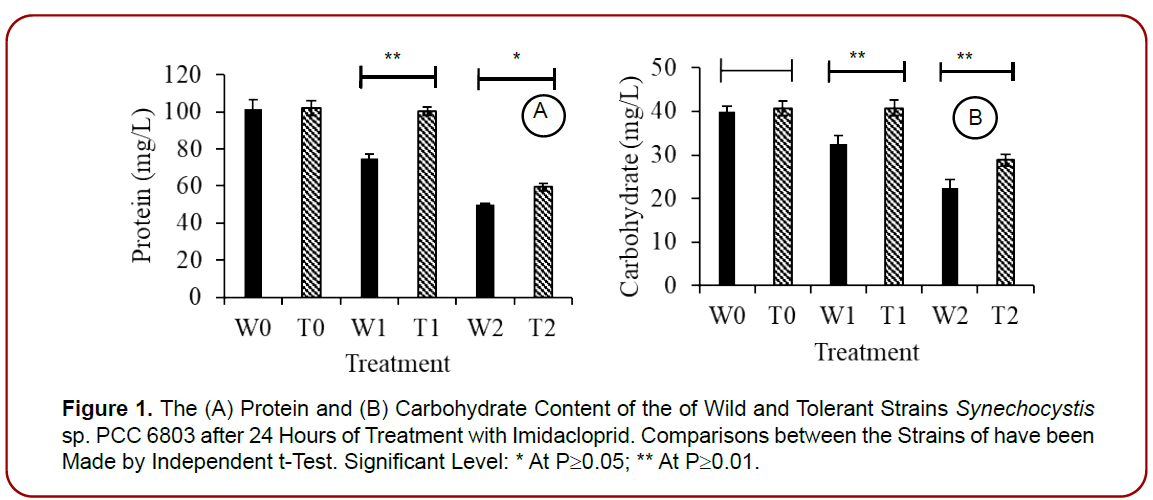
Figure 1. The (A) Protein and (B) Carbohydrate Content of the of Wild and Tolerant Strains Synechocystis sp. PCC 6803 after 24 Hours of Treatment with Imidacloprid. Comparisons between the Strains of have been Made by Independent t-Test. Significant Level: * At P≥0.05; ** At P≥0.01.
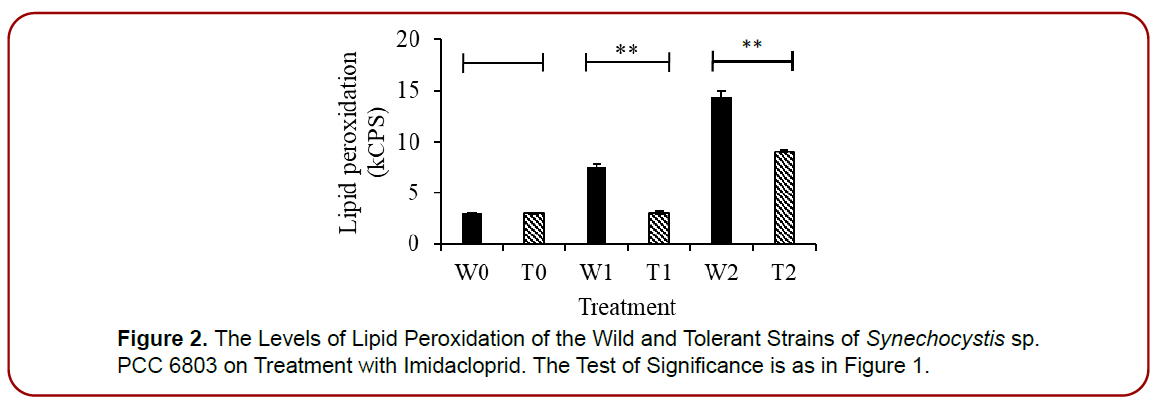
Figure 2. The Levels of Lipid Peroxidation of the Wild and Tolerant Strains of Synechocystis sp. PCC 6803 on Treatment with Imidacloprid. The Test of Significance is as in Figure 1.
Activities of esterases and phosphatases
Enhanced esterases and phosphatase activities of plants, algae, and microbes have been reported under OP insecticide stress [26,35,63,64]. IM treatment caused significant enhancement of esterases and phosphatases in both strains (Figure 3). In the untreated cultures, the esterase activity of T0 was significantly higher than of W0 (t=8.62; n=12). It may be noted that the T strain was maintained in the medium containing 1 mM of IM and the presence of the insecticide may be the reason of the high level of esterases in the culture. Similarly, the T strain also showed a significantly high activity of phosphatases (t=5.39; n=12). Insecticide treatment caused enhanced activities of both the enzymes in both W and T strains and there was a concentration-dependent increase of activities. In any of the selected concentrations, the activities of the enzymes was significantly high in the T strain than in the W strain (t=6.85 and 11.39 at 1 mM and 2 mM IM, respectively). (Figure 3)
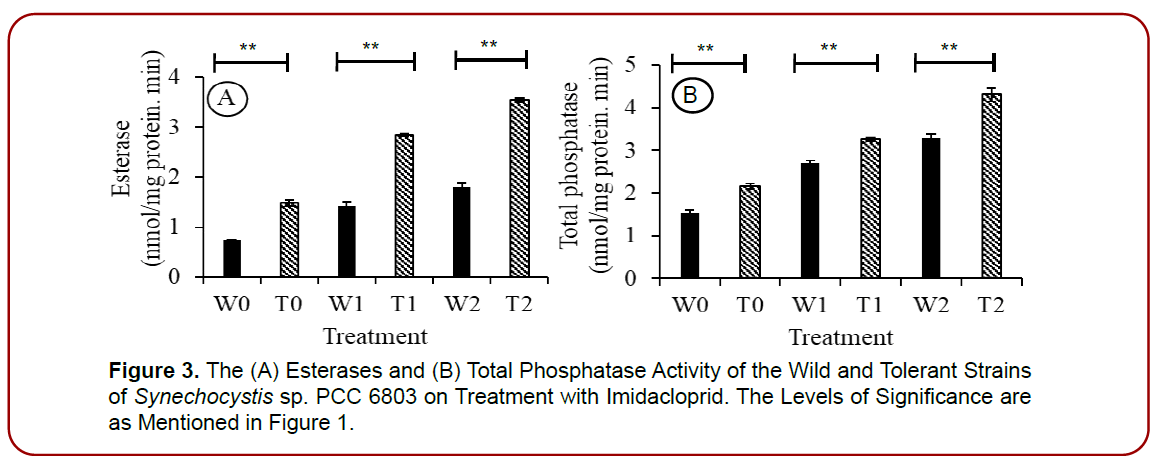
Figure 3. The (A) Esterases and (B) Total Phosphatase Activity of the Wild and Tolerant Strains of Synechocystis sp. PCC 6803 on Treatment with Imidacloprid. The Levels of Significance are as Mentioned in Figure 1.
Sahu and Gothalwal [64] observed that Nostoc sp. showed high phosphatase activity under dimethoate treatment and was able to use the insecticide as a source of phosphorus. High esterase activities were also attributed to the high tolerance of the test species and the enzymes enabled the cyanobacterium Anabaena to metabolize the insecticide. However, there is no report on the stimulation of esterases and phosphatases by neonicotinoid insecticides. This study showed that IM was also counteracted by enhanced activity of esterases and phosphatases and in the tolerant strain, efficient growth of the cyanobacterium in the presence of 1 mM IM may be attributed to such enhanced activities of the enzymes.
Degradation of imidacloprid
Removal of pesticides from contaminated medium has been achieved by the application of algae, fungi, and bacteria [65,66]. However, the efficiency of degradation vary with the pesticide concentration, chemical structures and the capability of the organism to metabolically or cometabolically degrade the chemical. Mohapatra et al. [67] have observed that IM degradation is strongly influenced by the abiotic factors. Because of high stability and water solubility, IM has shown persistence in the environment [68- 70]. During 24 hours of incubation, IM showed negligible autodegradation in both concentrations (0.3 % and 0.48 % at 1 mM and 2 mM, respectively, Figure 4). However, both strains cause significantly high degradation of insecticides. In any of the concentrations, the degradation of IM was higher by the T strain as compared to the W strain. The efficiency of the T strain to cause degradation could be observed at 1 mM of insecticide. At this concentration, the removal (from the medium) of the chemical by the T strain was 45 % higher than that of the W strain. Further, it was observed that the BCF in the W strain was 2.71 times and 1.87 times higher than in the T strain at 1 mM and 2 mM of IM respectively, clearly demonstrating that the T strain not only showed a better ability to cause the removal of the insecticide but also did not significantly accumulate the chemicals in the cells, thus making degradation.
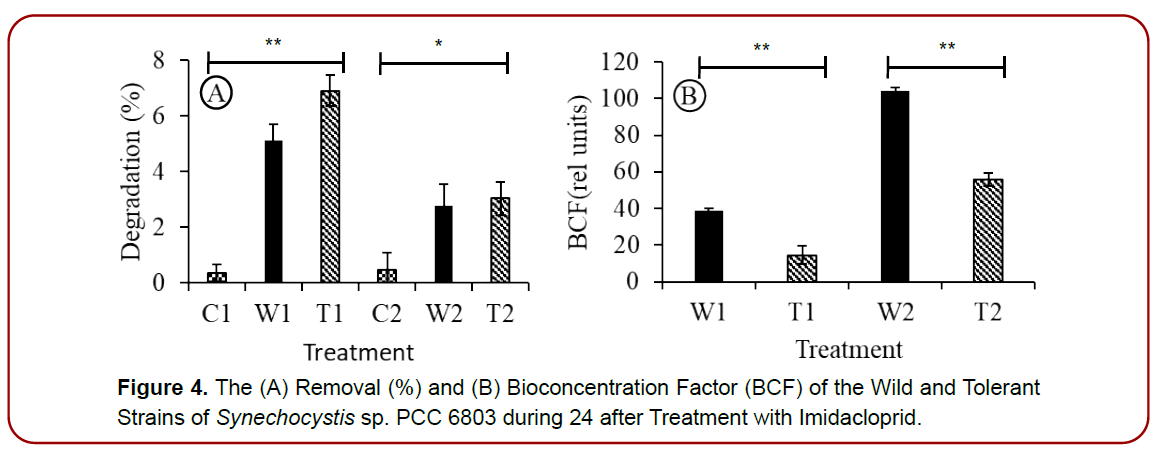
Figure 4. The (A) Removal (%) and (B) Bioconcentration Factor (BCF) of the Wild and Tolerant Strains of Synechocystis sp. PCC 6803 during 24 after Treatment with Imidacloprid.
The BCF is a standard measure of the rate of accumulation of toxicants by the organism, when exposed to contamination. Tolerance development is indicated by low BCF of a chemical vis-à-vis improved metabolic performance in the contaminated medium. Effective rates of degradation have been achieved with the tolerant species/ strains [9,43,71]. Liu et al. [71] reported a high rate of degradation of three OP insecticides by a strain of Aspergillus niger, isolated from an OP-contaminated soil. Mohapatra et al. [26] observed that a laboratory-induced malathion tolerant Aspegillus niger could efficiently degrade four related OP chemicals. Swain et al. [35] reported a high metabolic efficiency and insecticide-degrading ability of the tolerant strain of Anabaena sp. PCC 7119. About 50 % of IM removal was observed within 20 hrs of incubation with tolerant Nannochlorospsis sp. but in this case the applied concentration was lower (38 μM) than of the lowest effective concentration. The ability of the tolerant strain to grow and degrade IM at high concentration indicates that the strain has potential to rapidly decontaminate soil with low residual concentration of the insecticide.
The presence of insecticide residues in crop fields and their effects on soil microflora have become significant as their negative impacts have been found in diverse agroecosystems. The impact analysis and development of organisms/ procedures for rapid pesticide degradation have become imperative to limit non-target toxicity. In this study, we measured the toxicity of insecticide imidacloprid by monitoring growth and metabolic performance of the wild and the tolerant strains of Synechocystis sp. PCC 6803. Comparison showed that the T strain successfully tolerated 1 mM of IM and its growth and metabolic efficiencies were not significantly altered by the insecticide whereas, a significant adverse impact was seen in the wild strain. The insecticide treatment caused enhanced expression of esterases and phosphatases, which were seen as the basis of tolerance in the T strain. As expected, the levels of esterases and phosphatases activities were significantly high in the T strain, that were stimulated by the insecticide. It is important to understand the molecular mechanism involved in enzyme overexpression and catalysis, which will be helpful in designing new alternatives for efficient treatments of insecticide residues and bioremediation of the contaminated sites. High efficiency of the T strain to degrade IM at such a high concentration indicates that the T strains can be a promising candidate for an efficient removal of IM residues from the contaminated sites. The efficiency of the T strain needs to be validated in the soil system.
The authors thank the Head of the Department of Botany, Ravenshaw University, Cuttack, India for the laboratory facilities. The infrastructural assistance to the department by DST, Govt. of India, New Delhi under DST-FIST programme, research fellowship to SM (No. ST-BT-MISC-0026-2023) by Science and Technology Department, Govt. of Odisha, and to BBS (No. 09/1036(13215)/2022-EMR-I) by CSIR, Govt. of India, New Delhi are sincerely acknowledged.
This research did not receive any specific grant from the funding agency in the public, commercial or non-for-profit sector.
None to report